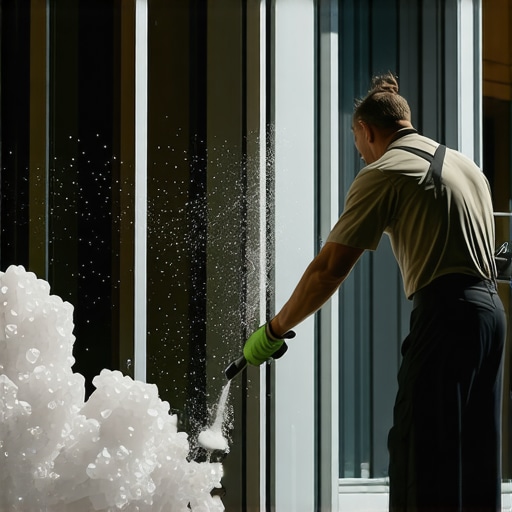
The Invisible Enemy on Your Glass Surface
As a master glazier who has spent nearly three decades dangling from swing stages and shimming 800-pound IGUs (Insulated Glass Units) into place, I have seen it all. Homeowners spend a fortune to replace windows, thinking a brand-new sash will solve their visibility issues forever. But by 2026, the industry has shifted. We aren’t just installers anymore; we are molecular glass managers. The secret that high-end pros are now adding to their buckets isn’t some proprietary chemical from a high-pressure salesman; it is simple, finely-milled calcium carbonate, often referred to as ‘whiting powder.’ This $2 mineral is the difference between a window that looks ‘clear’ and a window that achieves true optical clarity.
The Condensation Crisis: A Narrative of Misdiagnosis
I recall a specific case in a high-humidity coastal residence where a homeowner called me in a panic because their six-month-old triple-pane units were ‘sweating’ and ‘fogging’ on the exterior. I walked in with my hygrometer and a thermal imaging camera, and the readings were telling. I showed them that the humidity was hovering at 62%, and the interior dew point was perfectly synchronized with the glass surface temperature. It wasn’t the windows failing; it was the lack of air exchange and the presence of microscopic mineral etching on the glass surface that allowed moisture to cling. I took a handful of calcium carbonate, made a slurry, and polished a small section of the glass. The water immediately stopped ‘sheeting’ and started ‘beading.’ It wasn’t a window repair job; it was a physics lesson. Most people assume glass is a solid, smooth plane. In reality, under a microscope, it looks like the surface of the moon. This $2 mineral fills those microscopic voids, preventing environmental pollutants from anchoring themselves to your view.
The Glass Class: Decoding the NFRC Label
To understand why this mineral addition is critical in 2026, you have to understand the modern glass sandwich. When we talk about a high-performance window, we are looking at a complex assembly. The U-Factor is king in the North, measuring the rate of heat loss. The lower the number, the better the insulation. Then you have the SHGC (Solar Heat Gain Coefficient), which is vital for my friends in the South. If you are in a cold climate like Chicago, you want a higher SHGC on your south-facing windows to allow ‘free’ heat from the sun to warm your slab. In 2026, we are seeing more Low-E coatings on Surface #3—the interior-facing surface of the inner pane—to reflect long-wave infrared radiation back into the room during winter.
“Installation is just as critical as the window performance itself. A high-performance window installed poorly will fail.” – AAMA Installation Masters Guide
However, these advanced coatings and the gas fills—typically Argon or sometimes a blend—are useless if the glass surface itself is degraded. When you use a harsh, ammonia-based window cleaner, you are often stripping away the very silanes used to treat the glass. By adding a mild mineral abrasive like calcium carbonate, you are performing a mechanical cleaning that removes ‘hydrophobic’ contaminants without scratching the silica matrix of the glass. This is essential for maintaining the Visible Transmittance (VT) rating of your unit. A window that is etched by hard water or salt spray might lose 5-10% of its VT, effectively making your home darker and your lighting bills higher.
Window Repair vs. Total Replacement: The Installer’s Reality
I see too many ‘caulk-and-walk’ contractors telling people they need to replace windows when a simple window repair and a deep glass restoration would suffice. If your frame is solid—whether it’s a thermally broken aluminum or a high-density fiberglass—you might only need to replace the IGU. But if the ‘Rough Opening’ is showing signs of rot, no amount of cleaning will save you. When we pull a window, we aren’t just looking at the glass; we are looking at the ‘Sill Pan’ and the ‘Flashing Tape.’ If the previous installer didn’t follow the shingle principle (lapping the top layers over the bottom), water will eventually find the ‘Muntin’ or the ‘Sash’ and begin the slow process of decay.
“Proper flashing and water shedding at the sill are the primary defenses against structural rot in fenestration assemblies.” – ASTM E2112 Standard Practice
The Physics of the $2 Mix
Why does the $2 mineral work? It’s about pH balance and mechanical lifting. Most organic soils on a window are acidic. Calcium carbonate is slightly alkaline. When you mix it into your window cleaner, you are neutralizing acids while the mineral particles act as tiny ball bearings, lifting bird droppings, tree sap, and industrial fallout without the need for a steel wool pad that could damage the ‘Glazing Bead’ or the ‘Sash’ finish. In the 2026 market, where fiberglass frames have become the standard due to their expansion-contraction stability (matching the glass itself), keeping the glass-to-frame interface clean is paramount. If dirt builds up in the ‘Weep Hole,’ the system can’t drain. When the ‘Sill’ fills with water, the hydrostatic pressure eventually pushes moisture past the secondary seal of the IGU, leading to that dreaded ‘blown’ window look.
Climate Logic: Where You Live Matters
If you are in a cold climate, your primary enemy is heat loss. You want those ‘Warm-Edge Spacers’—the little bars that hold the panes apart. In the old days, these were aluminum, which acted like a thermal bridge, bringing the cold right to the edge of the glass and causing condensation. Today, we use stainless steel or structural foam. If you keep the glass clean with our mineral mix, you reduce the surface area available for frost to kick-start. In the South, where the SHGC is the priority, a clean window reflects more IR radiation. A dirty window actually absorbs heat, which then radiates into your living room, forcing your A/C to work harder. This isn’t just about aesthetics; it’s about the BTU load on your HVAC system.
Final Verdict from the Glazing Bench
Don’t fall for the marketing hype of ‘self-cleaning’ glass that relies solely on UV activation. Those coatings often fail in shaded areas or high-pollution zones. Instead, stick to the fundamentals. Check your ‘Rough Opening’ for plumb and level, ensure your ‘Shim’ placement isn’t bowing the frame, and use a mineral-based cleaning strategy to preserve the integrity of your glass. Window repair is a science of details. Whether you are dealing with a historic wood sash or a modern curtain wall, the goal is the same: managing the transition between the interior and the exterior without letting the elements win. Stop buying the $40 ‘magic’ sprays and go buy a bag of whiting powder. Your windows—and your wallet—will thank you in 2026.
I found the article about calcium carbonate in window cleaning to be quite insightful. As a homeowner in a high-pollution urban area, I’ve noticed how quickly my windows get grimy and etched, especially in the winter with salt spray and hard water deposits. I’ve always assumed that harsh cleaners or replacing the windows were the only options, but the idea of mechanically restoring them with a simple mineral mixture is much more appealing and cost-effective. I do wonder, though, how practical it is to evenly apply and rinse out the slurry in larger or hard-to-reach windows? Has anyone here tried this method at home or with professional tools, and what was your experience? Also, are there particular types of glass or coatings that might be sensitive to this alkaline mineral, or is it generally safe across all modern window types? I’d love to hear any tips or cautionary advice from those who’ve tested this approach—it seems like a promising way to extend the life of existing windows without costly replacements.