The Glazier’s Truth: Why Your Windows Look Ruined and How to Save Them
I have spent over two decades in the glazing industry, from hanging off the sides of skyscrapers to shimming 100-year-old historic sashes. I have seen every shortcut taken by ‘caulk-and-walk’ installers who think a bit of silicone can mask a poor rough opening fitment. One of the most common complaints I hear from homeowners isn’t about mechanical failure: it is about the glass itself looking ‘foggy’ or ‘stained.’ They think they need to replace windows entirely when, in reality, they are fighting a losing battle against mineral etching. A homeowner called me in a panic because their new windows were ‘sweating.’ I walked in with my hygrometer and showed them the humidity was 60 percent. It wasn’t the windows; it was their lifestyle: specifically, how they were managing the dew point on the glass surface. This condensation, when mixed with household dust and minerals, creates a hard water crust that most store-bought sprays can’t touch. This is where a simple $6 professional glazier hack comes into play, but before you apply it, you must understand the science of the surface you are treating.
“Installation is just as critical as the window performance itself. A high-performance window installed poorly will fail.” – AAMA Installation Masters Guide
The Molecular War on Your Glass Surface
To the naked eye, a piece of float glass looks perfectly smooth. To a master glazier, it is a landscape of microscopic peaks and valleys. Glass is actually a porous material in the context of chemical bonding. When hard water: water rich in calcium and magnesium: sits on the glass, it doesn’t just dry; it calcifies into the pores. If you live in a northern climate like Minneapolis or Chicago, this issue is exacerbated by the U-Factor of your glazing unit. In the winter, the interior surface of your glass stays colder. When your indoor humidity hits that cold surface, it reaches the dew point and turns into liquid water. This liquid water then leaches minerals from the glass itself and surrounding materials, creating a white, hazy film that looks like a permanent fog. This is a common precursor to window repair needs because homeowners often scratch the glass trying to scrub it off with abrasive pads. You are not just cleaning; you are performing chemical restoration.
The $6 2026 Window Cleaner Hack: Citric Acid and Distilled Tension
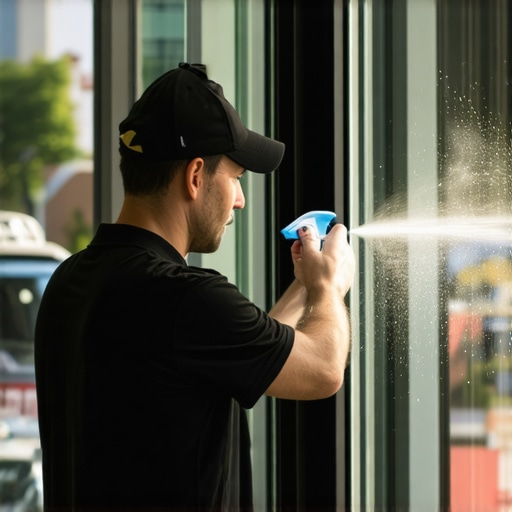
The secret that most high-pressure window cleaner companies won’t tell you is that pH balance is everything. Most commercial cleaners are alkaline or ammonia-based, which can actually worsen mineral deposits over time. The professional hack involves creating a low-pH sacrificial solution. For under $6, you can mix 50 percent distilled water (to ensure no new minerals are introduced) and 50 percent high-grade white vinegar or a concentrated citric acid powder. The acetic acid in the vinegar breaks the ionic bond between the calcium carbonate and the glass silicate. To apply this like a pro, you need to understand the Glazing Bead. Do not just spray the center of the pane. Start at the top and let the solution dwell in the corners where the sash meets the frame. This is where most mineral buildup hides. Use a professional-grade squeegee with a fresh rubber blade to pull the solution across the glass in a single motion. This prevents the ‘ghosting’ effect often seen with paper towels. If the spots are particularly stubborn, you are likely dealing with Stage 2 corrosion, where the minerals have actually etched the glass surface. In this case, the $6 hack requires a mild cerium oxide polish, which is still well within the budget if purchased in bulk.
Understanding the Climate Physics: Why the North Demands Better Glass
In cold climates, the enemy is heat loss and the subsequent condensation it creates. When we talk about window repair, we are often talking about managing the thermal bridge. A window is a hole in your thermal envelope. In the North, we prioritize a low U-Factor. This is the rate at which a window, door, or skylight conducts non-solar heat flow. The lower the U-Factor, the more energy-efficient the window is at keeping heat inside. However, a low U-Factor isn’t enough if you have a ‘cold’ edge. This is why we use warm-edge spacers between the panes of glass. If you see ‘spots’ appearing specifically around the perimeter of your glass, your spacer has likely failed, or you have a thermal bridge through an uninsulated rough opening. If the shim placement was incorrect during installation, the frame can bow, putting pressure on the glazing bead and allowing moisture to bypass the primary seal. This isn’t just a cleaning issue; it is a structural failure of the Insulated Glass Unit (IGU).
“Standard Practice for Installation of Exterior Windows, Doors and Skylights requires a continuous air and water barrier transition between the window frame and the wall.” – ASTM E2112
When to Stop Cleaning and Start Window Repair
There is a point where no amount of $6 hacks will save your view. As a glazier, I look for the ‘breath of death’: a rainbow-like sheen inside the double-pane unit. This indicates that the argon gas has leaked out and been replaced by moist ambient air. Once the desiccant in the spacer is saturated, the moisture will begin to corrode the Low-E coating on Surface #3. Low-E, or low-emissivity, is a microscopically thin metallic layer that reflects long-wave infrared radiation. In northern climates, we want this coating on the third surface (the inner pane, facing the gap) to bounce heat back into the house. If this coating oxidizes due to a seal failure, the glass will look permanently dirty. You cannot clean the inside of a sealed unit. This is when you must replace windows or at least replace the IGU. If your operable windows are difficult to slide, the issue might be the sill pan or a clogged weep hole. Weep holes are designed to allow water that enters the glazing channel to exit to the exterior. If these are painted shut by an amateur, water backs up into the rough opening, rotting the flashing tape and eventually the wood framing. Always check your weep holes before assuming you have a glass leak.
The Professional Maintenance Protocol
To keep your glass in 2026 condition, you must treat it as a technical component of your home, not just a transparent wall. First, maintain your flashing tape and exterior seals. If water cannot get away from the window, it will eventually find its way in. Second, use the $6 acid-based cleaning hack twice a year to prevent Stage 1 mineral etching from becoming permanent Stage 2 damage. Third, monitor your indoor humidity. If you see condensation on your muntins or the bottom of the sash, your indoor air is too wet for the exterior temperature. By managing the dew point, you prevent the very moisture that creates hard water spots. A master glazier knows that a clean window is the result of both chemistry and physics working in harmony. Don’t let a high-pressure salesman convince you that a little bit of mineral buildup requires a $20,000 replacement contract. Start with the chemistry, understand your U-Factor, and always, always keep your weep holes clear.