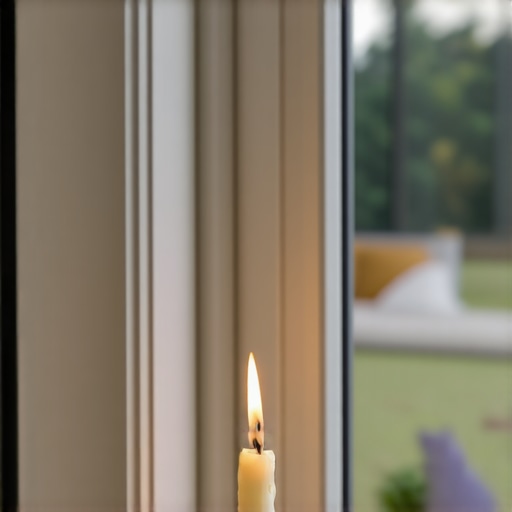
The Anatomy of a Draft: Why Your Candle Flame is Flickering
You stand there on a cold Tuesday night with a single lit candle held near the corner of your double-hung window. The flame dances wildly, or worse, it snuffs out entirely. This is the moment of truth for your home’s thermal envelope. Many homeowners assume a flickering flame means they need a professional window cleaner to scrub away the grime, but as a master glazier with over two decades in the trenches, I can tell you that the issue is far more structural than aesthetic. That flickering flame is a visual representation of air infiltration, a technical term for your expensive furnace-heated air escaping through the gaps in your sash and frame. It is the physics of pressure differentials at work. When the wind hits the exterior of your home, it creates positive pressure on the windward side and negative pressure on the leeward side. If your windows are not sealed properly, the house acts like a vacuum, pulling air through every available orifice. This is not just a comfort issue; it is a financial drain.
The Condensation Crisis: A Narrative Shift
A homeowner in a northern climate once called me in a total panic because their brand-new, high-efficiency windows were ‘sweating’ so much that water was pooling on the sill. They were convinced the windows were defective and demanded I replace windows at no cost. I walked into the living room, pulled my digital hygrometer from my tool belt, and showed them a reading of 65 percent relative humidity. It was January. The windows weren’t failing; the home’s interior environment was out of balance. Because the new windows were so tight compared to the old drafty ones, the moisture from their cooking, showering, and even breathing had nowhere to go. It hit the cold glass and reached its dew point instantly. I had to explain that while they thought they had a window problem, they actually had a ventilation problem. This highlights a critical reality in the glazing world: the window is part of a complex system, not an isolated piece of glass. If you do not understand how air moves, you will never understand why your windows behave the way they do.
“Installation is just as critical as the window performance itself. A high-performance window installed poorly will fail.” AAMA Installation Masters Guide
Blueprint of a Failure: The Installation Autopsy
When we perform the candle test and find significant leaks, we have to look deeper than just the glass. We must perform what I call an installation autopsy. Often, the leak is not coming through the glass itself, but around the perimeter of the frame. This brings us to the science of the Rough Opening. A common mistake in a rushed window repair or a cheap installation is the failure to properly shim the window. Shims are small, wedge-shaped pieces of wood or plastic used to level and square the window within the rough opening. If an installer fails to use enough shims or places them incorrectly, the frame can bow. This bowing prevents the sash from seating properly against the weatherstripping, creating a direct path for air to bypass the window’s defenses. Furthermore, we must look at the Flashing System. In a proper installation, we follow the ‘Shingle Principle,’ ensuring that every layer of moisture barrier and flashing tape overlaps the layer below it. This ensures that water is naturally shed away from the building. When an installer relies solely on a bead of caulk rather than a proper sill pan, the window is destined for failure within five to seven years. A sill pan is a three-sided flashing component that sits at the bottom of the rough opening, designed to collect any water that gets past the primary seals and direct it out through weep holes.
The Technical Reality of Air Infiltration
To understand why the candle test matters, we must look at how the National Fenestration Rating Council (NFRC) measures window performance. While most people focus on the U-Factor, which measures heat loss through the glass, the Air Infiltration rating is arguably more important for comfort. This rating measures how many cubic feet of air pass through a square foot of window area at a specific wind speed. A rating of 0.30 cfm/sqft is the industry standard for ‘good,’ but high-performance windows can achieve 0.01 cfm/sqft. If your candle is flickering, you are likely dealing with a window that has degraded far beyond the 0.30 threshold. This degradation often happens in the weatherstripping. Most modern windows use a pile weatherstripping or a bulb seal. Over time, UV radiation and temperature fluctuations cause these materials to lose their elasticity. Once the seal is gone, your expensive triple-pane glass is effectively neutralized because the air is just flowing around it. This is why a simple window repair like replacing the weatherstripping or the glazing bead can sometimes save a homeowner thousands compared to a full replacement.
“Standard Practice for Installation of Exterior Windows requires that the fenestration assembly be integrated with the water-resistive barrier to prevent air and water penetration.” ASTM E2112
The Climate Logic of Thermal Management
In northern climates where the candle test is most common, we are fighting a constant battle against heat loss. This is why we focus on the U-Factor and the placement of Low-E coatings. Low-E, or low-emissivity, is a microscopically thin layer of silver or other metallic oxides applied to the glass. In a cold climate, we want this coating on Surface Number Three (the inward-facing side of the inner pane). This allows the coating to reflect long-wave infrared radiation back into the room, keeping the heat where you want it. If the candle test reveals leaks, it means the convective loop between the panes is being disrupted. Modern insulated glass units (IGUs) are filled with Argon or Krypton gas. These gases are denser than air and slow down the transfer of heat. However, if the seal of the IGU is breached, the gas escapes and is replaced by moist air, leading to the dreaded fogged window. If you see fog, the thermal performance of your window has dropped by as much as 30 percent, and no amount of cleaning will fix it. You are looking at a glass replacement or a full window unit replacement.
Why the Installer Matters More Than the Brand
I have seen homeowners spend forty thousand dollars on premium fiberglass windows only to have them leak air like a sieve because the installer didn’t use a proper drip cap or failed to insulate the weight pockets in an old wood-frame house. When you replace windows, you are paying for the labor and the technical expertise as much as the product. A master glazier knows that every house settles, and no rough opening is ever perfectly square. We use high-grade polyurethane sealants rather than cheap latex caulk because polyurethane can handle the expansion and contraction cycles of the seasons. We ensure that the muntins are properly aligned and that the sash lock draws the meeting rail tight. If the meeting rail is not tight, the candle test will fail every single time. It is about the precision of the fit. If you are conducting the candle test and seeing movement, do not just reach for the caulk gun. Analyze the source. Is it coming from the glazing bead? Is it coming from the junction where the frame meets the siding? Understanding the ‘why’ behind the leak is the only way to ensure a permanent fix. Windows are the eyes of the home, but they are also the most vulnerable points in the wall. Treat them with the technical respect they deserve, and they will keep you warm for decades.