Understanding Fenestration Maintenance from a Master’s Perspective
In my twenty-five years of handling fenestration products, I have seen every form of glass degradation imaginable. Most homeowners treat their windows as static objects, but a window is a dynamic thermal barrier. When you ask about the best way to clean fly specks off your glass, you are not just asking about aesthetics: you are asking about the preservation of the silica lattice and the integrity of the Glazing Bead. Fly specks, or frass, are more than just unsightly dots: they are acidic biological deposits that, when baked by the sun, can create permanent etching on high-performance glass surfaces. If you ignore them, you are not just looking at a dirty window: you are looking at potential window repair or even the need to replace windows prematurely due to surface compromise.
“Installation is just as critical as the window performance itself. A high-performance window installed poorly will fail, and a window maintained poorly will degrade twice as fast.” – AAMA Installation Masters Guide
The Condensation Crisis: A Narrative of Moisture and Maintenance
A homeowner called me in a panic because their new windows were sweating. I walked in with my hygrometer and showed them the humidity was 60 percent. It was not the windows: it was their lifestyle. They were running a humidifier in a sealed room with thirty houseplants. That excess moisture was not just fogging the glass: it was creating a breeding ground for houseflies. These flies gravitate toward the warmth of the glass and the moisture on the Sash, leaving behind acidic residue. This is why cleaning is not just about soap: it is about managing the micro-climate around the Rough Opening. If your humidity is too high, you are essentially inviting biological agents to etch your investment. Understanding the U-Factor of your glass is vital here: a lower U-Factor means the interior pane stays warmer, which reduces the condensation that attracts these pests in the first place.
The Technical Reality of Fly Specks: Why They Stick
Fly frass is composed of proteins and metabolic waste. On a microscopic level, glass is not perfectly smooth: it is an amorphous solid with a porous surface. When the sun hits a window, the glass expands. This thermal expansion allows the acidic compounds in the fly specks to penetrate deeper into the surface. If you are in a cold climate like Minneapolis, your glass undergoes massive thermal stress. The Low-E coating on Surface #3 is designed to reflect heat back into the room, but if the exterior Surface #1 is covered in acidic residue, the solar heat gain can cause localized hot spots. This is why a professional window cleaner focuses on the chemistry of the bond. You are not just wiping: you are neutralizing an acid.
The Glass Class: Decoding Performance and Protection
When we look at the NFRC label, we often focus on the SHGC (Solar Heat Gain Coefficient) or the Visible Transmittance (VT). However, the longevity of these ratings depends on the cleanliness of the glass. A window covered in fly specks and environmental pollutants has its VT compromised. If you have a triple-pane unit with Argon gas fill, the internal pressure is balanced. But if you use harsh abrasives to scrub off fly specks, you risk damaging the Glazing Bead or the secondary seal. This can lead to gas dissipation, turning your high-tech insulator into a foggy piece of junk.
“The performance of a fenestration system is dependent upon the maintenance of its components. Neglect of the transparent surfaces can lead to irreversible solar etching.” – NFRC Performance Standards Manual
The Master Glazier’s Cleaning Protocol
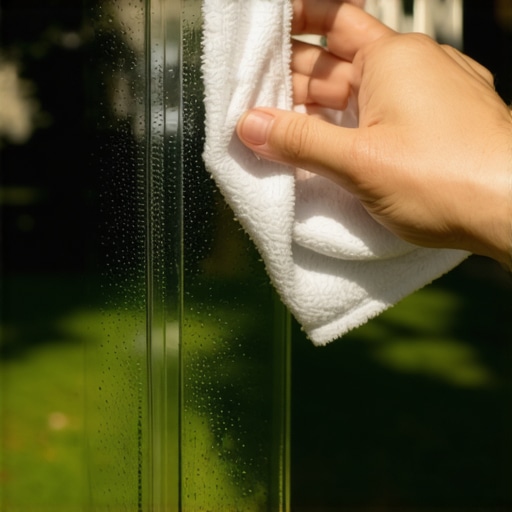
To clean fly specks without damaging the glass, follow this technical protocol. First, avoid any ammonia-based cleaners if you have high-performance coatings. Ammonia can react with certain Sash materials and degrade the Flashing Tape if it drips into the Rough Opening. Instead, use a solution of distilled water and a pH-neutral surfactant. The goal is to rehydrate the protein in the fly speck. I recommend a window cleaner solution that uses a mild citric acid to neutralize the alkaline nature of the waste. Applying a saturated cloth to the area for sixty seconds is more effective than scrubbing. Once the bond is broken, use a lint-free microfiber cloth to lift the residue. Do not use a razor blade on tempered glass or glass with a hard-coat Low-E surface, as this will create ‘fines’ that scratch the surface irreparably.
Structural Integrity: Beyond the Glass
While you are cleaning, you must inspect the Operable parts of the window. Check the Weep Hole in the Sill Pan. If these are clogged with debris or dead insects, water will back up into the wall cavity. This is a common cause of rot that leads people to replace windows. A window is a system: the Shim, the Muntin, and the Sash must all work in harmony. If you notice the fly specks are concentrated in one corner, it might indicate an air leak. Flies are attracted to the thermal plumes escaping from a poorly sealed Rough Opening. In this case, no amount of cleaning will solve the problem: you need window repair to address the seal failure or the Flashing Tape application.
When Cleaning Reveals the Need to Replace Windows
Sometimes, what looks like a fly speck is actually ‘spalling’ or internal desiccant dust. If you clean the exterior and the interior and the speck remains, the Insulated Glass Unit (IGU) has failed. The seal is gone, and the Argon has escaped. At this point, the thermal efficiency of the window has plummeted. You might see a rise in your energy bills or feel a draft. In my experience, once the seal is breached, the only real solution is to replace windows or at least the IGU. Trying to ‘repair’ a fogged window is like trying to un-pop a balloon. You must look for the NFRC rating of your new unit, ensuring the SHGC matches your climate needs. If you are in the North, look for a high SHGC to allow passive solar heating. If you are in the South, you want a very low SHGC to keep the heat out.
Final Professional Advice
The best way to clean fly specks is to prevent them through proper environmental management and regular, gentle maintenance. Do not wait for the sun to bake the residue into the glass. Treat your windows with the same respect you would a fine optical lens. Remember, the installer matters more than the sticker on the glass. If your window was not leveled with the proper Shim or if the Sill Pan was omitted, the resulting structural shifts can create gaps that invite pests and moisture. Keep your Weep Hole clear, your Sash clean, and your Glazing Bead intact. By following these glazier-approved methods, you ensure that your view remains clear and your home remains efficient for decades to come. “