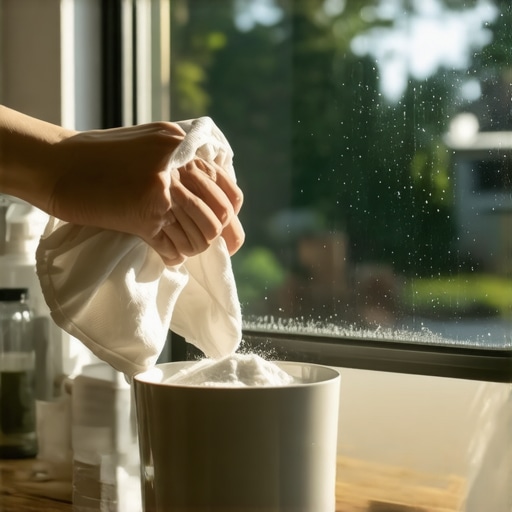
After twenty-five years in the glazing trade, I have seen it all. I have stood on forty-story scaffolding to inspect curtain wall seals and spent weeks in dusty crawlspaces ensuring a sill pan was properly sloped to manage moisture. Most homeowners see a window as a simple piece of glass. To me, it is a complex thermal barrier, a managed breach in the building envelope that must handle wind loads, solar radiation, and the inevitable vapor pressure of a humid interior. When a client asks me about the best window cleaner, they are usually looking for a way to restore the original clarity of their glass. But often, what looks like a dirty window is actually a cry for help from a failing IGU or an Insulated Glass Unit. Before we talk about the cornstarch secret, we need to talk about why you can see those streaks in the first place.
The Condensation Crisis: A Master Glazier’s Perspective
A homeowner called me in a panic because their new windows were sweating. I walked in with my hygrometer and showed them the humidity was 60 percent. It wasn’t the windows; it was their lifestyle. They had dozens of tropical plants and a humidifier running on high in a tightly sealed house. This moisture was condensing on the coldest surface in the room: the glass. They thought they needed a better cleaner to get rid of the foggy residue, but the reality was that they were witnessing the dew point in real-time. When the interior air temperature drops below the saturation point at the glass surface, water precipitates. If that moisture gets trapped between the panes, you no longer have a cleaning problem; you have a seal failure. This is when the conversation shifts from maintenance to the need to replace windows or at least the glazing units themselves.
The Chemistry of the Cornstarch Secret
Most commercial cleaners rely on detergents and alcohols that leave behind a microscopic film. This film attracts dust and creates the very streaks you are trying to avoid. The cornstarch secret is not folklore; it is a matter of surface tension and mechanical abrasion. Cornstarch is a fine, non-polar substance that acts as a micro-abrasive. When mixed with water and vinegar, it creates a solution that physically lifts oils and minerals from the silica surface of the glass without scratching. In the shop, we might use cerium oxide for polishing out minor scratches, but for daily maintenance, a tablespoon of cornstarch in a gallon of warm water is the professional standard for achieving a truly naked glass surface. You are essentially stripping the glass down to its original state, allowing the squeegee to glide across the surface with zero drag. This is critical for window repair assessments, as it allows us to see the difference between surface debris and actual pitting or chemical etching on the glass.
“Installation is just as critical as the window performance itself. A high-performance window installed poorly will fail.” – AAMA Installation Masters Guide
The Glass Class: Decoding Thermal Performance
When you are cleaning your windows, you are interacting with what we call Surface #1 (the exterior) and Surface #4 (the interior) of a standard double-pane unit. But the real magic happens on Surface #2 and Surface #3. In colder climates, we prioritize the U-Factor, which measures the rate of heat transfer. A lower U-Factor means the window is a better insulator. To achieve this, we use Low-E (Low Emissivity) coatings. These are microscopic layers of silver or other low-emissivity materials applied to the glass. In a northern climate, we often place this coating on Surface #3. This allows the sun’s short-wave infrared radiation to enter the home but reflects the long-wave infrared heat back into the room. This prevents the heater from working overtime and keeps the interior glass surface warm, which in turn prevents the condensation I mentioned earlier.
The Anatomy of the Window System
If you are looking at your windows and realizing that no amount of cornstarch will fix the draft, you have to look at the frame and the installation. Every operable sash sits within a frame that is fitted into a rough opening. The gap between that frame and the house framing must be managed. We use shim blocks to level the unit, but if the installer just stuffed fiberglass insulation in that gap and called it a day, they failed. That gap needs backer rod and high-grade sealant or low-expansion foam to create an air seal. Furthermore, the sill pan is your last line of defense. If water gets past the primary seals or the glazing bead, the sill pan must be sloped to direct that water out through the weep hole system. Without proper flashing tape integrated into the house wrap in a shingle-lap fashion, that water will eventually find its way into your wall studs, leading to rot that costs far more than the windows themselves.
Understanding the NFRC Label
Before you replace windows, you must understand the National Fenestration Rating Council (NFRC) label. It provides the only apples-to-apples comparison of window performance. Beyond the U-Factor, you must look at the Solar Heat Gain Coefficient (SHGC). In a cold climate, a higher SHGC can be beneficial as it provides passive solar heating. However, if you have large south-facing windows, a high SHGC might turn your living room into a greenhouse in July. We also look at Visible Transmittance (VT), which tells you how much natural light is actually getting through those coatings. A window that is too dark will force you to turn on lights, negating the energy savings. High-performance spacers, like warm-edge technology made of structural foam instead of aluminum, also play a huge role in keeping the edge of the glass warm and preventing perimeter condensation.
“Performance ratings such as U-factor and Solar Heat Gain Coefficient are essential for determining the energy efficiency of a window system.” – NFRC Certification Standards
The Decision: Repair or Replace?
Sometimes a window repair is as simple as replacing a broken muntin or a cracked glazing bead. If the frame is structurally sound, specifically if it is made of pultruded fiberglass or high-quality vinyl with multi-chambered profiles, you can often just replace the IGU. However, if the frame has bowed or if the wood has succumbed to dry rot because of poor flashing, a full-frame replacement is the only responsible path. Do not let a salesman talk you into a pocket replacement if your sills are soft. A pocket replacement, where the new window is dropped into the old frame, often leaves the original rot hidden behind new trim. It is the definition of a caulk-and-walk job. Demand a full tear-out if there is any sign of moisture infiltration in the rough opening.