The Reality of Optical Maintenance in High-Performance Glazing
I have spent over twenty-five years as a glazier, and if there is one thing I have learned, it is that most people treat their windows like an afterthought until they can no longer see through them. A window is not merely a piece of glass; it is a complex thermal envelope component designed to manage the transfer of energy. When you are looking for the best methods for drying windows without lint, you are not just cleaning; you are performing essential maintenance on a critical architectural element. In my career, I have seen beautiful fiberglass and wood units ruined by ‘caulk-and-walk’ installers who ignore the fundamental physics of the Rough Opening, but I have also seen homeowners destroy their investment by using abrasive cleaners that strip the Low-E coating or degrade the Glazing Bead. To achieve a professional finish, you must understand the materials you are working with and the environmental factors at play.
The Condensation Crisis: A Diagnostic Lesson
A homeowner once called me in a panic because their new, high-efficiency windows were ‘sweating’ so profusely they could barely see the street. They were convinced they needed a window repair or a full replacement. I walked into the house, not with a bucket of soap, but with a calibrated hygrometer. I showed them that the interior humidity was hovering at 60 percent while the outside temperature was a biting ten degrees. It was not a failure of the glass or the Argon gas fill; it was a simple matter of physics. The interior glass surface had reached the dew point. No amount of lint-free drying would solve the underlying issue of poor ventilation. This illustrates a vital point: before you worry about streaks or lint, you must ensure the integrity of the unit. If you see moisture between the panes, you are looking at a failed seal, and no window cleaner in the world will fix that. At that point, you are no longer in the realm of maintenance; you are in the realm of having to replace windows.
“Installation is just as critical as the window performance itself. A high-performance window installed poorly will fail to meet its energy ratings and life expectancy.” – AAMA Installation Masters Guide
The Physics of Lint: Why Paper Fails
Most people reach for a roll of paper towels when they see a smudge. As a professional, this makes me cringe. Paper is a wood-based product comprised of short cellulose fibers. When you rub these fibers against an amorphous solid like glass, you are creating a significant amount of static electricity. This static charge acts as a magnet, pulling those tiny cellulose fragments back onto the surface, resulting in the very lint you are trying to avoid. Furthermore, paper towels are often treated with adhesives and binders that can leave a microscopic film on the glass. This film attracts atmospheric pollutants, meaning your windows will get dirty faster the more you ‘clean’ them this way. To truly achieve a lint-free finish, you must move away from disposable paper products and embrace the tools used in the trade.
The Tool Kit: Squeegees, Huck Towels, and Surfactants
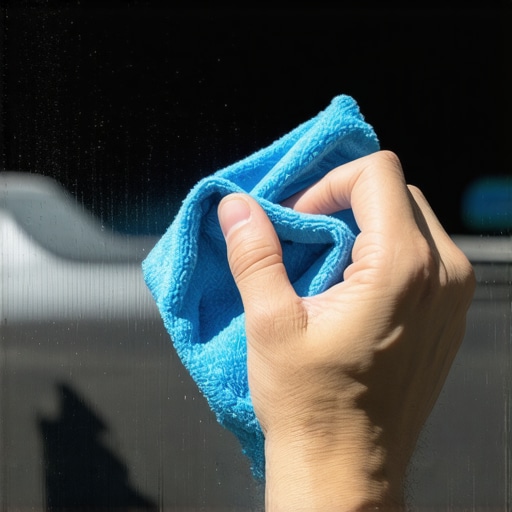
If you want a professional result, you need a professional kit. This starts with a high-quality squeegee with a replaceable rubber blade. In a cold climate like Chicago or Minneapolis, the durometer (the hardness) of that rubber matters. A softer rubber will conform better to the glass in freezing temperatures, ensuring a clean pull without skipping. You also need ‘Huck’ towels, often called surgical towels. These are 100 percent cotton, lint-free, and have been washed enough times to remove any loose fibers. Unlike microfiber, which can sometimes hold onto oils and redistribute them, a clean Huck towel is the gold standard for detailing the edges of the Sash and the Glazing Bead. For the cleaning solution, avoid anything with ammonia. Ammonia can be aggressive toward the sealants used in modern Insulated Glass Units (IGUs). A simple mixture of deionized water and a few drops of a high-surfactant dish soap is often superior. The surfactant lowers the surface tension of the water, allowing it to lift particulates away from the glass surface so they can be easily removed by the squeegee.
“The purpose of a standardized installation and maintenance practice is to provide a procedure that prevents water infiltration and premature product failure.” – ASTM E2112
The Professional Technique: The Scrub and the Pull
Start by saturating the glass with your applicator. This is the time to inspect the frame. Look at the Weep Hole at the bottom of the frame. Is it clear of debris? If the weep hole is blocked, water will back up into the sill, eventually rotting the sub-sill or damaging the Flashing Tape that protects your home’s structure. Once the glass is wet, use your squeegee in a continuous motion. The ‘fanning’ technique is the most efficient, where you never lift the blade from the glass, but for the average person, a series of overlapping vertical or horizontal pulls is safer. Between every pull, you must wipe the squeegee blade with your lint-free towel. This prevents the transfer of dirty water back onto the clean glass. Finally, use the towel to detail the very edge of the glass where it meets the frame. This prevents ‘runs’ that occur when water trapped in the Glazing Bead slowly drips down the clean pane.
Maintenance Beyond the Glass: When to Replace Windows
While cleaning, you should be performing a mini-audit of your window’s health. Check the Operable parts of the window. Does the sash slide smoothly, or is it binding? Binding can be a sign that the house has settled or that the Rough Opening was not properly Shimmed during installation. Check the condition of the wood or vinyl. If you see cracks in the frame or if the glass feels excessively cold to the touch in winter, your U-Factor might be much higher than modern standards. In the North, we prioritize a low U-Factor to keep heat inside. If you find that your heating bills are astronomical and you feel a draft even when the window is locked, it might be time to stop cleaning and start looking at new units. Triple-pane glass with a warm-edge spacer is the current gold standard for preventing the very condensation issues I discussed earlier. Remember, a window is a system, and every part, from the Sill Pan to the Muntin, must work in harmony to protect your home.