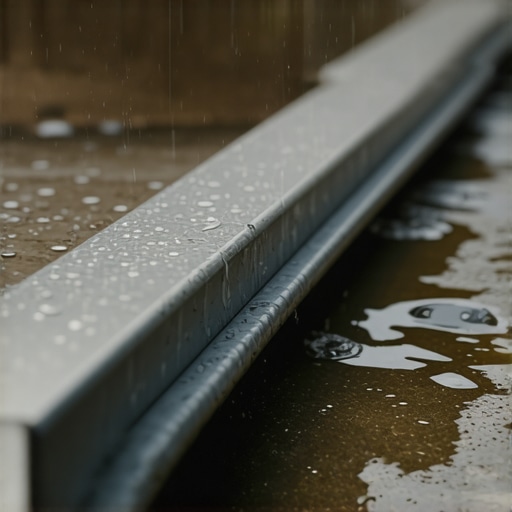
The Anatomy of a Wet Track: Why Water Management Often Fails
When a homeowner notices a pool of water sitting in the track of their sliding patio door, the immediate reaction is usually a mix of panic and frustration. In my 25 years as a master glazier, I have seen thousands of these cases, and the reality is that water in a track is rarely a simple leak. It is a failure of physics, either in the way the door manages external precipitation or how it responds to the internal environment of the home. To understand why your track is wet, we have to look at the sliding door not as a static object, but as a complex system of extrusions, gaskets, and pressure zones. We are dealing with bulk water management and the relentless nature of hydrostatic pressure.
A homeowner recently called me in a panic because their new high-performance sliding doors were ‘sweating’ so much that the track was overflowing onto the hardwood floors. I walked in with my hygrometer and showed them that the relative humidity in their house was 60 percent while it was 10 degrees Fahrenheit outside. It was not a window repair issue in the traditional sense; it was their lifestyle. They had a whole-house humidifier cranked up to ‘tropical,’ and that moisture was hitting the coldest surface in the room: the bottom of the sliding door track. When warm, moist air hits a surface below the dew point, it turns to liquid. This is not a failure of the door; it is a law of thermodynamics. However, if the water is coming from the outside, we have a much different problem on our hands involving the drainage engineering of the sill itself.
The Shingle Principle and the Physics of the Sill Pan
Every sliding door is designed to take on a certain amount of water. Because the track is an open channel where the Operable Sash must slide, it is impossible to make it 100 percent airtight and watertight against a driving rain. Therefore, manufacturers build in a drainage system. This system relies on the ‘Shingle Principle,’ where every layer of the assembly overlaps the one below it to shed water outward.
“Installation is just as critical as the window performance itself. A high-performance window installed poorly will fail.” – AAMA Installation Masters Guide
At the heart of this system is the Sill Pan. This is a flashed component that sits within the Rough Opening before the door is even set. If an installer skips the sill pan or fails to use Flashing Tape correctly, any water that bypasses the primary seals has nowhere to go but into the subfloor. When water collects in the track, it is usually because the Weep Hole system is compromised. These are small slots or valves at the bottom of the exterior frame designed to let water exit. If these are clogged with debris, or worse, if a window cleaner has used a wax-based product that has gunked up the baffles, the water backs up like a clogged sink.
The Thermal Bridge: Why Condensation Targets the Track
In cold climates, we have to talk about the U-Factor and the thermal bridge. The track is often made of aluminum or has aluminum reinforcements. Even in a ‘thermally broken’ frame, the bottom track is the coldest point because cold air is denser and settles at the floor level. If your door has a standard Low-E coating on Surface #2, it is reflecting solar heat out, but in the winter, you actually want a coating on Surface #3 to keep the internal pane of glass warmer. When the glass stays cold, the air directly adjacent to it cools down, loses its ability to hold moisture, and deposits that moisture right into the track. This is why you see moisture more frequently on the Glazing Bead and the lower rail of the Sash. It is not always a leak; it is often the house ‘breathing’ on the cold glass.
If you are looking to replace windows or doors to solve this, you must look at the NFRC labels. You want a high Condensation Resistance (CR) rating. This is achieved through warm-edge spacers that separate the two panes of glass. Older doors used aluminum spacers that acted like a highway for cold to travel from the outside to the inside. Modern spacers use stainless steel or structural foam to break that bridge.
“The water penetration resistance of a fenestration product is dependent on the proper functioning of the drainage system, including weep holes and baffles.” – AAMA/WDMA/CSA 101/I.S.2/A440
The Installation Autopsy: When the Door was Doomed from Day One
Sometimes the water in the track is a result of a physical installation error. If the door is not perfectly level, the water will pool at one end of the track and may never reach the Weep Hole. During a professional window repair assessment, I often find that the installer did not Shim the sill properly. If the sill is ‘crowned’ or ‘sagged,’ the Operable door will not seat correctly against the weatherstripping, allowing wind-driven rain to bypass the gaskets. Furthermore, if the Rough Opening was not prepared with a sloped sub-sill, any water that does get past the frame will sit against the wood, leading to rot that you won’t see until the floor starts to soft-spot.
You should also inspect the Muntin bars if you have a grid pattern. On some cheaply made doors, the grids are external and can actually funnel water toward the Glazing Bead if they are not snapped in correctly. Every component of the door must work together to move water away from the interior. If your track is consistently wet, start by cleaning the exterior weep holes with a small wire or compressed air. If the water persists even when it hasn’t rained, check your home’s humidity levels. If the water is coming in during storms, it is time to look at the structural integrity of the installation and whether the Flashing Tape was integrated with the house wrap in a weather-board fashion.
Final Verdict: Maintenance vs. Failure
Not every wet track requires you to replace windows. Regular maintenance is key. Use a non-abrasive window cleaner to keep the tracks free of silt and pet hair, which act like a sponge and pull water inward through capillary action. Ensure the weatherstripping is not compressed or torn. However, if the track is collecting water because the frame itself has warped or the thermal breaks have separated, no amount of cleaning will fix the underlying physics. In those cases, the only solution is a full-frame replacement that prioritizes a proper Sill Pan and a drainage-first installation strategy. Water management is a science, and your sliding door is the laboratory where that science is tested every time it rains.