The Glazier’s Reality: A Broken Seal is a Broken Home
I remember a call I took three winters ago in a bitter January deep freeze. A homeowner had accidentally put a projectile through a massive fixed-lite architectural unit. By the time I arrived, they had tried to use a standard clear packing tape to hold the shards together. The adhesive had already crystallized and failed because the interior humidity was hitting the freezing glass surface, causing a layer of frost that rejected the tape’s bond. I found the family huddled in the kitchen while the living room temperature had plummeted to forty degrees. The problem was not just the hole, it was the total failure to understand the physics of the building envelope. When you are looking at a broken pane, you are looking at a compromised pressure boundary. Whether you need a window cleaner to prep the area or a full team to replace windows, the next forty-eight hours are a battle against thermodynamics and moisture migration.
“Installation is just as critical as the window performance itself. A high-performance window installed poorly will fail.” – AAMA Installation Masters Guide
The Anatomy of the Break: Assessing the Rough Opening
Before you touch the glass, you must identify what you are dealing with. Is this an annealed glass failure or a tempered safety glass event? Annealed glass breaks into large, lethal daggers. It is the stuff of nightmares for a master glazier. Tempered glass, common in doors and low-level windows, shatters into thousands of tiny pebbles. If your sash is still intact, you are in a better position than if the frame itself is warped. You need to examine the glazing bead, that small strip of vinyl or wood that holds the glass in the channel. If the glazing bead is damaged, your temporary fix must be mechanical, meaning it needs to be screwed or braced into the rough opening, not just taped to the frame. Most people reach for the duct tape, but that is a rookie mistake. Duct tape leaves a residue that is a nightmare for the window repair specialist who has to prep that surface later. Instead, look for a low-residue flashing tape or a specialized construction-grade adhesive film.
Thermal Physics in Cold Climates: Why the Patch Fails
In a northern climate, the enemy is convection. When that glass breaks, the argon or nitrogen gas fill between the panes is gone instantly. You have lost your thermal break. The U-Factor, which measures the rate of heat loss, has just skyrocketed. A standard double-pane Insulated Glass Unit (IGU) might have a U-Factor of 0.30. A piece of plywood over a hole? You are lucky to get 1.0. This means the interior surface of your temporary patch will be freezing. When the warm, moist air from your home’s HVAC system hits that cold surface, it will condense. This water will then run down into the wooden sill or the interior drywall, leading to rot and mold. This is why a temporary fix must include a vapor barrier. You are not just stopping the wind, you are managing the dew point. I always tell my clients to use a layer of heavy-duty polyethylene plastic, sealed with a high-tack tape to the interior casing, creating a dead-air space between the plastic and the exterior plywood. This mimics the physics of an IGU by creating a stagnant air layer that acts as an insulator.
“Air leakage through fenestration products can account for a significant portion of a building’s heating and cooling loads, making the seal of even a temporary repair critical for moisture control.” – NFRC 400 Procedure
The Installation Autopsy: Why Plywood is a Precise Tool
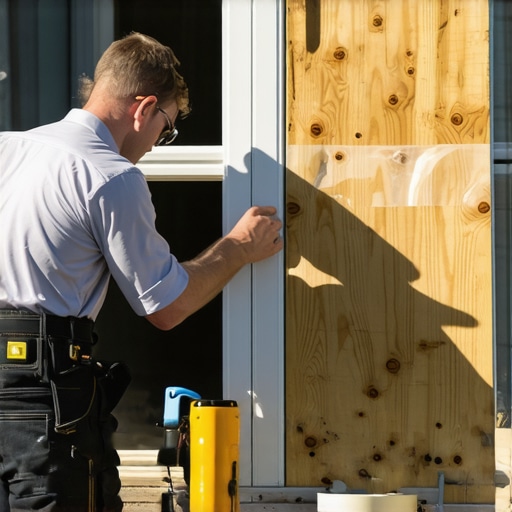
If the window is completely shattered, you need a full board-up. This is where I see the most damage to window frames. Do not drive screws directly into the vinyl or aluminum extrusions. You will ruin the frame’s integrity and make it impossible to simply replace the glass, forcing you to replace windows entirely. Instead, use a compression fit. Cut your plywood to be slightly smaller than the exterior masonry or siding opening. Use 2×4 bracing on the interior and exterior, connected by long bolts through the plywood. This sandwiches the window frame without penetrating it. We call this a ‘no-damage board up.’ It preserves the sash and the mitered corners of the frame. If you must use a window cleaner to remove the oils and dirt from the frame before applying tape, ensure it is a non-ammoniated cleaner. Ammonia can degrade some of the specialized coatings on modern window frames and compromise the secondary seal of the remaining glass unit.
The Technical Steps to a Secure Temporary Seal
First, wear Level 3 cut-resistant gloves. Safety is not a suggestion. Use a vacuum with a HEPA filter to remove glass shards from the tracks and the weep holes. If the weep holes are blocked by glass, any rain that hits your temporary patch will back up into the house. Second, if the glass is still in the frame but cracked, use a clear ‘collision film’ used in the automotive industry. It is designed to stick to glass under high wind loads. Apply it to both the interior and exterior surfaces. This stabilizes the ‘island’ of glass and prevents it from falling out. Third, for a full hole, cut a piece of rigid foam insulation to fit the interior of the frame. This provides a much higher R-value than plywood alone. Place the foam in first, then the plywood on the exterior. Seal the perimeter of the plywood with a temporary caulk, something like a removable ‘weather strip’ caulk that can be peeled off like a rubber band when the new glass arrives. This prevents water from wicking behind the plywood and hitting the raw wood of the rough opening. Remember the shingle principle: any tape or plastic should be applied from the bottom up, so that the top layer overlaps the bottom layer, allowing water to flow over the joints rather than into them.
The Glazier’s Final Word: Repair vs. Replace
While you wait for your new glass, you have a choice to make. Is this a simple window repair or is it time for a full-frame replacement? If your windows are more than twenty years old, the desiccant inside the spacers is likely saturated anyway. The desiccant is the material that absorbs moisture between the panes. Once it is spent, you see that foggy condensation that never goes away. A broken pane is often the catalyst for a homeowner to realize their entire glazing system is failing. If you decide to replace windows, don’t just look at the price. Look at the spacer technology. Avoid metal spacers which act as a thermal bridge. Look for warm-edge technology like structural foam spacers. They reduce the stress on the primary seal and keep the edges of the glass warmer, which prevents the very condensation that makes temporary fixes so difficult to maintain. A window is a complex machine, a hole in the wall that you are asking to stay dry and warm. Treat it with the technical respect it deserves.