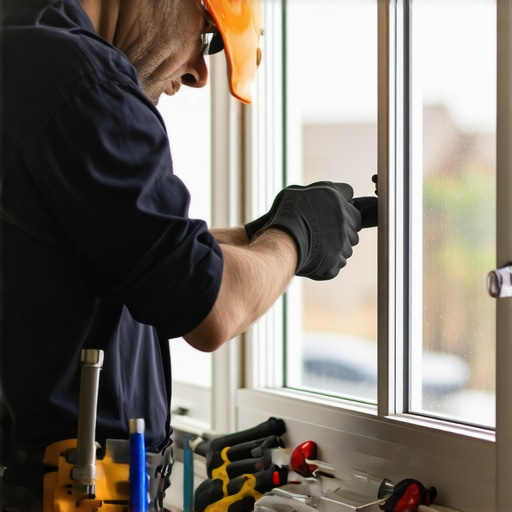
The Anatomy of the Midnight Pop: Why Your Windows Are Talking Back
You are lying in bed on a cold January night in Chicago when it happens. A sharp, rhythmic crack sounds from the corner of the master bedroom, sounding less like a house settling and more like a plastic ruler snapping against a desk. Most homeowners ignore it, but to a master glazier, that sound is a frantic SOS from a window frame under extreme thermal stress. When frames pop, they are telling you that the physics of expansion and contraction are winning the war against your home’s structure. In 2026, as we see more extreme temperature swings, these structural complaints are becoming the number one reason for a service call. If you have been searching for a window repair solution, you need to understand that a popping frame is rarely about the glass and almost always about the tolerances of the installation itself.
The Installation Autopsy: A Case of Restricted Movement
I recall a specific project where I was called to a high-end development in Naperville. The homeowner was convinced the glass was cracking. I pulled a vinyl window out of that house and the header was completely black with rot, despite the unit being only three years old. Why? The previous installer had relied on the nailing fin as a structural component rather than a water management tool, and worse, they had jammed the unit into the Rough Opening with zero clearance. As the vinyl expanded in the summer sun, it had nowhere to go but out, bowing the frame and breaking the seal of the flashing tape. This created a direct path for moisture to hit the OSB sheathing. The popping sound the homeowner heard was the frame literally trying to tear itself away from the frozen shims during the winter. This is the reality of the ‘caulk-and-walk’ mentality that plagues our industry today.
“Installation is just as critical as the window performance itself. A high-performance window installed poorly will fail.” AAMA Installation Masters Guide
Fix 1: Re-establishing the Thermal Expansion Gap
The first no-fail fix for a popping frame involves auditing the Rough Opening tolerances. Every material has a Coefficient of Linear Thermal Expansion. Vinyl, which is the most common material for those looking to replace windows due to cost, moves significantly more than the wood or brick it is surrounded by. If an installer shims the window too tight or fails to leave a 1/4 inch to 3/8 inch gap around the perimeter, the frame will bind. To fix this, we must often perform a partial ‘surgical’ extraction. This involves removing the interior casing to expose the shim space. If we find that the shims are driven so tight that they are compressing the jamb, we must back them out and reset them. We use a high-density plastic shim rather than cedar, as cedar can compress and rot over time. By ensuring the frame has room to ‘float’ within the opening, the popping sounds disappear because the material can expand without hitting a hard structural stop. This is a technical window repair that requires a steady hand and a deep understanding of how the Sash interacts with the frame under load.
Fix 2: Engineering the Sealant Joint with Backer Rod
Most popping sounds are actually the sound of ‘stiction’—the static friction between a moving window frame and the rigid siding or trim. If your window repair consists of just squirted-on cheap caulk, you are setting yourself up for failure. A proper professional repair involves the ‘Three-Sided Adhesion’ rule, or rather, the avoidance of it. When sealant sticks to the back of the gap, the sides of the frame, and the trim, it cannot stretch; it simply tears or pulls the frame with it, causing that audible pop. We use a closed-cell backer rod inserted into the gap before applying a high-performance, low-modulus silicone. The backer rod ensures the sealant only sticks to the frame and the building’s exterior, allowing it to act like a rubber band. This elasticity is crucial in northern climates where the exterior of the frame might be 10 degrees Fahrenheit while the interior is 70 degrees. This temperature delta places immense pressure on the Glazing Bead and the frame corners. Without a flexible joint, something has to give, and usually, it’s the integrity of your air barrier.
“The window installation shall be designed to accommodate movements of the window and the building including thermal expansion and contraction.” ASTM E2112 Standard Practice for Installation of Exterior Windows
Fix 3: Managing the Dew Point and Humidity Loads
Sometimes the pop isn’t the frame hitting the wall; it is the internal components of the window reacting to moisture. In cold climates, the U-Factor of your window determines where the dew point falls. If you have older, under-performing units, moisture can condense inside the frame channel. This water freezes, expands, and physically pushes the frame members apart, creating a popping sound as the ice breaks the friction of the internal joinery. The fix here is two-fold. First, we ensure the Weep Hole system is entirely clear. A window cleaner often overlooks these small slots at the bottom of the frame, but if they are clogged with debris, the frame becomes a reservoir. Second, we may need to address the interior humidity. If your home is at 50% humidity when it is 0 degrees outside, you are asking for trouble. By lowering the interior humidity and ensuring the warm-edge spacers are intact, we keep the frame temperatures above the dew point, preventing the ice-jacking that leads to frame noise and eventual failure.
The Physics of Northern Comfort: Why U-Factor Trumps All
In the North, our primary enemy is heat loss. When you choose to replace windows, you must look at the NFRC label with a focus on the U-Factor, not just the Solar Heat Gain Coefficient. A low U-Factor (ideally below 0.27) means the window is a better insulator. For these northern installations, we utilize a Low-E coating on Surface #3. This reflects the long-wave infrared radiation—the heat from your furnace—back into your living room. We also prefer Argon or Krypton gas fills between the panes. These heavy gases slow down the convective currents inside the glass unit. If you feel a ‘draft’ near a closed window, it is often not a leak, but a convective loop where the air in the room hits the cold glass and drops to the floor. By maintaining a warmer interior glass surface, we reduce the thermal shock to the frame, which in turn reduces the popping and snapping sounds caused by extreme temperature gradients across the vinyl or fiberglass profile.
Final Inspection: The Installer Over the Brand
You can buy the most expensive triple-pane, krypton-filled fiberglass window on the market, but if it is installed by someone who doesn’t understand Sill Pans and Rough Opening tolerances, it will perform worse than a single-pane relic from the 1920s. A true professional window repair or replacement focuses on the ‘Shingle Principle’—ensuring that every layer of flashing and tape laps over the one below it so water is shed to the exterior. Whether you are dealing with a simple Sash adjustment or a full-frame tear-out, remember that the window is a hole in your thermal envelope. Managing that hole requires more than just a tube of caulk; it requires an understanding of structural movement and thermal dynamics. Don’t let a ‘popping’ frame turn into a rotting header. Address the movement, manage the moisture, and respect the physics of the glass.