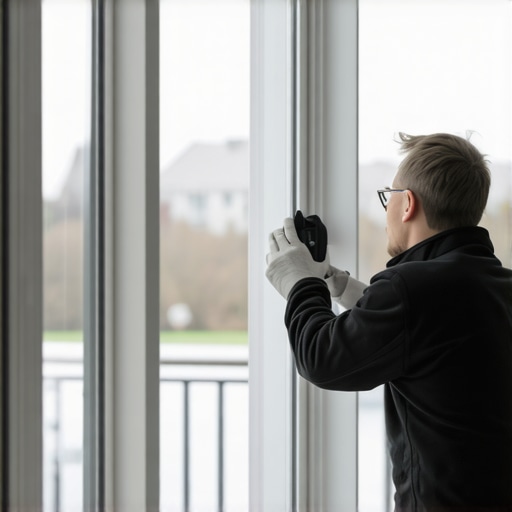
The ‘Paper Trap’ and the Reality of Fenestration Failure
You have probably heard of the ‘Paper Trap’ test—a simple diagnostic where you close a window on a single sheet of paper or a dollar bill and try to pull it out. If the paper slides through without resistance, you are told your windows are shot. But as someone who has spent over two decades measuring Rough Opening tolerances and diagnosing thermal bridging, I can tell you that the paper test is only the tip of the iceberg. It tells you about the Sash-to-frame contact, but it says nothing about the state of your Glazing Bead, the integrity of your Flashing Tape, or the degradation of your Sill Pan. Before you commit to a $30,000 replacement project, you need to understand the physics of what is actually happening in that hole in your wall.
“Installation is just as critical as the window performance itself. A high-performance window installed poorly will fail.” — AAMA Installation Masters Guide
A homeowner called me in a panic because their new windows were ‘sweating’ and they were convinced the seals had failed within six months. I walked in with my hygrometer and showed them the humidity was 60%. It wasn’t the windows; it was their lifestyle—too many plants and a poorly vented crawlspace. The windows were actually doing their job, providing a cold surface for the internal moisture to condense upon because the glass temperature was below the dew point. This is the first lesson of the glazier: the window is part of a system, not an island. If you are failing the paper test, we need to look at whether the Operable parts of your window are simply out of square or if the frame has undergone permanent thermal deformation.
The Physics of the Cold: Why U-Factor Governs the North
In our northern climates, the enemy is simple: heat loss and the resulting condensation. When we talk about performance, we are obsessed with the U-Factor. While most homeowners look at the price tag, I am looking at the NFRC label for a number below 0.27. The U-Factor is the rate of heat loss; the lower it is, the better the window insulates. This is achieved through ‘Glazing Zooming’—specifically, the application of Low-E (low-emissivity) coatings on Surface #3. In a triple-pane unit, Surface #3 is the inward-facing side of the middle pane or the outward-facing side of the inner pane, designed to reflect long-wave infrared radiation back into your living room.
We also have to discuss the Sash material. I have seen countless cheap vinyl windows fail the paper test because the manufacturer didn’t use steel or aluminum reinforcement. Vinyl has a high coefficient of linear thermal expansion. In a Minneapolis winter, that vinyl frame is shrinking while your house stays the same size. This creates gaps that no amount of weatherstripping can close. If you are going to replace windows, you must decide between the stability of fiberglass, which expands at almost the same rate as glass, or the high maintenance but superior aesthetics of wood.
The Installation Autopsy: Beyond the Window Cleaner’s Reach
Most drafts aren’t coming through the glass; they are coming around the frame. When I perform a window repair autopsy, I often find that the original Shim placement was haphazard, causing the frame to bow. If the frame isn’t square, level, and plumb within 1/8th of an inch, the Sash will never seat correctly against the weatherstripping, and you will fail the paper test every time. Furthermore, look at your Weep Hole. If a window cleaner or a sloppy painter has clogged those small holes at the bottom of the frame, water will back up into the Sill Pan and eventually rot your subfloor.
“The water-resistive barrier must be integrated with the window flashing to ensure a continuous plane of protection.” — ASTM E2112 Standard Practice for Installation
Water management is a science of the ‘Shingle Principle.’ Every layer must lap over the one below it. When we install a new unit, we aren’t just replacing windows; we are rebuilding the moisture barrier. This involves Flashing Tape that integrates with the house wrap and a sloped Sill Pan that ensures any water that bypasses the primary seals is directed back outside. If your current ‘pro’ is just squirting a bead of caulk around the exterior and calling it a day—what I call a ‘caulk-and-walk’—you are looking at a structural failure within five years.
Decoding the ROI: Is It Worth the Cost?
Let’s be honest about the math. Replacing every window in a standard colonial home to save $40 a month on heating is a financial disaster. The ROI on energy savings alone can be decades. You replace windows for three real reasons: structural integrity, acoustic dampening, and operational safety. If your windows are painted shut or the Muntin bars are rotting, you have a safety hazard. If you can hear your neighbor’s dog like it’s in the room with you, your 1990s-era double-panes have likely lost their Argon gas fill, and the Glazing Bead is no longer holding the glass under tension.
When you do shop, ignore the sales hype about ‘space-age’ technology. Look for warm-edge spacers. Older windows used aluminum spacers to separate the glass panes, which acted as a thermal bridge, conducting cold directly to the inner pane and causing that dreaded condensation ring. Modern spacers use stainless steel or structural foam to break that bridge. This, combined with a proper Rough Opening seal using low-expansion foam (not the stuff that bows the jambs), is what actually makes a home comfortable. Don’t just pass the paper test; ensure your home’s envelope is scientifically sound. If you aren’t ready for a full tear-out, a meticulous window repair focusing on weatherstripping and Sash alignment can often buy you another five years of performance.