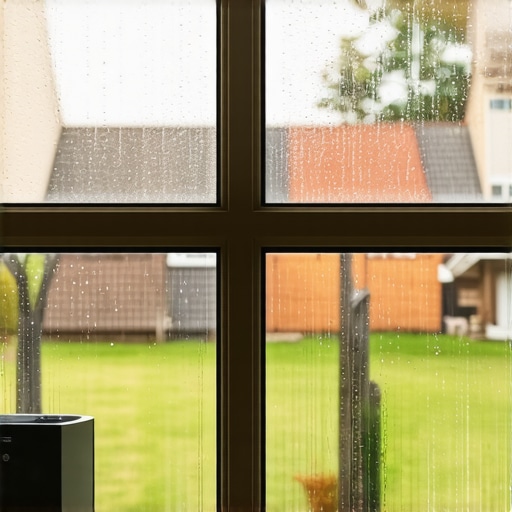
The Dew Point Battle: Why Glass Cries in the Winter
Finding a puddle on your windowsill in the morning is not just an annoyance; it is a symptom of a thermal imbalance that can lead to structural rot and mold. As a glazier with over two decades in the field, I have seen homeowners spend thousands on a window cleaner or temporary window repair only to realize the problem is rooted in the physics of their home. Windows do not create water. They are simply the coldest surface in your room, and when warm, moist air hits that cold glass, it reaches its dew point and transforms into liquid. This is the same principle as a cold beer can on a July afternoon.
The Condensation Crisis: A Master Glazier’s Perspective
A homeowner called me in a panic because their new windows were ‘sweating’ within weeks of installation. They were convinced the glass was defective. I walked in with my hygrometer and showed them the humidity in their living room was 60 percent at 70 degrees Fahrenheit. It was not a failure of the glazing bead or the sash; it was their lifestyle. They had a crawlspace with standing water and were boiling pasta without a vent fan. I had to explain that even the most advanced triple-pane system cannot defy the laws of thermodynamics if the interior vapor pressure is too high.
“Installation is just as critical as the window performance itself. A high-performance window installed poorly will fail.” AAMA Installation Masters Guide
The Anatomy of Thermal Performance
To understand why you need to replace windows or investigate a professional window repair, you must look at the NFRC (National Fenestration Rating Council) label. In cold climates like Chicago or Minneapolis, the U-Factor is the most important metric. This measures the rate of heat loss. A lower U-Factor means the window is a better insulator. When we talk about sweating, we are often looking at the temperature of the glass surface #3 (the interior face of the inner pane). If that surface stays warm, condensation cannot form. This is achieved through Low-E (Low Emissivity) coatings. These are microscopic layers of silver or other low-emissivity materials applied to the glass. In a northern climate, we want that coating on surface #3 to reflect the long-wave infrared radiation—the heat from your furnace—back into the room. This keeps the glass temperature above the dew point.
The Role of the Spacer and Warm Edge Technology
The edge of the glass is the most vulnerable spot for condensation. Historically, windows used aluminum spacers to hold the two panes of glass apart. Aluminum is a fantastic conductor of cold, creating a thermal bridge that chills the perimeter of the glass. This is why you often see a ring of moisture around the edges of a window. Modern warm-edge spacers, made of structural foam or thermoplastic, break that bridge. When you replace windows, ensuring they have a non-metallic spacer is vital for preventing that perimeter sweat. Furthermore, the space between the panes should be filled with Argon or Krypton gas. These gases are denser than air and slow down the convective currents within the Insulated Glass Unit (IGU), further keeping the inner pane warm.
When Window Repair is Not Enough
Many people ask if a simple window repair can fix sweating. If the moisture is between the panes of glass, the seal has failed. Once the desiccant inside the spacer is saturated, the window becomes foggy, and the insulating gas has escaped. At this point, the IGU is a thermal liability. However, if the moisture is on the inside surface, the fix is often about air management. You might need to check your weep holes—those small slots at the bottom of the exterior frame designed to let water out. If they are clogged, water backs up in the track and increases local humidity at the sill. You should also inspect the rough opening for air leaks. If cold air is whistling around the frame because of poor flashing tape application, it will chill the frame and lead to condensation on the vinyl or wood.
“Standard practice for the installation of exterior windows, doors, and skylights must account for the continuity of the water-resistive barrier and the air barrier.” ASTM E2112
The Structural Impact of Moisture
Ignoring window sweat leads to the destruction of the sash and the muntins. If you have wood windows, that water will eventually get under the paint and start the rot process. Even with vinyl windows, the moisture can run down into the sill pan. If the installer did not use a proper sill pan or failed to shim the window correctly to allow for drainage, that water will sit against the wooden framing of your house. I have pulled out windows where the rough opening header was completely compromised because of chronic condensation that the homeowner thought was just ‘a little fog.’ If you see black spots on your drywall or the window cleaner cannot remove the haze because it is inside the glass, it is time to act.
Technical Solutions for a Drier Home
If you are not ready to replace windows, you can mitigate the issue by improving circulation. Use an ERV (Energy Recovery Ventilator) to swap moist indoor air with dry outdoor air without losing your heat. Ensure your operable windows have tight weatherstripping. If the glazing bead is loose, cold air can penetrate the glass pocket, lowering the surface temperature. In some cases, a window repair specialist can replace just the glass units while keeping the existing frames, provided the frames are not warped or rotted. This is a cost-effective way to upgrade to modern Low-E glass and warm-edge spacers without a full tear-out.