The Anatomy of Friction: Why Your Window Hardware Grinds
In twenty-five years of being a glazier, I have seen it all. I have climbed forty-story curtain walls and restored wood sashes that were older than my grandfather. One thing that drives a homeowner crazy faster than a drafty room is a window lock that feels like it is full of sand. You go to secure your home for the night, and instead of a smooth, satisfying click, you get a gritty, metallic grind that makes you wince. This is not just an annoyance; it is a symptom of a failing system that could lead to a permanent window repair or, worse, the need to replace windows prematurely. Most people think they need a window cleaner to solve this, but the issue is usually deep within the mechanics of the hardware itself.
The Gritty Truth: A Narrative of Neglect
A homeowner called me in a panic because their new windows were ‘sweating.’ I walked in with my hygrometer and showed them the humidity was 60%. It was not the windows; it was their lifestyle. But more importantly, when I tried to close the window to check the seal, the cam lock barely moved. It was seized with a mixture of drywall dust and condensation-induced oxidation. They thought they had bought lemons, but the reality was that the installation had left the rough opening slightly out of square, putting immense pressure on the sash. The lock was fighting against the frame, and the friction was slowly destroying the hardware. I had to explain that a window is a machine, and like any machine, it requires precision and the right kind of lubrication to function. If that lock does not pull the sash tight against the bulb seal, your high-performance U-factor means nothing because air is leaking around the perimeter.
“Installation is just as critical as the window performance itself. A high-performance window installed poorly will fail.” AAMA Installation Masters Guide
The Physics of the Cam Lock and the Sash
To understand why your lock is gritty, you have to understand the ‘Rough Opening’ and the ‘Sash’ alignment. When an installer sets a window, they use a shim to level the frame. If the frame is bowed even an eighth of an inch, the lock and the keeper will not line up. This misalignment causes the metal to scrape. Over time, this scraping creates ‘swarf’ or tiny metal shavings. Combine that swarf with household dust or salt air in a coastal environment, and you have a recipe for a lock that feels like it is filled with gravel. In the North, where we deal with extreme cold, the enemy is heat loss. A gritty lock often means the sash is not fully ‘Operable’ or is not seating correctly into the ‘Sill Pan’. This creates a thermal bridge where warm air escapes and cold air enters, often leading to condensation on the ‘Glazing Bead’ and the glass itself.
The Thermal Logic of a Tight Seal
In a cold climate like Chicago or Minneapolis, we prioritize the U-Factor. We want a low U-factor to keep the heat inside. We look for triple-pane units with Argon gas and a Low-E coating on Surface #3 to reflect long-wave infrared radiation back into the living space. However, all that technology is bypassed if the window lock cannot pull the meeting rail tight. A gritty lock usually indicates that the hardware is struggling to overcome the resistance of the weatherstripping. If you have to force the handle, you are likely bending the ‘Muntin’ bars or stressing the ‘Sash’ frame. This is why we focus on ‘Warm-edge spacers’ to prevent condensation, but if the lock fails, that moisture will sit in the ‘Weep Hole’ track, freeze, and further degrade the hardware.
“The air leakage rate of a window is heavily dependent on the compression of the seals, which is governed by the latching force of the hardware.” NFRC Performance Standards
Why WD-40 is the Enemy and Dry Lube is the Hero
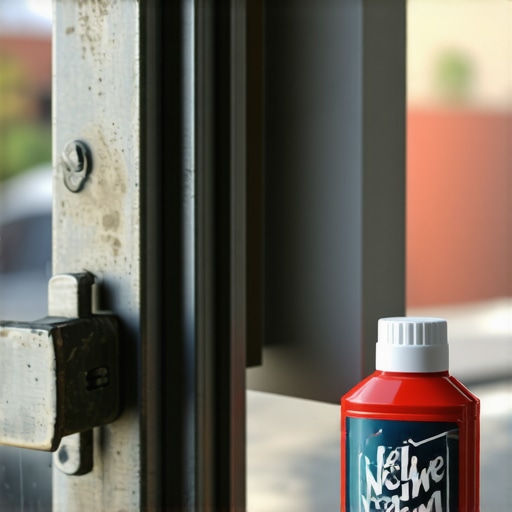
When homeowners feel a gritty lock, their first instinct is to grab a can of blue-and-yellow spray. Stop right there. Using a wet lubricant or a penetrating oil like WD-40 is a ‘caulk-and-walk’ mentality. Wet lubricants are ‘dust magnets.’ They sequester airborne particulates and create a grinding paste that will accelerate the wear on your zinc die-cast hardware. Instead, you need a dry lube solution, typically a PTFE (Polytetrafluoroethylene) or a high-grade graphite spray. These substances provide a low-friction barrier without the sticky residue. Before applying, you must act as a window cleaner for the hardware itself. Use a vacuum with a brush attachment to remove the grit from the keeper and the ‘Glazing Bead’ area. Then, apply the dry lube to the pivot points of the lock and the sliding tracks of the sash.
The Installation Autopsy: When Cleaning Isn’t Enough
Sometimes, the grittiness is a sign of a deeper structural failure. If the ‘Flashing Tape’ was not applied correctly, or the ‘Drip Cap’ is missing, water can infiltrate the ‘Rough Opening’. This water often migrates toward the hardware. If you see rust or a white chalky substance (aluminum oxidation) on your locks, a simple lubricant will not save you. You are looking at a window repair that might involve pulling the trim to check for rot. If the ‘Sill Pan’ is not draining through the ‘Weep Hole’ correctly, the standing water creates a micro-climate of high humidity right at the lock level. This is where the ‘Shingle Principle’ of water management is vital. Everything must overlap so that water flows down and out, never sitting against the hardware.
When to Replace Windows vs. Repairing Hardware
I tell my clients that if the frame is sound and the glass is clear, we can usually save the window. Replacing a cam lock or a sweep lock is a straightforward window repair. However, if the ‘Sash’ is warped or the vinyl has become brittle and cracked at the corners, it is time to replace windows. When you do choose new units, look for ‘Impact-rated’ hardware if you are in a high-wind zone, or ‘Anodized’ finishes if you are near the coast. Always ensure your installer uses proper ‘Shim’ techniques to keep the unit square, level, and plumb. A perfectly installed window should lock with the pressure of a single finger. If you are fighting the window, the window is winning, and your energy bills will reflect that loss.
Maintenance Protocol for Longevity
To keep your windows functioning, you should perform a ‘Hardware Audit’ twice a year. In the spring, after the winter soot has settled, and in the autumn, before the deep freeze. Clean the tracks, check the ‘Weep Holes’ for blockages, and apply your dry lube. This simple act can extend the life of your windows by decades. Do not be the person who ignores a gritty lock until the handle snaps off in January. Manage your openings like the precision instruments they are.