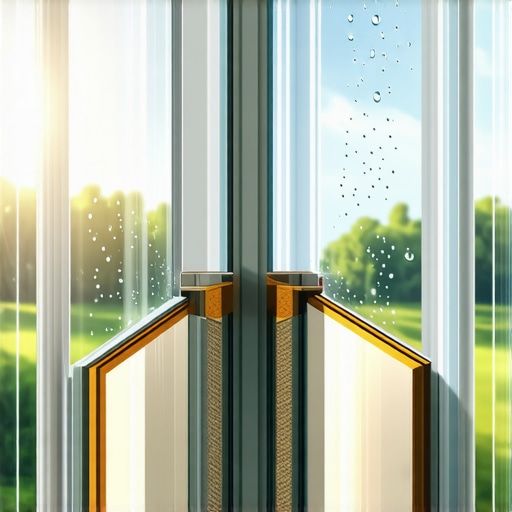
You wake up on a crisp autumn morning, expecting to see your garden through your high-performance windows, but instead, you are greeted by a thick, stubborn layer of mist on the exterior of the glass. Your first instinct is likely one of frustration or concern. You might think your seals have failed, or perhaps you are wondering if you need an immediate window repair or if it is time to replace windows entirely. Before you call a window cleaner or start shopping for replacements, let us look at the physics of the building envelope. This phenomenon is not a defect: it is actually a badge of honor for your window’s thermal performance.
The Condensation Crisis: A Master Glazier’s Perspective
I recall a specific morning in early October when a homeowner called me in a panic because their new, expensive windows were ‘sweating’ on the outside. I walked into their living room with my hygrometer and a thermal imaging camera. They were convinced I had sold them a batch of ‘duds’ with blown seals. I had to show them that the internal humidity was at a healthy level and the internal glass temperature was nearly identical to the room temperature. It was not the windows failing: it was their thermal efficiency working too well. The exterior pane was so well-insulated from the interior heat that its temperature had dropped below the dew point of the outside air. In the glazing industry, we call this radiative cooling. The glass was essentially looking at the cold night sky and losing heat faster than the atmosphere could replace it. This is a common occurrence with modern, high-performance glazing systems that utilize advanced Low-E coatings on Surface #2.
“Installation is just as critical as the window performance itself. A high-performance window installed poorly will fail.” – AAMA Installation Masters Guide
The Science of the Dew Point and Surface Temperatures
To understand why this happens, we must look at the thermal break between the panes. In a standard double-glazed unit, we have four surfaces. Surface #1 is the exterior face. Surface #2 is the inner face of the outer pane. Surface #3 is the outer face of the inner pane, and Surface #4 is the interior face you can touch from your couch. In a high-efficiency window designed for southern or temperate climates, we typically see a Low-E (low-emissivity) coating on Surface #2. This coating is designed to reflect solar heat back toward the outside, keeping the home cool. However, at night, this same coating prevents heat from the home from reaching the exterior pane of glass. When the temperature of that exterior glass (Surface #1) drops below the ambient dew point, moisture in the air condenses into liquid water. If you had old, inefficient windows, heat from your furnace would leak through the glass, warming up the exterior pane and preventing this fog from forming. Ironically, the fog is proof that you are not wasting money heating the neighborhood.
The Anatomy of Modern Glazing
When we discuss a window assembly, we are looking at a complex marriage of materials. The Sash holds the glass in place, while the Glazing Bead secures the unit against the frame. Inside that unit, you have a spacer bar, often a warm-edge spacer made of structural foam or a composite rather than aluminum. Aluminum spacers act as a thermal bridge, conducting cold directly to the edges of the glass. If you see fogging only at the edges of your windows, it might be an indication of an older spacer technology. Modern units use Argon or Krypton gas fills between the panes to further reduce convective heat transfer. The Rough Opening of your window must be properly shimmed and sealed with Flashing Tape to ensure that while the glass is doing its job, the wall around it is not leaking air. A common mistake during a window repair is ignoring the Sill Pan or the Weep Hole. If a Weep Hole is clogged, water cannot escape the frame, which can lead to localized humidity spikes and eventually rot.
“The National Fenestration Rating Council (NFRC) provides energy performance ratings in several categories: U-factor, Solar Heat Gain Coefficient (SHGC), Visible Transmittance (VT), and Air Leakage.” – NFRC Performance Standards
U-Factor vs. Solar Heat Gain: Choosing the Right Glass
If you live in a climate where external fogging is frequent, you are likely dealing with high humidity and significant night-to-day temperature swings. In these regions, the SHGC (Solar Heat Gain Coefficient) is your most important metric. A low SHGC means the window is blocking a high percentage of solar radiation. This is achieved through spectrally selective coatings that allow visible light through while blocking the infrared spectrum. If you were to replace windows in a northern climate, you might prioritize a low U-Factor instead, which measures the rate of non-solar heat loss. In those scenarios, you might even put the Low-E coating on Surface #3 to keep the heat inside. But beware: changing the location of that coating changes the temperature of the glass surfaces and can either increase or decrease the likelihood of external condensation.
Maintenance and the Role of the Window Cleaner
While external fogging is a natural physical process, keeping the glass clean can actually help it dissipate faster. Dirt, pollen, and dust provide ‘nucleation sites’ for water droplets to cling to. A professional window cleaner using a squeegee and a mild detergent can remove these particles, allowing the moisture to sheet off more evenly. However, if the fogging is occurring *between* the two panes of glass, no amount of cleaning will help. This is a sign of a ‘blown seal’ or a ‘seal failure.’ This happens when the desiccant inside the spacer bar becomes saturated with moisture and can no longer keep the inter-pane space dry. In this case, a window repair is usually not possible: you generally need to replace the Insulated Glass Unit (IGU).
The Installer’s Impact
I have seen many DIY projects where the homeowner attempts to replace windows themselves but forgets the critical nature of the ‘shingle principle’ in water management. You must always overlap your materials so that gravity carries water away from the structure. This includes the proper application of a Drip Cap at the head of the window and ensuring the Flashing Tape integrates with the house wrap. If the window is not perfectly level and plumb, the Operable Sash may not seal correctly against the weatherstripping, leading to air infiltration. This air leakage can actually change the local temperature around the glass, causing strange condensation patterns that look like a failure but are actually an installation error. Precision with a Shim and a level is the difference between a window that lasts forty years and one that rots your framing in five.
Summary: Should You Worry?
In conclusion, if you see fog on the outside of your glass in the morning, celebrate. It means your home’s thermal envelope is intact and your windows are doing exactly what they were engineered to do: keeping your expensive conditioned air inside. Do not rush into a window repair unless the moisture is inside the unit. Keep your Weep Holes clear, ensure your Flashing is sound, and let the sun burn off that morning dew naturally. Your energy bill will thank you even if your view is obscured for an hour or two each morning.