Stop Blasting Your Investment: Why a High-Pressure Hose Is a Window’s Worst Enemy
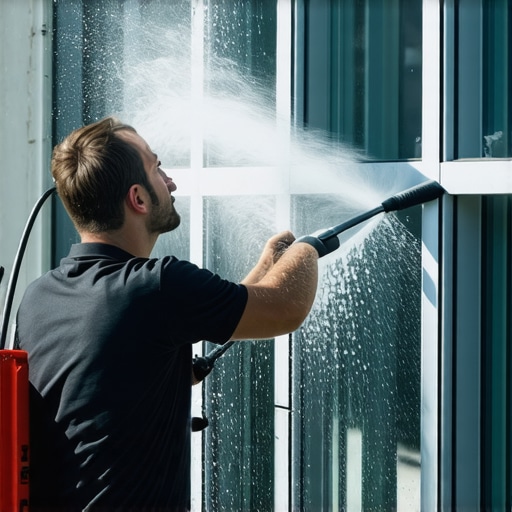
I have spent twenty-five years watching homeowners treat their fenestration like a concrete driveway. It starts with a rental pressure washer and a sunny Saturday. By Monday, my phone is ringing because the windows are suddenly foggy or the drywall underneath the sill is soft to the touch. As a master glazier, I can tell you that a window is a precision instrument, a complex assembly of glass, desiccant, spacers, and sealants. It is designed to shed rain falling at terminal velocity, not to withstand a concentrated 3,000 PSI jet stream delivered from six inches away. If you think your professional window cleaner is just being lazy by using a squeegee instead of a power washer, you are mistaken. They are protecting the structural integrity of your home.
I remember a specific call in early October. The client had just detailed their siding with a heavy-duty pressure washer. Within a week, three of their south-facing double-pane units looked like a terrarium. I had to break the news: they did not just clean the glass; they murdered the IGU seals. I walked in with my hygrometer and showed them that the moisture was not a manufacturing defect but an environmental injection. Once you force water past the primary seal and saturate the desiccant, the unit is effectively dead. This is why understanding the mechanics of a window is vital before you ever pick up a hose.
The Physics of the Insulated Glass Unit (IGU)
To understand why pressure is the enemy, we have to look at how a modern window is built. Most residential windows are double-pane or triple-pane units. These are not just two sheets of glass stuck together. They are part of an Insulated Glass Unit (IGU). The panes are separated by a spacer bar, which is filled with a desiccant material designed to absorb tiny amounts of moisture. This assembly is then sealed twice. The primary seal is usually a polyisobutylene (PIB) tape, and the secondary seal is often a high-grade silicone or polysulfide.
This seal is designed to withstand atmospheric pressure changes and wind loads. It is not designed to withstand a mechanical water jet. When you hit the glazing bead, that small strip of vinyl or wood that holds the glass in place, with 3,000 PSI, you are creating a pressure differential that far exceeds what the window was rated for during AAMA testing. The water is forced behind the glazing bead and sits against the IGU seal. Over time, or sometimes instantly, this pressure causes a breach. Once that seal is compromised, the argon or krypton gas escapes, and moisture-laden air enters. This leads to the dreaded fogging that no window cleaner can wipe away. At that point, you are no longer looking at a simple cleaning task; you are looking at a window repair bill or the need to replace windows entirely.
“Installation is just as critical as the window performance itself. A high-performance window installed poorly will fail.” – AAMA Installation Masters Guide
The Weep Hole and the Shingle Principle
Windows are designed on the shingle principle. This means every layer of the window, from the sash to the sill, is designed to overlap the layer below it so that water flows down and away from the building. When you look at the bottom of your window frame, you will see small slots called weep holes. These are the exit points for any water that manages to get past the initial weatherstripping. They are gravity-fed drainage systems. They are not intake valves.
When you use a high-pressure hose, you are essentially reversing the physics of the window. You are pointing a nozzle at those holes and forcing water into the internal drainage channels of the frame. In a standard installation, the window sits in a rough opening that should be protected by a sill pan and flashing tape. However, few installations are perfect. If you force enough water into those channels at high pressure, it can overflow the sill pan and reach the wooden framing. This leads to hidden rot. By the time you see the mold on your drywall, the studs and the header might already be soft. The cost of a window cleaner is a fraction of the cost of structural remediation.
The Danger to Frame Materials and Hardware
It is not just the glass seals at risk. The materials of the frame itself are susceptible to damage. If you have wood windows, high pressure can strip the paint or stain, exposing the raw timber to moisture. Even worse, it can force water into the joints of the sash where the horizontal rails meet the vertical stiles. This is a recipe for catastrophic wood rot. For vinyl windows, the pressure can crack the welds or dislodge the weatherstripping, leading to air leaks that will haunt you every January.
Then there is the hardware. Your window has delicate balance systems, hinges, and locks that are often lubricated with specific greases. A high-pressure blast can wash away these lubricants and replace them with water and grit. This leads to corrosion and mechanical failure. An operable window should glide smoothly; after a power washing, you might find it gritty and difficult to lock. This mechanical stress can even bend the muntin bars if they are decorative external grids, or strip the Low-E coating if you happen to have a window with a hard-coat finish on the exterior surface.
“Water penetration resistance is a key metric for any fenestration product. Exceeding the design pressure during maintenance can lead to serviceability failures that are not covered by manufacturer warranties.” – ASTM E2112 Standard Practice
The Financial Reality of Window Care
The myth of energy savings often drives people to keep their windows pristine, but the ROI of window replacement is a long-term game. If you destroy your windows by trying to save money on a professional window cleaner, you are destroying your ROI. Replacing a single IGU can cost hundreds of dollars, and if the frame is damaged, you might be looking at thousands for a full-frame replacement. Proper maintenance involves a soft wash approach: a bucket, a mild detergent, and a soft brush or squeegee. This protects the seals, keeps the weep holes clear of debris without flooding them, and ensures the flashing tape remains dry. If you are in a cold climate like Chicago or Minneapolis, where the U-Factor is king, preserving that gas fill inside your panes is essential for keeping your heating bills manageable. A failed seal turns your expensive triple-pane window into a glorified single-pane unit.
Proper Cleaning Protocols for the Homeowner
If you want to maintain your windows like a professional, put the pressure washer away. Start by vacuuming the tracks and ensuring the weep holes are not clogged with dirt or dead insects. Use a garden hose on a low-pressure spray setting to rinse away loose dust. Use a soft microfiber cloth or a professional-grade squeegee with a solution of water and a tiny drop of dish soap. This method ensures that the glazing bead remains intact, the IGU seals are not stressed, and the rough opening remains dry. This is the only way to avoid a premature window repair or the expensive necessity to replace windows before their time. Respect the glass, respect the seals, and your windows will protect your home for decades.
[IMAGE_PLACEHOLDER]