As a master glazier with over 25 years in the field, I have seen every imaginable failure in commercial fenestration systems. One of the most misunderstood and potentially dangerous issues is the development of stress cracks in large-scale commercial glass. I recall a specific incident where I pulled a massive insulated glass unit from a commercial building downtown where the edge had been biting into a misaligned setting block. The previous installer had rushed the job, ignoring the precision required for a proper rough opening fit. The result was a cascading fracture that eventually compromised the structural integrity of the entire storefront. This is not merely a cosmetic issue; it is a signal that the physics of your building envelope are working against the glass. When you hire a window cleaner or a maintenance crew, they are often the first line of defense in identifying these ‘silent’ killers of commercial glass. In this technical breakdown, we will examine why these cracks form, the role of thermal dynamics, and why a timely window repair or a full project to replace windows is non-negotiable for commercial property owners.
The Physics of Thermal Stress and the Solar Heat Gain Coefficient
In commercial environments, especially in regions with high solar radiation, the primary enemy of glass longevity is thermal stress. This occurs when there is a significant temperature differential between different areas of a single glass lite. For instance, the center of a glass pane may absorb intense solar radiation and expand, while the edges, which are shaded by the glazing bead and tucked into the frame, remain much cooler. This expansion in the center creates tensile stress at the edges. If the stress exceeds the edge strength of the glass, a crack is inevitable. This is where the Solar Heat Gain Coefficient (SHGC) becomes a critical metric. In hot climates, we prioritize a low SHGC to block as much radiant heat as possible. To achieve this, we typically place Low-E coatings on Surface #2. This is the inner surface of the outermost pane. By reflecting heat at this stage, we prevent the energy from ever entering the building. However, this also means Surface #2 gets incredibly hot. Without proper edge treatment or if the glass is annealed rather than heat-strengthened, this heat creates a dangerous thermal gradient.
“Installation is just as critical as the window performance itself. A high-performance window installed poorly will fail.” – AAMA Installation Masters Guide
Identifying the Anatomy of a Stress Crack
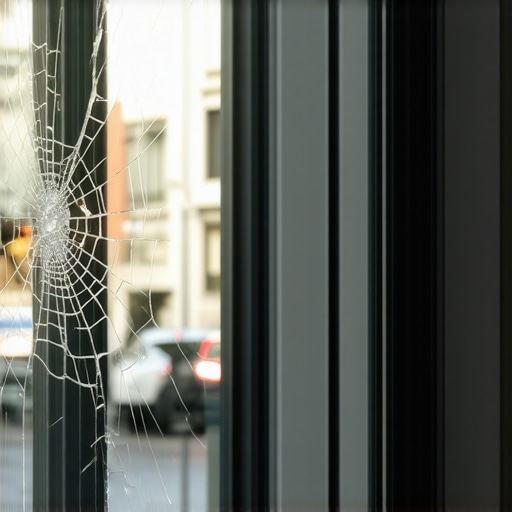
How do you distinguish a stress crack from a crack caused by impact? A master glazier looks at the origin point. An impact crack usually radiates from a central point of contact in a ‘spider web’ pattern. A thermal stress crack, however, almost always begins at the edge of the glass and travels perpendicular to the edge for about an inch or two before it starts to meander. This is because the edge is where the tensile stress is highest. When I am training technicians for window repair, I tell them to look for the ‘V-nick’ or the small chip on the edge. These microscopic imperfections, often caused during the cutting process or rough handling during installation, act as stress concentrators. Over time, as the building undergoes thermal cycling, these nicks grow into full-blown fractures. Commercial glass is often held in place by a pressure plate and a glazing bead. If these components are over-torqued, they restrict the natural expansion and contraction of the glass, leading to mechanical stress cracks. This is why proper shimming and the use of high-quality setting blocks are paramount. If the glass is not floating correctly in the frame, it is a ticking time bomb.
The Role of Frame Material and Moisture Management
Commercial frames are typically made of aluminum due to its strength and durability. However, aluminum has a high coefficient of thermal expansion. It moves significantly more than the glass it holds. To manage this, high-quality commercial systems utilize a polyamide thermal break. This break separates the interior and exterior aluminum sections, reducing heat transfer and mitigating some of the movement issues. Furthermore, moisture management is essential. Every commercial system must have a functional weep hole system. If water becomes trapped in the glazing pocket because of a clogged weep hole or a failed sill pan, it can cause the primary seal of the insulated glass unit to fail. This leads to condensation inside the panes, which increases the thermal mass of the air gap and accelerates the risk of thermal stress cracks. When you see fogging or moisture, it is often a precursor to a fracture.
“Proper edge treatment and the elimination of edge damage during the cutting and handling process are essential to minimizing the risk of thermal breakage.” – ASTM E2112 Standard Practice
When to Repair and When to Replace
Many property managers ask if a stress crack can be fixed. The reality is that for commercial glass, a crack is a death sentence for that specific unit. Once the glass has fractured, the hermetic seal of the insulated glass unit is compromised. The argon or krypton gas fill escapes, and the desiccant within the spacer bar becomes saturated. This ruins the insulating value of the window. While you can technically perform a temporary window repair with resins, it is not a structural or long-term solution. In commercial applications, you must replace windows that show signs of stress cracking to ensure the safety of pedestrians and the efficiency of the HVAC system. A professional window cleaner should be instructed to report any hairline fractures immediately. If caught early, you can schedule a replacement before the glass becomes unstable. Neglecting these cracks can lead to spontaneous glass fallout, which is a massive liability in high-traffic urban areas.