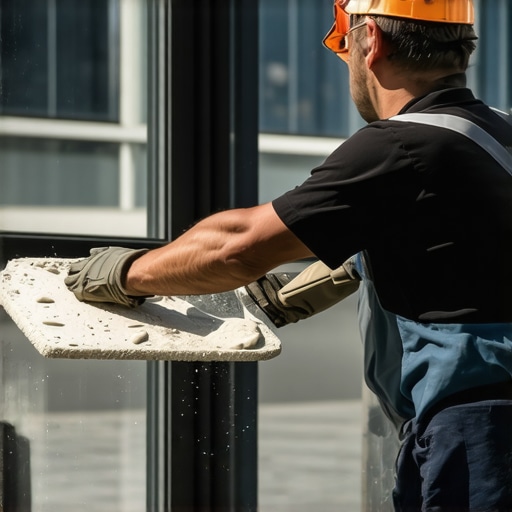
The Invisible Enemy on Your Glass Surface
When you look through a window, you see a transparent barrier. As a glazier with over two decades in the field, I see a complex molecular structure that is far from smooth. To the naked eye, glass appears flat; under a microscope, it looks like a mountain range full of peaks and valleys. In industrial environments, these valleys become traps for microscopic metallic fallout, brake dust, and chemical overspray. This is where standard window cleaner fails and where the professional window repair specialist turns to the clay bar. This is not about aesthetics; it is about preserving the structural integrity of the glazing unit and ensuring the Low-E coatings function as designed.
A facility manager at a manufacturing plant once called me because the high-performance glazing I installed two years ago looked like it was ‘rotting.’ They saw grey speckles they could not scrub off with traditional squeegees. I arrived with my digital moisture meter and a specialized synthetic clay bar. I showed them that the ‘rot’ was actually metallic fallout from their own HVAC exhaust that had bonded to the glass surface. It was a failure of maintenance, not a failure of the glass unit. This grime was not just sitting on the glass; it had undergone a process called ‘sintering’ where the hot metal particles effectively melt themselves into the surface of the glass. If left alone, these particles would oxidize and cause permanent pitting, forcing the client to replace windows years before their expected lifecycle ended.
“Installation is just as critical as the window performance itself. A high-performance window installed poorly will fail.” AAMA Installation Masters Guide
The Science of Surface Decontamination
In our northern climate, where we fight constant cycles of freezing and thawing, the glass surface undergoes significant thermal expansion and contraction. When industrial grime is trapped in the pores of the glass, it creates localized stress points. A clay bar works through mechanical shearing. As the clay glides over a lubricated glass surface, it grabs onto any protrusion that extends above the ‘valleys’ of the glass. It pulls the contaminant out of the pore rather than just wiping the top off. This is vital when we talk about window repair in industrial zones where sulfur and nitrogen oxides from nearby factories mix with moisture to create a mild acidic film on the glass.
For those of us in the cold north, the U-Factor is our primary metric. We need our windows to keep heat inside. When a window is covered in a layer of industrial film, it can actually interfere with the glass’s ability to admit visible light while reflecting long-wave infrared radiation back into the room. If the glass is dirty on surface number one, which is the exterior face, the thermal performance of the entire unit is compromised. We use Low-E coatings on surface number three in these regions to reflect heat back into the building, but if the exterior glass is choked with grime, the glass temperature drops, moving the dew point closer to the interior surface and increasing the risk of condensation on the sash and muntins.
The Anatomy of a Glazing Unit
To understand why we use clay bars, you must understand the components of the window. We have the sash, which holds the glass, and the glazing bead, which secures it. Between the glass and the frame, we have a complex system of sealants and spacers. Industrial grime often settles at the bottom of the glass near the weep holes. If these weep holes are blocked by a slurry of dust and water, the entire drainage system fails. Water backs up into the rough opening, eventually rotting the wood shims and the framing underneath. By using a clay bar to keep the glass and the area near the glazing bead perfectly clean, we ensure that water moves off the glass and into the sill pan as intended.
“Standard practice for installation involves not just the physical placement but the long-term maintenance of the fenestration assembly to prevent moisture-related failures.” ASTM E2112
When I perform a window repair, I often see that the issue started with poor cleaning habits. Using harsh abrasives or razor blades can damage the glass or the seals. A clay bar is a non-abrasive way to restore the glass to a ‘factory clean’ state. It is a slow, methodical process. You must lubricate the glass with a specialized solution, then glide the clay back and forth. You will feel the resistance at first; that is the clay grabbing the embedded iron and carbon. As the surface becomes smooth, the clay will glide with zero friction. This is the only way to ensure the glass is truly clean before applying any hydrophobic coatings or sealants.
Thermal Dynamics and Maintenance
In Minneapolis or Chicago, our windows are the front line against extreme cold. We rely on warm-edge spacers to keep the perimeter of the glass warm and prevent that dreaded ring of frost. However, if the glass surface is pitted from industrial contaminants, the emissivity of the glass changes. This can lead to uneven heating across the pane, which in rare cases, contributes to thermal stress cracks. When you hire a professional window cleaner who understands the needs of industrial glass, they are not just making the view better; they are extending the life of your investment. If you have to replace windows every fifteen years because the glass has become permanently etched, your return on investment disappears. Proper decontamination with clay bars can extend that life to thirty or forty years.
Technical Execution: How to Restore Glass
The process begins at the rough opening. We ensure the window is level and plumb, but the final step is always the glass preparation. For industrial sites, we follow a strict protocol. First, a high-volume rinse to remove loose grit. Second, a standard wash with a neutral pH soap to remove oils. Third, the clay bar treatment. We focus heavily on the corners near the glazing bead where debris accumulates. We never use clay bars on windows with aftermarket films or on surface number four if it has a hard-coat Low-E, as the clay could mar the metallic coating. This is why you need a master glazier who knows which surface is which. We check the glass for any signs of seal failure, such as fogging between the panes, before proceeding. If the seal is gone, no amount of cleaning will save the unit, and it is time for a full window repair or replacement.
The Role of the Sill Pan and Flashing
Maintenance of the glass surface is only half the battle. If we are cleaning industrial windows, we also inspect the flashing tape and the sill pan. In industrial settings, the vibration from heavy machinery can sometimes cause the shims to shift or the sealant joints to crack. While the clay bar restores the glass, we are looking at the overall health of the opening. Is the drip cap still diverting water? Is the flashing tape still bonded to the sheathing? A window is a system, not a product. When we talk about being a window cleaner, we are really talking about being a building envelope technician.
Why We Avoid the ‘Quick Fix’
I have seen many ‘tin man’ installers tell homeowners or facility managers that they need to replace windows because the glass looks ‘cloudy.’ Often, that cloudiness is just years of bonded mineral deposits and pollution that a standard wash won’t touch. A hundred dollars in clay bar supplies and a few hours of skilled labor can often save a ten-thousand-dollar window order. We prioritize the science of the glass. We look at the NFRC labels, we understand the U-Factor requirements for our zone, and we treat the glass with the respect a precision instrument deserves. Don’t buy the hype of the latest ‘self-cleaning’ glass without understanding that even those require maintenance in heavy industrial zones. The clay bar remains the gold standard for restoration.