The Anatomy of a Streak-Free Surface
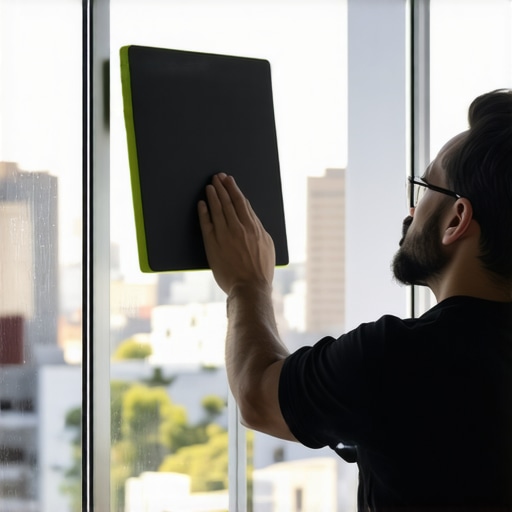
In the world of high-performance fenestration, the difference between a mediocre job and a professional finish often comes down to the final ten seconds of the process. For over twenty-five years, I have seen every shortcut in the book, from newspaper buffing to expensive chemical sprays that leave more residue than they remove. I have stood on scaffolding forty stories up, managing curtain wall installations where the Visible Transmittance (VT) was the primary selling point for the architect. When you are dealing with glass that costs more per square foot than most people spend on a car, you learn that the standard squeegee is just the beginning. The real secret to that crystalline, non-existent look is a tool borrowed from the classroom: the felt blackboard eraser.
A homeowner called me in a panic because their new windows were sweating. I walked in with my hygrometer and showed them the humidity was 60 percent. It was not the windows; it was their lifestyle, specifically their tendency to keep the house tightly sealed without proper air exchange. However, during that visit, I noticed something else. Their window cleaner had left behind a microscopic film of soap and mineral deposits that were catching the morning sun, making the glass look like a hazy mess. I pulled a standard felt eraser from my kit and began to buff the surface. Within seconds, the haze vanished, and the glass seemed to disappear. This is not magic; it is a fundamental understanding of the microscopic topography of glass.
“Installation is just as critical as the window performance itself. A high-performance window installed poorly will fail.” – AAMA Installation Masters Guide
When we talk about window repair or the decision to replace windows, we must discuss the surface integrity of the glass. Glass is not a perfectly flat, solid plane. At a molecular level, it has peaks and valleys. When a window cleaner uses a liquid solution, tiny amounts of moisture and cleaning agent get trapped in these pores. If you live in a high-humidity environment, this moisture can attract dust and pollen, leading to premature degradation of the glazing bead and potentially clogging the weep hole. The blackboard eraser works because the dense wool felt acts as a high-grit mechanical polisher. It creates just enough friction to lift the static-charged particles and the last remnants of evaporated water without scratching the sash or damaging the muntin finish.
The Physics of Friction and Static Charge
The rough opening of your window is a complex ecosystem. It is where your home meets the elements, and moisture management is the most critical factor in preventing long-term structural damage. I have seen countless cases where a sill pan was perfectly installed, but the homeowner neglected the maintenance of the glass itself, leading to water cascading off the frames in ways that bypass the flashing tape. When you use a blackboard eraser for the final buff, you are effectively neutralizing the static charge on the surface. This is vital because many modern windows feature a Low-E coating on Surface #2 or Surface #3. In colder climates like Chicago or Minneapolis, we prioritize the U-Factor, ensuring the coating reflects long-wave infrared radiation back into the room to maintain warmth. If the exterior glass is dirty, it can actually interfere with the Solar Heat Gain Coefficient (SHGC) by absorbing heat into the glass rather than transmitting light.
“The primary goal of any window installation is to manage the transition between the exterior environment and the interior conditioned space, maintaining a continuous air and water barrier.” – ASTM E2112 Standard Practice
During a window repair, we often find that the shim has settled, or the operable parts are sticking due to dirt buildup. Clean glass is about more than just aesthetics; it is about the health of the entire unit. When I train new installers, I tell them that if they leave a single fingerprint on the glazing bead, they have failed the client. We use the eraser to ensure that every square inch of the glass is pristine. This tool is particularly effective at the edges, where a squeegee often leaves a thin line of water. By running the felt along the perimeter of the glass where it meets the frame, you ensure that no moisture seeps behind the seal.
Choosing the Right Tool for the Climate
In the South, where the heat is relentless, we focus on blocking the sun. You want your Low-E coating on Surface #2 to reflect that radiant heat before it even enters the glass. In these regions, a dirty window is a liability. The particulates on the glass can cause localized thermal stress, which in extreme cases, can lead to glass breakage. A window cleaner who understands this will spend as much time buffing as they do washing. When you are deciding whether to replace windows, you should look for units with warm-edge spacers, which prevent the edges of the glass from becoming cold spots that attract condensation. Once those units are in place, the blackboard eraser becomes your best friend for maintaining that high-performance finish. It is a simple tool for a complex job, bridging the gap between old-world craftsmanship and modern material science. Do not settle for the caulk and walk method. Ensure your windows are polished to the point of invisibility, allowing the visible light in while keeping the environmental stressors out.