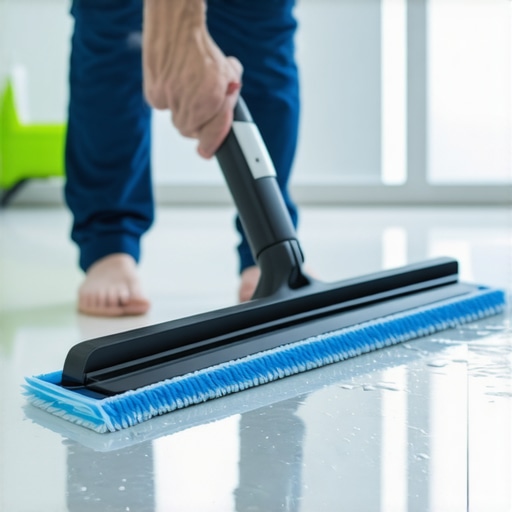
The Myth of the Streak-Free Blade
In twenty-five years of glazing, I have seen every possible tool used to maintain a sash. Most homeowners and even some professional window cleaner crews swear by the traditional brass-handled rubber squeegee. It is the tool of the trade, right? Not necessarily. After thousands of installs and just as many warranty calls, I have realized that the physics of the squeegee often works against the modern window. When we talk about window repair or the decision to replace windows, we are usually looking at the integrity of the seal and the clarity of the glass. The traditional squeegee relies on a perfect, frictionless glide that is increasingly difficult to achieve on modern high-performance glass. This is why we have transitioned our entire maintenance protocol to a specialized microfiber pad system. We are not just cleaning; we are protecting a complex thermal barrier.
“Installation is just as critical as the window performance itself. A high-performance window installed poorly will fail.” – AAMA Installation Masters Guide
The Condensation Crisis and the Microfiber Pivot
A homeowner called me in a panic because their new windows were ‘sweating.’ I walked in with my hygrometer and showed them the humidity was 60%. It wasn’t the windows; it was their lifestyle. But more importantly, as I examined the glass, I saw the telltale signs of ‘squeegee drag.’ The homeowner had been trying to scrub away the condensation streaks with a standard rubber blade, and in doing so, they were actually compromising the microscopic surface tension of the glass. Modern windows often feature a hard-coat Low-E on Surface #4 (the room-side surface) to meet stringent U-Factor requirements in cold climates like Chicago or Minneapolis. This coating is incredibly thin. A rubber squeegee, if it catches a piece of grit, acts like a diamond-tipped stylus. The microfiber pad system, conversely, uses capillary action to lift debris away from the surface rather than scraping it across the plane. This shift in maintenance philosophy is essential for anyone who wants to avoid premature window repair or the need to replace windows due to surface degradation.
The Physics of Modern Glazing Surfaces
To understand why microfiber wins, we have to perform a bit of Glazing Zooming. Standard float glass looks smooth, but under a microscope, it is a landscape of peaks and valleys. When we apply a Sputtered or Magnetron Sputter Vacuum Deposition (MSVD) coating, we are adding layers of silver and metal oxides that are only atoms thick. If you are in a Northern climate, your U-Factor is king. You want to keep the heat inside. This means your glass might have a coating that is slightly more ‘grabby’ than old-school clear glass. A rubber squeegee has a high coefficient of friction. When that rubber blade skips or ‘chatters’ across the pane, it leaves behind microscopic deposits of carbon and rubber. These deposits attract dust, which leads to more frequent cleaning and more opportunities for scratching. The microfiber pad system uses a weave of polyester and polyamide fibers that are split to a denier of less than 1.0. This allows the fibers to reach into the microscopic pores of the glass, pulling out the minerals left behind by evaporated water without the need for high-pressure mechanical scraping.
Structural Integrity and the Maintenance Connection
Every window is a hole in the wall that needs to be managed for heat, light, and water. When I perform a window repair, I often look at the Glazing Bead and the Weep Hole first. If a window cleaner has been dumping gallons of soapy water onto the sash and then ‘whipping’ it off with a squeegee, that water has to go somewhere. Often, it ends up sitting in the glazing pocket because the volume of water exceeds the capacity of the weep system. Over time, this standing water attacks the polyisobutylene (PIB) seal of the Insulated Glass Unit (IGU). Once that seal is breached, the desiccant inside the spacer bar becomes saturated, and you get permanent internal fogging. At that point, you cannot clean your way out of the problem; you must replace windows. The microfiber system uses a ‘damp-to-dry’ method. We use significantly less water, which means we are not flooding the Sill Pan or putting undue pressure on the Flashing Tape that protects the Rough Opening.
“Standard Practice for Installation of Exterior Windows, Doors and Skylights must ensure that the fenestration assembly is integrated into the water-resistive barrier of the wall.” – ASTM E2112
The Installation Autopsy: Why Squeegees Fail the Sash
Let us look at the Sash itself. Most modern operable windows, whether they are casement or double-hung, are designed with very tight tolerances. When you use a squeegee, you are often applying significant lateral pressure to the glass to ensure a clean break at the edges. This pressure can actually deflect the glass within the frame, especially on large picture windows. This deflection puts stress on the setting blocks and the shims that hold the window in place. Over years of aggressive cleaning, this can lead to ‘sash sag,’ where the window no longer sits squarely in the frame. By switching to a microfiber system, the pressure is distributed evenly across the pad. There is no need to ‘dig’ into the corners to get the water out. We are protecting the mechanical balance of the window while achieving a level of clarity that rubber simply cannot match.
When Cleaning Reveals the Need to Replace Windows
Sometimes, the transition to a better cleaning system reveals that the window is beyond saving. During a maintenance cycle, we often check the perimeter. If we see that the Flashing Tape is peeling or that the Rough Opening shows signs of moisture intrusion, the squeegee is the least of the homeowner’s worries. A common sign of failure is ‘iridescence’ or an oil-slick appearance on the glass. This is often ‘glass rot’ or corrosion caused by water being trapped against the glass for extended periods—often a result of poor cleaning techniques that leave water in the tracks. If the glass has reached this stage, window repair is a temporary fix. You are looking at a full-frame replacement to restore the thermal envelope of the building. The microfiber pad allows us to feel these imperfections and surface changes much more intimately than a rigid brass handle ever could. We can detect the start of seal failure before it becomes a structural nightmare.
The Math of Microfiber vs. Traditional Methods
People often ask about the ROI of specialized cleaning tools. While the ‘Tin Man’ salesman will try to sell you ‘self-cleaning’ glass with a titanium dioxide coating, the reality is that all glass requires maintenance. The microfiber system reduces the time spent on each sash and eliminates the need for harsh surfactants that can degrade the vinyl or wood finish of your frames. It is about longevity. If you can extend the life of your IGU seals by five or ten years by keeping the glazing pockets dry and the glass surface free of micro-abrasions, the system pays for itself a hundred times over. We are not just looking for a clear view; we are looking to maintain the SHGC (Solar Heat Gain Coefficient) and the U-Factor that you paid for when you chose your high-performance glazing package. Every scratch and every chemical residue slightly alters the performance of those coatings. Precision maintenance is the final step in the installation process.