In my twenty five years of hanging glass across the country, from high performance residential units to complex commercial curtain walls, I have seen more glass ruined by well intentioned maintenance than by actual environmental stress. Most people look at a window and see a simple transparent pane. I see a sophisticated piece of building science that manages solar heat gain, UV infiltration, and thermal transfer. When you approach a window as a professional window cleaner or a homeowner looking to avoid an early window repair, the tools you choose dictate the longevity of the glazing system. We frequently get calls from homeowners demanding to replace windows because they look perpetually hazy or scratched, only to find that their cleaning regimen has been a systematic assault on the glass surface. The transition from traditional cotton rags to engineered microfiber is not a matter of convenience, it is a matter of preserving the integrity of the glazing bead and the specialized coatings that make modern windows efficient.
“Installation and subsequent maintenance are just as critical as the window performance itself. A high-performance window installed poorly or maintained with abrasive materials will fail to meet its design life.” – AAMA Installation Masters Guide
A homeowner called me in a panic because their new windows were ‘sweating’ and looked ‘cloudy’ only six months after a full frame tear-out. I walked in with my hygrometer and a high-powered LED inspection light. I showed them the humidity was 60 percent, which explained the interior condensation, but the cloudiness was something else entirely. It was a buildup of paraffin wax and wood oils transferred from the ‘clean’ rags they were using. They were effectively polishing their windows with floor-cleaning leftovers. It wasn’t a defect in the glass, it was a failure of the cleaning medium. This is why we are adamant about the science of the cloth.
The Microscopic Reality of Glass and Cotton
To understand why a microfiber cloth is superior, you have to understand the surface of the glass. While glass appears smooth to the naked eye, under a microscope it is an amorphous solid with peaks and valleys. When you use a traditional cotton rag, you are using a fiber that is rounded and relatively large. These round fibers tend to push dirt and oils across the surface, depositing them into the microscopic pores of the glass. Cotton also sheds lint. Those tiny white specks you see when the sun hits the sash at a 45 degree angle are the remnants of your ‘cleaning’ cloth. This lint acts as a binder for atmospheric pollutants, leading to a faster buildup of grime that can eventually lead to the need for a professional window cleaner to use chemical de-scaling agents.
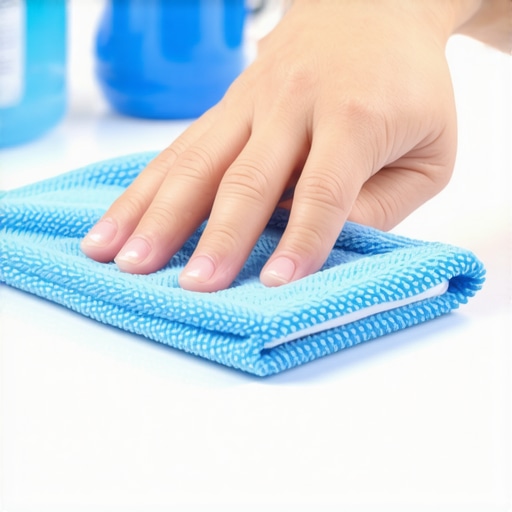
Microfiber is a different beast entirely. It is a synthetic blend, usually polyester and polyamide, where the fibers have been split to a size less than one denier. This is roughly one hundredth the thickness of a human hair. Because these fibers are split, they have a wedge shaped cross section instead of a round one. This geometry allows the cloth to actually lift and trap dirt, oils, and even microbes within the fiber structure rather than just moving them around. In a cold climate like Chicago or Minneapolis, where the U-Factor is king, keeping the interior surface (Surface #4) clean is vital. If you have a Low-E coating on that interior surface, using a rough cotton rag or paper towel can cause micro-abrasions that permanently degrade the coating’s ability to reflect long-wave infrared radiation back into the room.
The Physics of the Clean: Capillary Action and Static Charge
Microfiber works through two primary physical forces: capillary action and static electricity. When the cloth is dry, the polyester fibers create a static charge that attracts dust like a magnet. This is critical for cleaning the muntin and the glazing bead where dust tends to collect. When damp, the polyamide fibers create capillary suction, drawing liquid and dissolved minerals into the cloth and holding them there. This is why you can often clean a window with just water and a high-quality microfiber cloth, avoiding the harsh ammonia-based cleaners that can degrade the sealants around the glass or damage the finish on a wood or vinyl sash. Using fewer chemicals also means there is less residue left behind to attract the next layer of soot or pollen.
“Glass surfaces must be cleaned with materials that do not leave abrasive residues or cause mechanical damage to the surface coatings, especially in high-performance fenestration systems.” – ASTM E2112 Standard Practice
In regions where the Solar Heat Gain Coefficient (SHGC) is the priority, such as the hot South, many windows utilize a Low-E coating on Surface #2 (the inner face of the outer pane). While this coating is protected within the Insulated Glass Unit (IGU), the exterior surface (Surface #1) is still subjected to hard water spots and environmental pollutants. If you use a rag that has been laundered with fabric softener, you are applying a thin layer of silicone or wax to that exterior surface. When the sun hits that window in Phoenix or Miami, that wax bakes onto the glass. Eventually, this can look like a seal failure, leading a homeowner to think they need to replace windows when they actually just need a proper decontamination. Microfiber, when laundered correctly without softeners, eliminates this risk of cross-contamination.
Managing the Drainage: Weep Holes and Sills
A window is a water management system. Every operable window has a sill designed with a specific slope to shed water. Part of that system includes weep holes, which are small openings in the frame that allow water that gets past the sash to exit the building. When you clean with a rag that sheds lint, that lint accumulates in the sill and can eventually plug the weep holes. This leads to water backing up into the rough opening, potentially rotting out the subfloor or the header below. I have performed many a window repair where the root cause was simply a clogged drainage system. Microfiber’s lint-free nature ensures that you aren’t inadvertently sabotaging your window’s ability to handle a rainstorm. When wiping down the track and the sill, the microfiber’s ability to reach into tight corners allows you to clear out the debris that traditional bulky rags leave behind.
The Long-Term Economics of Professional Tools
I often hear that microfiber is an unnecessary expense. I disagree. When you consider the cost of a window repair or the price to replace windows in an entire home, the investment in a dozen high-quality cloths is negligible. A single high-performance fiberglass or wood window can cost over a thousand dollars. Treating that investment with a five-cent rag is a mistake. Furthermore, the durability of microfiber is far superior to cotton. A good cloth can be washed hundreds of times, provided you avoid the dryer sheet and the fabric softener. This longevity makes it the more sustainable choice for both the professional window cleaner and the homeowner. By maintaining the glass properly, you extend the life of the unit and ensure that the thermal performance you paid for actually lasts for the duration of the warranty and beyond.
Ultimately, window maintenance is about more than just aesthetics. It is about protecting the building envelope. Whether you are dealing with a double-hung wood window in an old Victorian or a modern casement unit with argon gas fill and warm-edge spacers, the way you treat the glass surface impacts the entire system. Don’t be the installer who relies on the nailing fin while ignoring the flashing, and don’t be the homeowner who relies on old t-shirts to clean their glass. Use the tools that match the technology of the window itself. That means microfiber, every time.