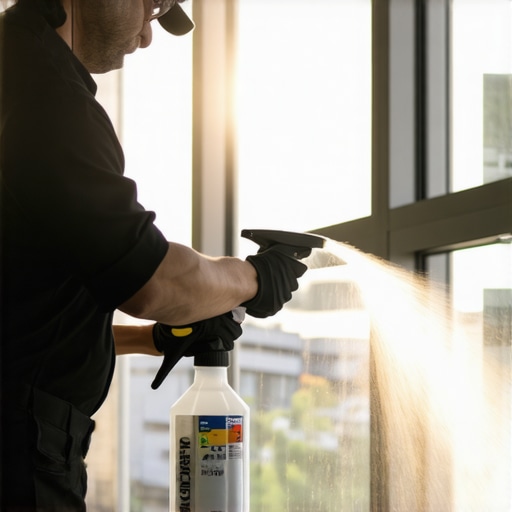
The Microscopic Reality of Your Glazing Surface
For twenty-five years, I have walked onto job sites where homeowners complain about their glass looking ‘tired.’ They see a hazy reflection and assume the IGU (Insulating Glass Unit) has suffered a seal failure. Often, they are ready to drop fifteen thousand dollars to replace windows that are structurally sound. Before you pull out the crowbar and start measuring the Rough Opening for a full-frame replacement, you need to understand the material science of the glass surface. Glass is not the smooth, impenetrable barrier it appears to be. Under a microscope, it is a landscape of peaks and valleys, a porous surface that traps atmospheric pollutants, mineral deposits, and VOCs. This is where the 2026 shift toward $4 silica sprays originates.
“Installation is just as critical as the window performance itself. A high-performance window installed poorly will fail.” – AAMA Installation Masters Guide
A homeowner called me in a panic because their new windows were ‘sweating’ and looked perpetually dirty despite constant scrubbing. I walked in with my hygrometer and showed them the humidity was 60%. It wasn’t the windows; it was their lifestyle and their cleaning regimen. They were using ammonia-based cleaners that were stripping the factory-applied coatings and leaving a high-friction residue. This residue was grabbing onto moisture, creating a nucleation point for condensation. I introduced them to a simple silica-based solution. Silica, or SiO2, is the primary component of glass itself. When you apply a liquid silica spray, you aren’t just cleaning; you are performing a microscopic window repair by filling the surface voids with a sacrificial layer of liquid glass. This creates a hydrophobic surface where water beads and rolls off, taking pollutants with it before they can etch into the pane.
The Physics of Hydrophobicity and Visible Transmittance
In the trade, we talk about Visible Transmittance (VT). This is the fraction of the visible spectrum of sunlight that passes through the Sash and into your living space. Most people ignore VT until their room feels dark and dingy. A buildup of environmental grime can drop your VT by 10% or more. By using a silica spray, you are maintaining the peak optical clarity of the glass. The silica molecules form a covalent bond with the substrate. This is not like a wax that sits on top and yellows over time; it is a molecular integration that levels the ‘peaks and valleys’ of the glass float. When the surface is level, light enters at the intended angle of incidence rather than scattering, which improves the clarity of your view and the aesthetic of the Muntin bars and internal grids.
Why the $4 Solution Beats the High-Pressure Sales Pitch
I have seen salesmen try to convince seniors that they need a full tear-out because their glass has ‘aged out.’ Unless the frame is warped or the Sill Pan is compromised, the glass itself rarely ‘ages out’—it just gets dirty at a molecular level. A $4 bottle of silica-infused spray can often restore the Operable feel and look of a window for a fraction of the cost. When we look at window cleaner technology for 2026, the focus has moved away from harsh solvents toward surface modifiers. These modifiers reduce the surface energy of the glass. High surface energy attracts dust; low surface energy repels it. By lowering that energy, you ensure that the Glazing Bead stays cleaner, preventing the growth of mold in the tracks that often leads to premature failure of the Shim or the wooden components of the frame.
“Proper maintenance of the fenestration assembly is vital to ensuring the long-term thermal performance as rated by the NFRC.” – NFRC Homeowner Maintenance Portal
Thermal Management and the Role of Clean Surfaces
Whether you are in a cold climate dealing with U-Factor issues or a hot climate focused on Solar Heat Gain Coefficient (SHGC), the cleanliness of your glass matters. In high-heat zones like Phoenix, a dirty window absorbs more thermal energy than a clean one. The particulate matter on the glass acts as a heat sink, absorbing infrared radiation and transferring it through the glass into the home. By using a silica spray to keep the exterior surface (Surface #1) pristine, you are ensuring that the Low-E coatings on Surface #2 can do their job of reflecting long-wave infrared radiation back to the outside. This is a critical component of replace windows logic: don’t replace them if you can restore their thermal efficiency with proper maintenance. If the Flashing Tape is still intact and there is no rot in the header, a deep clean with a silica-based protectant can extend the life of your glazing by a decade.
The Technical Application: Avoiding the Caulk-and-Walk Method
Applying these sprays is not about a quick wipe. You must ensure the Weep Hole areas are clear so that any runoff doesn’t pool and create a secondary site for mineral buildup. Start by cleaning the frame and the Sash with a pH-neutral soap. Check the Sill Pan for debris. Once the glass is dry, apply the silica spray in a cross-hatch pattern. This ensures that the silica particles are forced into the microscopic pores of the glass. This is the same logic we use when applying Flashing Tape—it is all about the contact and the seal. Once cured, the glass will have a ‘self-cleaning’ property. The next time it rains, the water will gather into tight spheres and wash away the dust that would otherwise settle and create that ‘foggy’ look that leads people to erroneously think they need a window repair professional.