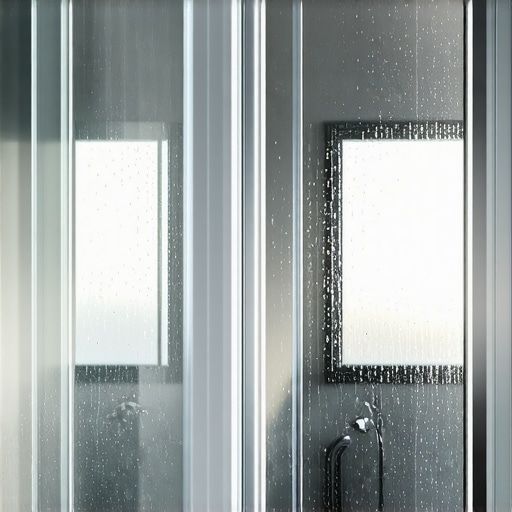
Most homeowners view a fogged bathroom window as a minor annoyance or a signal to grab a towel. From my perspective as a master glazier with a quarter-century in the field, that fog is a visual map of thermodynamic activity. It is the physical manifestation of the dew point being reached on a cold surface. When you step out of a hot shower, you are effectively turning your bathroom into a high-pressure humidity chamber. If your glass surface temperature is lower than the dew point of that humid air, water vapor undergoes a phase change into liquid. While the soap rub secret is a clever surfactant hack, understanding why it works requires a deep dive into the physics of glass and the structural integrity of your sash.
“Condensation is not a window defect; it is a symptom of high humidity levels and the temperature differential between the interior glass surface and the ambient air.” – NFRC Condensation Resistance Fact Sheet
A homeowner once called me in a total panic because their brand new vinyl windows were sweating profusely every morning. I walked into the master suite with my hygrometer and found the humidity levels were hovering around 62 percent while the outside temperature was a brisk 20 degrees. It was not a case for a window repair or a warranty claim on the IGU (Insulated Glass Unit). I had to explain that their lifestyle, specifically the lack of ventilation and the use of a large humidifier, was the culprit. The glass was doing exactly what physics dictated it should do. It was a cold plane in a moist environment. This narrative repeats itself in bathrooms across the country where the glazing bead meets the glass. If your window is old and the desiccant inside the spacer has reached its saturation point, you might see fogging between the panes, which is a different beast entirely. That is a seal failure, and the only real fix is to replace windows or the IGU itself.
The Molecular Science of the Soap Rub Hack
Why does rubbing a bar of soap on a dry window prevent fog? It is not magic; it is surface tension management. Water molecules are polar and like to stick together, forming tiny hemispherical beads when they condense on a smooth, non-porous surface like glass. These beads scatter light in every direction, which is what we perceive as fog. When you apply a thin layer of soap, you are introducing surfactants like sodium stearate. These molecules have a hydrophilic head and a hydrophobic tail. The soap layer breaks the surface tension of the condensing water. Instead of forming light-scattering beads, the water is forced to spread out into a thin, uniform film. Because this film is flat, it allows light to pass through without scattering, keeping the glass clear. However, as a professional, I must warn you that this is a temporary surfactant mask. It does not solve the underlying thermal transfer issue.
The Thermal Logic of Bathroom Glazing
In cold climates, the goal of any window installation is to keep the interior glass surface as warm as possible. This is where the U-Factor becomes the critical metric. A lower U-Factor means the window is a better insulator. If you are tired of the soap trick and want a permanent solution, you need to look at the spacer technology. Old-fashioned aluminum spacers act as thermal bridges, conducting cold from the exterior directly to the edge of the glass. This is why you often see a ring of frost or heavy condensation around the perimeter of the sash. Modern warm-edge spacers, often made of stainless steel or structural foam, break this thermal bridge. When we perform a window repair or a full replacement, we prioritize units with high-performance Low-E coatings on Surface 3. In northern climates, this coating reflects long-wave infrared radiation back into the room, keeping the glass surface temperature well above the dew point.
“Standard practice for installation requires that the rough opening be properly flashed and the window leveled with a shim to ensure the weep hole system functions correctly, preventing moisture entrapment.” – ASTM E2112 Standard Practice
Why Window Cleaner Choice Matters for Longevity
Many people unknowingly damage their window seals with the wrong window cleaner. Ammonia-based cleaners can be aggressive toward the sealants used in dual-pane units. Over time, these chemicals can degrade the polyisobutylene primary seal or the silicone secondary seal. Once that seal is compromised, the argon or krypton gas escapes and is replaced by moisture-laden air. This leads to permanent fogging inside the glass that no amount of soap can fix. When I talk to clients about maintenance, I always recommend a pH-neutral cleaner. If you see moisture inside the panes, you have a dead IGU. At that point, you must decide whether to replace windows entirely or just the glass. A professional glazier can often swap the glass unit within the existing sash, saving the frame and the exterior flashing tape integrity.
The Mechanics of Proper Ventilation
Even the best high-performance glass cannot overcome a complete lack of airflow. In a bathroom, the mechanical exhaust fan is your first line of defense against the dew point. It is not just about removing odors; it is about moisture evacuation. If your fan is not moving enough cubic feet per minute (CFM), the moisture stays in the room and finds the coldest surface, which is usually the glass or the metal muntin bars. When I inspect a rough opening for rot, I often find it behind the drywall of bathroom windows because of persistent condensation that has dripped down into the sill pan. If your window does not have a properly functioning weep hole system, that water has nowhere to go but into your wall cavity. This is why a proper install with a sloped sill and a drip cap is non-negotiable.
Understanding the NFRC Label
When you are shopping to replace windows, don’t let a salesman distract you with talk of “triple-silver coatings” without showing you the NFRC label. Look specifically at the Condensation Resistance (CR) rating. This number, ranging from 1 to 100, tells you how well the window resists the formation of moisture. A higher number is better. In a bathroom environment, a high CR rating is more important than a slightly better SHGC (Solar Heat Gain Coefficient). You want a window that maintains a stable surface temperature. Whether it is a fixed picture window or an operable casement, the goal is to minimize the thermal bridge. While the soap rub secret is a fun household tip, it is no substitute for a thermally broken frame and high-quality glazing beads that keep the unit airtight. If you are struggling with persistent moisture, it is time to stop reaching for the soap and start looking at the physics of your home’s envelope.