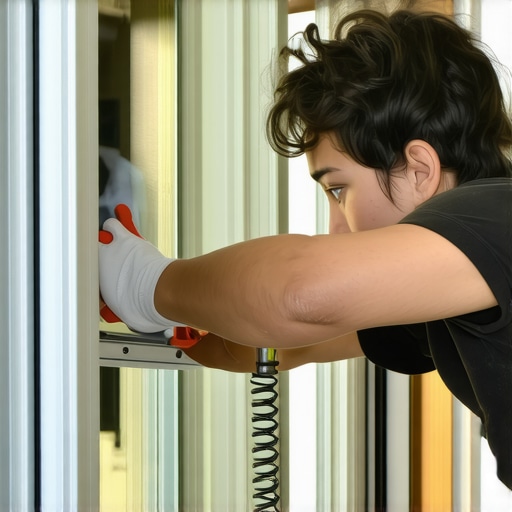
The Reality of Vertical Load Management in Modern Fenestration
When a homeowner notices a double-hung window won’t stay open, they often assume the entire frame has warped or that it is time to replace windows entirely. In my twenty-five years as a glazier, I have seen thousands of these cases, and more often than not, the culprit is a failure in the balance system. A window is a complex machine designed to manage gravity, wind pressure, and thermal transfer. To understand how to fix a broken window spring, you must first understand the physics of the counterweight. Whether you are dealing with a constant force coil, a block-and-tackle system, or an old-fashioned spiral balance, the objective is the same: providing enough upward tension to offset the weight of the sash. If your window is crashing down like a guillotine, your balance has reached its fatigue limit.
The Condensation Crisis: A Narrative of Neglect
A homeowner once called me in a panic because their new windows were ‘sweating’ and the sashes were becoming increasingly difficult to lift. I walked in with my hygrometer and showed them that the interior humidity was nearly 60 percent. It was not a manufacturing defect; it was their lifestyle affecting the mechanical integrity of the units. This excess moisture was not just fogging the glass; it was migrating into the jamb pockets, causing the steel springs to oxidize and the plastic balance shoes to swell. I had to explain that while they were looking for a window cleaner, what they actually needed was a lesson in psychrometrics and a set of replacement constant force springs. This scenario is a perfect example of how environmental factors dictate the lifespan of window hardware. In cold climates, specifically, the dew point often settles right in the track where your springs live, leading to premature failure if the thermal envelope is not managed correctly.
“Installation is just as critical as the window performance itself. A high-performance window installed poorly will fail to operate as intended, often leading to mechanical stress on balance systems.” – AAMA Installation Masters Guide
The Physics of the Constant Force Spring
To perform a professional window repair, you must look at the ‘Glazing Zoom’ of the hardware. Most modern vinyl windows use a constant force balance system. This consists of a stainless steel coil—usually 301 grade stainless—housed in a plastic thermal jacket. Unlike a traditional extension spring that increases tension the more it is stretched, a constant force spring provides a uniform amount of lift throughout the entire travel of the sash. This is achieved through the metallurgy of the coil. When you are performing a repair, you must identify the weight of your sash. If you have high-performance triple-pane glass with a low U-factor, your sash might weigh 30 pounds or more. Using a spring rated for 15 pounds will result in a sash that drifts downward. Conversely, overpowered springs will make the window difficult to close and may eventually rip the mounting screw out of the rough opening or the jamb track.
The North/Cold Climate Context: Thermal Contraction and Friction
In regions like Minneapolis or Chicago, the enemy is heat loss and the subsequent contraction of materials. When temperatures drop to sub-zero, the vinyl extrusions of the window frame contract more significantly than the glass or the metal springs. This contraction can narrow the jamb pocket, increasing the friction on the balance shoe. As a master glazier, I always tell my apprentices that a window repair in the North is about managing tolerances. If the shoe is pinched, the spring has to work harder, leading to metal fatigue. Furthermore, the Low-E coating on Surface #3 is designed to reflect long-wave infrared radiation back into the room. This keeps the glass warmer, but it also means the temperature differential between the glass and the cold jamb is extreme. This thermal gradient can cause the lubrication in your spiral balances to thicken, leading to that characteristic ‘grinding’ sound when you try to open the window.
Step-by-Step Technical Restoration of the Balance System
To begin the fix, you must first remove the operable sash. Tilt the sash in to a 90-degree angle and lift it clear of the pivot bars. Once the sash is removed, inspect the jamb track. You will see the balance shoe, which is the plastic block that the sash connects to. If you see a pile of rusted metal or a snapped ribbon of steel, your constant force spring is dead. You will need to unscrew the mounting bracket at the top of the track. Use a #2 square drive to avoid stripping the head. Once the assembly is loose, slide the shoe and the spring out of the ‘take-out’ slot. When ordering replacement parts, look at the stamp on the spring. It will often have a number like 540 or 640, indicating the tension. Do not guess. If the stamp is illegible, use a bathroom scale to weigh the sash and divide by two for the per-side tension requirement.
“The mechanical integrity of the window system, including all counterbalance components, must be maintained to provide the necessary force to operate the sash effectively and safely.” – ASTM E2112 Standard Practice
Advanced Troubleshooting: Pivot Bars and Alignment
Sometimes the spring is fine, but the pivot bar—the metal piece attached to the bottom of the sash—is snapped or misaligned. If the pivot bar does not seat correctly in the balance shoe, the spring cannot transfer its energy to the sash. During your window repair, check for ‘Rough Opening’ shifts. If the house has settled, the frame may be out of square, causing the sash to bind. This binding puts uneven lateral pressure on the springs. If you find yourself frequently needing to replace windows or hardware, the issue is likely not the window itself, but the structural opening. Use shims to ensure the jambs are perfectly plumb and level. A window that is 1/8th of an inch out of square can increase the operational force required by 50 percent, which will destroy even the highest quality stainless steel springs within a few seasons.
The Glazier’s Secret: Lubrication and Maintenance
Never use petroleum-based lubricants on window hardware. They attract dust and can degrade the vinyl. Instead, use a dry silicone spray. After replacing your springs, spray the track and the shoe. This reduces the coefficient of friction, allowing the spring to do its job with minimal resistance. This is especially critical in coastal environments where salt air can create a ‘crust’ inside the jamb. Regular cleaning with a dedicated window cleaner is not just for the glass; it is for the mechanical tracks as well. Remove the sash once a year to vacuum out the weep holes and the jamb pockets. Debris in the track is a leading cause of spring failure, as it forces the coil to bypass obstructions, leading to kinking.
Final Summary of Hardware Calibration
Fixing a broken window spring is an exercise in precision. You are recalibrating a machine that must withstand thousands of cycles while maintaining a thermal seal. By choosing the correct tension, ensuring the frame is square, and managing the climate-specific challenges of thermal contraction, you extend the life of your windows by decades. Do not settle for a ‘caulk-and-walk’ fix. Do the math, check the weights, and respect the physics of the sash.