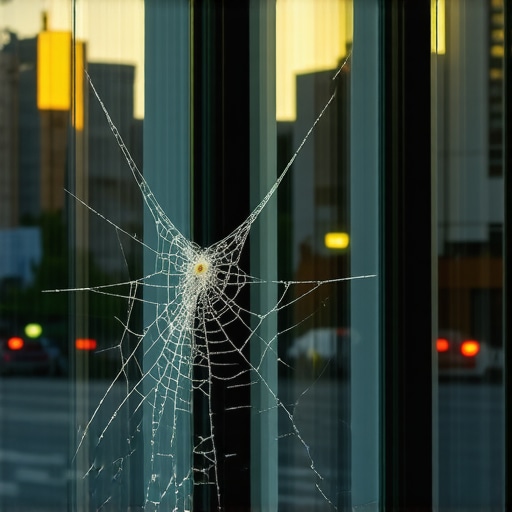
The Invisible Breach: Why a Crack is Never Just a Crack
In the world of commercial glazing, a hairline fracture on a storefront or an upper-floor curtain wall is often treated like a minor blemish. Facility managers frequently push it down the priority list, viewing it as an aesthetic nuisance rather than a structural emergency. However, as a master glazier with over two decades in the field, I can tell you that a crack is a signal that the building envelope has been compromised. A window is a complex thermal barrier, not a passive piece of silica. When that barrier breaks, the physics of the entire rough opening change. You are no longer just looking at a piece of glass, you are looking at a localized failure of your building’s climate control and structural integrity.
A homeowner or building manager called me in a panic because their new windows were ‘sweating’ and the interior drywall near the base was soft to the touch. I walked in with my hygrometer and a thermal imaging camera. I showed them that the humidity was nearly 65 percent inside, but more importantly, a small, ignored crack in the upper corner of the transom had allowed moisture to bypass the glazing bead. It was not just a window issue, it was a systemic failure caused by ignoring a single point of entry. The cost of that delay was not just a piece of glass, it was the removal of three sheets of mold-rearing drywall and the replacement of a saturated header.
“Installation is just as critical as the window performance itself. A high-performance window installed poorly will fail.” AAMA Installation Masters Guide
The Physics of the Insulated Glass Unit (IGU)
Modern commercial windows are typically Insulated Glass Units, or IGUs. These consist of two or more panes of glass separated by a spacer bar and sealed at the edges. The space between the panes is often filled with a noble gas like argon to reduce the U-factor. When a crack appears, the hermetic seal is breached. This results in the immediate loss of the gas fill. Once that gas escapes, it is replaced by ambient, moisture-laden air. This is why you see that foggy, milky appearance between the panes. The desiccant inside the spacer bar can only absorb so much moisture before it reaches its saturation point. Once that happens, the interior surfaces of the glass begin to corrode, a process known as glass permanent frosting. This is the point of no return where window cleaner is useless and you must replace windows entirely.
In northern climates where the delta between the interior and exterior temperature can be 50 degrees or more, the U-factor is the primary metric of success. A cracked pane turns your high-efficiency IGU into a thermal sieve. The U-factor, which measures the rate of heat transfer, spikes. The Low-E coating, which is typically applied to surface number three in cold climates to reflect heat back into the room, becomes less effective as the argon buffer is lost. You are effectively paying to heat the sidewalk through that breach. The radiant cold from a compromised window creates a convection current that makes the interior space feel drafty, even if the HVAC is running at full capacity.
The Cascade Effect: Structural and Liability Risks
Ignoring a cracked commercial window is a gamble with structural physics. Most commercial glass is either tempered or heat-strengthened. While tempered glass is designed to fail into small, relatively harmless cubes, a cracked pane of annealed or heat-strengthened glass can shards. These shards are held in place only by the glazing bead and the friction of the shim. Over time, wind load cycles and the natural expansion and contraction of the aluminum frame exert pressure on the fracture. This is what we call ‘crack propagation.’ A crack that starts at two inches can, after a heavy windstorm, traverse the entire diagonal of the lite.
“The integrity of the building envelope depends on the continuous management of water, air, and thermal transfer at all fenestration openings.” ASTM E2112 Standard Practice
Consider the weep hole system in a standard commercial frame. These small openings are engineered to allow water that enters the glazing pocket to exit the building. When a window is cracked, it can introduce more water than the weep system was designed to handle. If the water cannot exit fast enough, it backs up over the interior leg of the sill pan. This is where the real damage starts. This water can find its way into the wall cavity, leading to rot in the wood blocking or corrosion of the steel studs. A simple window repair that might have cost a few hundred dollars has now transformed into a multi-thousand dollar masonry and structural repair project.
Thermal Stress and the Hidden Culprit
Why did the window crack in the first place? Often, it is not an impact but thermal stress. In commercial buildings with deep shadows or heavy interior blinds, one part of the glass can become significantly hotter than the other. If the edges of the glass are not polished properly or if the glazing bead is too tight, the glass cannot expand. The result is a clean, 90-degree break from the edge. If you simply replace the glass without addressing the underlying cause, such as improper shimming or a lack of expansion room in the rough opening, the new pane will crack just as the old one did. This is why professional window repair involves more than just a putty knife and a tube of silicone. It requires an audit of the entire installation.
The Professional Path to Resolution
When you decide to replace windows in a commercial setting, you must look at the NFRC labels. You want to see a low SHGC (Solar Heat Gain Coefficient) if you are in a southern climate to block infrared radiation, but in the north, you are focused on that U-factor. The installation must involve high-quality flashing tape and a properly sloped sill pan. A ‘caulk-and-walk’ installer will just smear some sealant over the crack or slap a new lite into a dirty frame. A master glazier will pull the sash, inspect the muntins for alignment, ensure the weep holes are clear, and use the correct setting blocks to ensure the glass is centered. The goal is to restore the building envelope to its original specifications, ensuring that the window is once again a managed hole in the wall, not a liability waiting to shatter.