Beyond the Caulk: Why Smooth Operation is a Structural Necessity
In my twenty-five years of replacing thousands of failed units, I have seen more windows destroyed by a five-dollar can of the wrong lubricant than by actual structural settling. A window is a precision-engineered thermal envelope, a critical void in your wall that manages heat flux and moisture. When an operable vinyl sash becomes difficult to slide, the average homeowner reaches for whatever oil is under the kitchen sink. This is where the disaster begins. Vinyl, or unplasticized polyvinyl chloride (uPVC), has a specific chemical sensitivity. Applying petroleum-based lubricants to a vinyl track is essentially a slow-motion demolition of the frame’s integrity. These oils interact with the stabilizers in the PVC, causing the material to soften, swell, and eventually warp. I remember a call-back in a suburb of Chicago where a homeowner called me in a panic because their new windows were ‘sweating’ and wouldn’t budge. I walked in with my hygrometer and showed them the humidity was 65 percent. It was not just a ventilation issue; the excessive moisture had mixed with a heavy-duty grease they had applied to the tracks, creating a thick, abrasive paste that had ground down the glazing bead and jammed the balance system. The windows were not failing because of a manufacturing defect; they were failing because the owner had effectively glued them shut with ‘maintenance.’
“Regular maintenance of fenestration products is essential to ensure long-term performance and to prevent premature failure of the operating hardware.” AAMA 609.1-15 Guide for Cleaning and Maintenance
The Physics of Friction in Northern Climates
For those of us working in the Northern latitudes, the coefficient of thermal expansion is our constant shadow. Vinyl windows in cold climates experience significant contraction and expansion. When the temperature drops to sub-zero, the master frame contracts, and the tolerances within the rough opening tighten. This is when you notice the drag. If the sash is not gliding smoothly, the user applies more force. This force is transferred directly to the constant force balances or the block-and-tackle system. Over-stressing these components leads to snapped strings or shattered spring housings. Window repair in these instances often requires a total teardown of the internal hardware, which could have been avoided with proper lubrication. When we talk about the ‘proper way,’ we are talking about maintaining the low-friction surface that the engineers intended. This involves a deep window cleaner protocol that removes the microscopic debris that accumulates in the track valleys. Dust, pet hair, and skin cells act like sandpaper under the weight of a heavy double-pane insulated glass unit. If you do not clear this path, you are just lubricating the grit, which turns it into a grinding compound.
The Technical Anatomy of the Track
To understand lubrication, you must understand the anatomy of the operable unit. The bottom of the frame, the sill, contains weep holes designed to evacuate water. If you use a wet lubricant, it will eventually migrate into these weep holes, attracting dirt and clogging the drainage path. This leads to water backing up into the sill pan and, eventually, the subfloor. This is how a simple lubrication task turns into a full-scale rot repair. The goal is to use a ‘dry’ lubricant. High-grade dry silicone or PTFE (polytetrafluoroethylene) sprays are the industry standard. These substances provide a micron-thin layer of lubrication that does not attract particulates. Before application, the track must be vacuumed and wiped with a microfiber cloth and a mild, non-abrasive detergent. You must inspect the weatherstripping for any ‘fish-mouthing’ or tears. Weatherstripping that has lost its pile or has been crushed will create mechanical resistance that no amount of lubricant can fix.
“The air leakage rate of an operable window is significantly influenced by the integrity of the weatherstripping and the smooth operation of the sash within the frame.” NFRC 400: Procedure for Determining Fenestration Product Air Leakage
Step-By-Step Technical Calibration
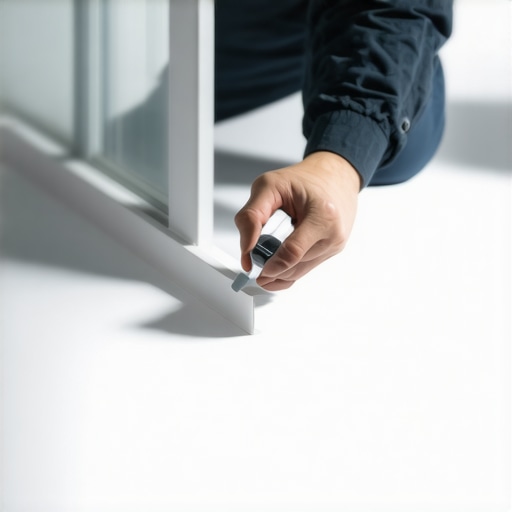
First, open the sash to its full extent. If it is a double-hung window, tilt the sashes in to access the outer tracks. Use a vacuum with a crevice tool to pull debris from the deepest parts of the jamb pocket. After vacuuming, use a damp cloth to remove the soot that often builds up from outdoor pollutants. Once the track is bone dry, apply the dry silicone spray to a clean rag rather than spraying it directly into the track. This prevents over-spray from getting on the glass or the glazing bead. Wipe the rag along the path where the sash makes contact with the frame. Operate the window several times to distribute the PTFE or silicone evenly across the balance shoes and the travel path. If you find that the window still resists movement, the issue is likely not lubrication but a failed balance or a frame that has been compressed by an over-shimed rough opening during the replace windows process. In high-performance northern homes, maintaining a low U-Factor is dependent on a tight seal. A window that does not close fully because of track friction is a massive energy leak, allowing warm, moist air to escape and condense on the cold outer frame, leading to ice damming within the window assembly itself.
When Lubrication Isn’t Enough
There is a point of no return. If you see ‘shingling’ on the vinyl where the sash has physically scraped away layers of the frame, the structural tolerances are gone. At this stage, you are no longer looking at window repair; you are looking at a full replacement. However, for 90 percent of homeowners, a semi-annual cleaning and a dry-lube application will extend the life of their vinyl units by decades. It is about respecting the material science of the PVC and the mechanical requirements of the hardware. Do not be the installer who tells a client to just ‘spray some WD-40 on it.’ That is a professional failure. We manage the hole in the wall, and that means keeping the mechanics of that void in peak condition. Lubrication is not an afterthought; it is the final step in ensuring the thermal envelope remains intact and functional for the lifespan of the building. “