The Precision of Glass Remediation: Why Safety Starts with Physics
In my twenty-five years as a master glazier, I have seen every possible DIY disaster. Most homeowners treat a broken window as a minor inconvenience, but from a technical standpoint, a shattered pane is a breach in your building envelope that compromises thermal regulation and structural safety. When you are dealing with an operable sash that has suffered an impact or a thermal stress crack, the immediate danger is not just the visible shards, but the microscopic glass dust that migrates into the tracks and weep holes. This guide addresses the professional methodology for stabilizing a break before you replace windows or call for a window repair specialist. We will focus on a specific technique I have used on thousands of jobs: the Painter’s Tape Hack.
The Narrative Matrix: A Lesson in Neglected Flashings
I recall a specific project in a drafty Victorian home where I was called to perform a simple glass swap. The homeowner had a cracked lower pane and had applied clear packing tape to the exterior. I pulled that wood sash out of the frame and my heart sank. The header above the window was completely black with rot. Why? The previous installer had relied solely on the nailing fin and a bead of cheap caulk instead of flashing tape and a proper sill pan. The crack in the glass had allowed moisture to bypass the glazing bead, and the packing tape had actually trapped that moisture against the wood, accelerating the decay. It was a five hundred dollar repair that turned into a five thousand dollar structural replacement. This is why we treat glass removal with the same precision as surgery.
The Mechanics of the Painter’s Tape Hack
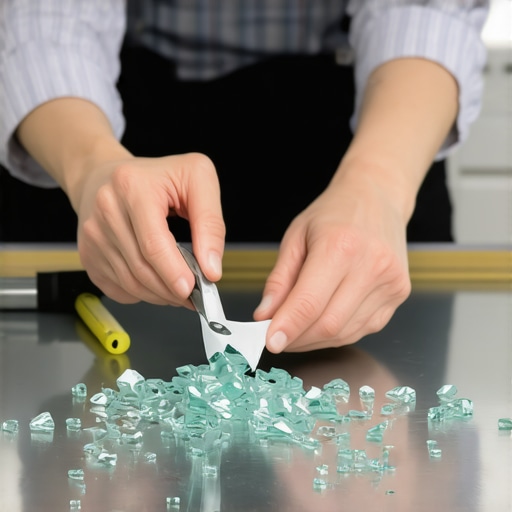
When you encounter a shattered Insulated Glass Unit (IGU), the goal is to remove the glass without sending shards into the rough opening. Traditional methods involve a hammer and a prayer, which usually ends with a window cleaner finding glass in the carpet for the next three years. Instead, use high-quality blue painter’s tape. You want to create a lattice across the entire surface of the broken pane. Start at the top and overlap each strip by at least half an inch, moving downward. This creates a contiguous ‘skin’ over the glass. When you eventually tap the glass to remove it from the bedding compound, the shards remain adhered to the tape, allowing you to pull the entire failure out in one controlled sheet. This prevents debris from clogging the weep holes, which are critical for drainage in modern vinyl and aluminum frames.
[IMAGE_PLACEHOLDER]
Thermal Performance and the Physics of the North
Since we are discussing window repair in climates where the mercury frequently drops below freezing, we must talk about the U-Factor. In the glazier world, the U-Factor is our bible; it measures the rate of heat transfer. A lower number means your window is better at keeping your expensive furnace-heated air inside. When you replace windows, you aren’t just buying glass; you are buying a thermal barrier. For those in cold regions, I always insist on an IGU with a Low-E coating on Surface #3. This reflects long-wave infrared radiation back into the room. We also look for argon or krypton gas fills. These noble gases are denser than air, which significantly slows down the convection loop that occurs between the panes of glass. If your windows are ‘sweating’ on the inside, it is often a sign that your warm-edge spacer has failed, allowing the edge of the glass to reach the dew point.
“Installation is just as critical as the window performance itself. A high-performance window installed poorly will fail.” AAMA Installation Masters Guide
Analyzing the Frame: Beyond the Glass
A window is an assembly of parts including the sash, the muntins, and the frame. If you are performing a window repair because of a crack, you must also inspect the shim placement. If a window was over-shimmed during installation, the frame can bow as the house settles, putting immense pressure on the glass. This leads to what we call a ‘stress crack,’ which usually starts at the edge of the glass and meanders across the pane in a characteristic S-shape. No amount of new glass will fix a bowed frame. In these cases, a pocket replacement or a full-frame tear-out is the only viable path. During a full-frame replacement, we ensure the rough opening is flashed with a self-adhering membrane that laps over the sill pan, ensuring that any water that bypasses the primary seals is directed back to the exterior.
The Role of the Professional Window Cleaner
I always tell my clients that a professional window cleaner is their first line of defense. While they are scrubbing the glazing bead, they are the ones who will notice a hairline crack or a failed seal (indicated by fogging between the panes). Detecting these issues early can prevent the type of catastrophic rot I described earlier. If you see a ‘rainbow’ effect on your glass, that is often a sign that the panes are collapsing inward due to the loss of the gas fill, a phenomenon known as ‘pressure collapse.’ This puts the glass under incredible tension, making it prone to shattering from even a minor temperature swing.
“Standard Practice for Installation of Exterior Windows, Doors and Skylights requires meticulous attention to the integration of the fenestration unit with the weather-resistive barrier.” ASTM E2112
The Anatomy of an Insulated Glass Unit
To truly understand window repair, you have to understand the IGU. Modern units consist of two or three layers of glass separated by a spacer bar. Inside that spacer is a desiccant, a material that absorbs any residual moisture. The entire unit is double-sealed with a primary seal of polyisobutylene and a secondary seal of silicone or polyurethane. When you replace windows, you are looking for units that have a high ‘Visible Transmittance’ (VT) but a low U-Factor. This allows natural light to enter without the associated heat loss. In the North, we also look at the Air Leakage (AL) rating. A window can have the best glass in the world, but if the interlocking meeting rail doesn’t have high-quality weatherstripping, the wind will whistle right through it, rendered your thermal coatings useless.
The Installer Matters More Than the Brand
You can buy the most expensive fiberglass window on the market, but if the guy installing it is a ‘caulk-and-walk’ contractor, you have wasted your money. Proper installation requires shims that are perfectly leveled and a rough opening that allows for the natural expansion and contraction of the frame. Vinyl frames, in particular, move a great deal with temperature changes. If the glazing bead is too tight or the frame is pinned too rigidly to the studs, the glass will eventually fail. My rule of thumb is simple: if you don’t see flashing tape and a level being used at every stage, the job isn’t being done right. Always ask your installer about their sill pan strategy. If they don’t know what that is, show them the door.