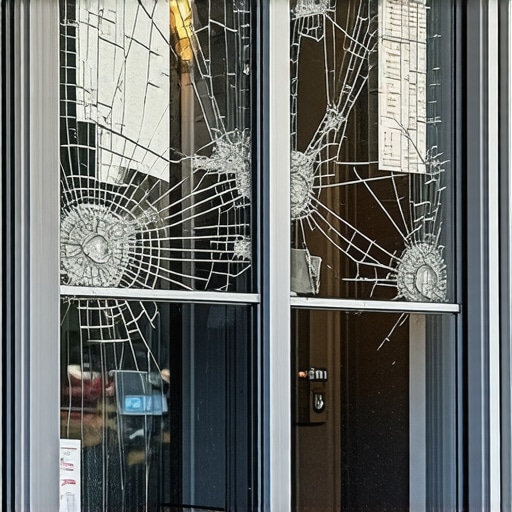
The Deceptive Silence of a Micro-Fracture
In the world of commercial glazing, there is no such thing as a minor chip. To the untrained eye, a small pit or a shell-shaped flake missing from the edge of a storefront pane is a cosmetic nuisance. To a master glazier, it is a ticking time bomb. When you look at a massive sheet of tempered or laminated glass in a retail environment, you are looking at a system under immense internal tension. That tiny chip is what we call a stress riser. It is the point where the structural integrity of the glass begins to unravel, often invisibly, until the moment of catastrophic failure.
I remember a specific job where I was called to a boutique in a high-traffic urban district. The owner complained that their window cleaner had noticed a small nick near the bottom of the 10-foot-high glass panel. I pulled that aluminum storefront frame out and what I found was a nightmare: the header was completely black with rot and oxidation. The previous installer had skipped the essential flashing tape and relied solely on the nailing fin and a bead of cheap silicone. Moisture had been migrating through the chipped edge for months, bypassing the glazing bead and saturating the sub-structure. The chip wasn’t just a mark; it was an entry point for the slow destruction of the building’s rough opening.
“Installation is just as critical as the window performance itself. A high-performance window installed poorly will fail.” — AAMA Installation Masters Guide
The Physics of Edge Stress and Thermal Expansion
To understand why you cannot ignore a chip, you have to understand Solar Heat Gain and thermal movement. Storefront windows are typically located in environments with high exposure to direct sunlight. In a southern-facing installation, we prioritize the Solar Heat Gain Coefficient (SHGC). We want that number to be low, usually by applying a Low-E coating on Surface #2. This reflects the sun’s radiant heat back toward the street rather than allowing it to bake the interior of the store. However, this creates a significant temperature differential across the glass. The center of the pane becomes incredibly hot while the edges, tucked into the aluminum sash and shaded by the frame, remain cooler.
This temperature gradient causes the glass to expand at different rates. In a perfect, unblemished pane, this stress is distributed evenly. But when a chip is present, the expansion forces concentrate at the tip of that fracture. This is the Dew Point of structural failure. The glass literally tries to pull itself apart at the site of the damage. If you don’t seek professional window repair immediately, a cold snap or a particularly hot afternoon will cause that chip to run into a full-length crack, necessitating a much more expensive project to replace windows.
Why Commercial Glazing Demands Precision
When we talk about the Rough Opening in a commercial setting, we are dealing with tolerances measured in sixteenths of an inch. A storefront window doesn’t just sit in a hole; it is supported by setting blocks and stabilized by shims. If a chip is located where the glass meets a setting block, the point-load pressure is astronomical. This is often where I see the most dangerous failures. The glass isn’t just sitting there: it is fighting gravity, wind pressure, and the building’s own natural shifting.
“Visible damage to the glass edge or surface can significantly reduce the structural integrity of the entire lite, especially under high wind loads or thermal stress.” — AAMA Glass Safety Standards
I have seen installers try to hide chips with a bit of caulk, but that is a “caulk-and-walk” mentality that I find intolerable. Water management is a science. Every storefront system is designed with weep holes to allow moisture that gets past the glazing gaskets to exit the building. When a chip leads to a crack, it often disrupts this drainage path. Suddenly, water is being siphoned into the internal sill pan where it can sit and stagnate, eventually leading to the mold and rot I mentioned earlier. This is why the NFRC ratings are so critical: they don’t just measure energy; they measure how the unit performs as a barrier.
The Hidden Risk to Public Safety
In a retail environment, the safety of pedestrians is paramount. Most storefronts use tempered glass, which is designed to break into small, relatively harmless cubes. However, a chip in tempered glass is a permanent invitation to spontaneous breakage. Unlike annealed glass, which might hold a crack for years, tempered glass is under so much compression that a deep enough chip will eventually cause the entire lite to shatter without warning. This is not a situation any business owner wants to navigate. When you see a chip, you aren’t just looking at a repair bill; you are looking at a liability.
If you are in a climate where the U-Factor is the primary concern, such as a northern city, the chip represents a different threat: the loss of the gas fill. Many modern storefronts utilize Argon between the panes to improve insulation. A crack originating from a chip breaks the primary seal. Once that gas escapes and is replaced by moist air, you get internal condensation. You’ll see that foggy, milky appearance between the panes that no window cleaner can ever touch. At that point, the thermal efficiency of the window is gone, and your HVAC system will be working overtime to compensate for the radiant cold.
The Glazier’s Verdict: Repair or Replace?
Many clients ask if they can simply perform a window repair on a chipped pane. If the chip is on the surface and away from the edges (the glazing bead area), it might be possible to resin-bond it. But if that chip is on the edge or near the muntins, the structural integrity is compromised. As a master glazier, my recommendation is almost always to replace windows that show edge damage. The risk of a 1/4 inch thick plate of glass falling into a sidewalk is too high to ignore.
The installation of the replacement must be flawless. This means using high-quality flashing tape, ensuring the sill pan is perfectly level, and verifying that the weep holes are clear of debris. It means selecting the right glass for the climate: perhaps a triple-pane unit with warm-edge spacers if you are in a cold region, or a thermally broken aluminum frame with a low SHGC for a desert environment. Don’t let a small chip become a structural catastrophe. Address the damage before the glass makes the decision for you.