Why Your Window Corners Are a Magnet for Grime
As someone who has spent over a quarter of a century inspecting glazing systems and managing rough opening tolerances, I have seen every possible failure of a window unit. One of the most common complaints I hear from homeowners is not actually about structural failure, but about the relentless accumulation of dirt in the corners of their sash. You spend hours with a window cleaner and a microfiber cloth, yet those ninety degree angles remain cloudy. This is not just a cleaning failure; it is a symptom of physics. Corners are where the glazing bead meets the sash rail and stile. These junctions are often the site of microscopic air turbulence or static charge, which pulls airborne particulates directly into the crevice. If you are struggling with this, the solution is not a more expensive chemical but a change in the physical medium of your polishing tool. Specifically, the humble coffee filter.
The Narrative of the Condensation Crisis
I recall a specific call from a homeowner in a drafty suburb who was convinced their new double-pane units were failing. They called me in a panic because their windows were ‘sweating’ and the corners were turning a dark, muddy grey. I walked in with my hygrometer and a thermal imaging camera. I showed them that the interior humidity was hovering at 65 percent while it was ten degrees Fahrenheit outside. It was not the windows that were failing; it was their lifestyle and their lack of a proper HRV system. The moisture was pooling in the corners because the warm-edge spacers were struggling to keep the edge of the glass above the dew point. That moisture acted as a glue for household dust. Once we corrected the humidity, we had to clean the damage. That was the first time I demonstrated the coffee filter technique to them. It is the only way to get into those tight tolerances without leaving behind the very lint that encourages future moisture ponding.
The Science of the Coffee Filter
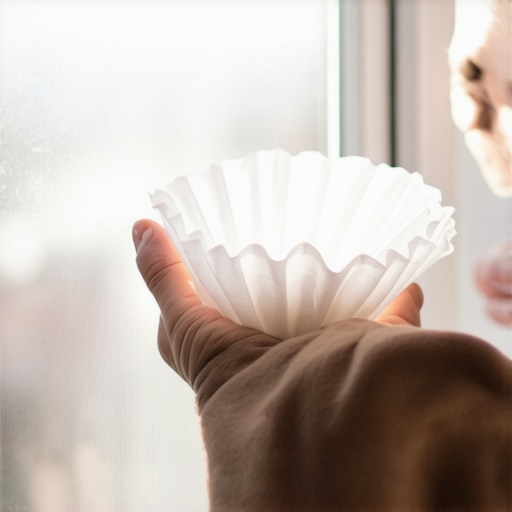
Why does a coffee filter work better than a high-end cloth? It comes down to the manufacturing process of the paper. Coffee filters are made from high-grade, long-fiber paper that is designed to remain intact even when saturated. Unlike paper towels, which are engineered for absorbency and often contain binders that leave a residue, or microfiber, which can be too bulky to reach the intersection of the glazing bead and the glass, the coffee filter is incredibly thin and lint-free. When you are performing a window repair or a deep clean, you need a material that can be compressed into the corner of the operable sash without shedding. The texture of the filter provides a mild abrasive quality that shears away the mineral deposits left by evaporated condensation without scratching the delicate Low-E coatings that might be present on surface four of your glazing.
“Installation is just as critical as the window performance itself. A high-performance window installed poorly will fail.” – AAMA Installation Masters Guide
The Physics of Heat Loss and Corner Soilage
In colder climates, the U-Factor of your window determines how much heat is escaping your home. However, many people forget that the U-Factor is an average across the entire unit. The center-of-glass performance is always superior to the edge-of-glass performance. In the corners, you have the thermal bridge of the spacer system and the potential for air leakage if the weatherstripping is not properly compressed. This temperature differential creates a localized micro-climate. When warm, moist indoor air hits that cold corner, it drops its moisture load. This is why the corners get dirtier than the center of the pane. If you are constantly having to clean these areas, you should check to see if you need to replace windows or if a simple window repair like replacing the bulb seal or adjusting the sash keepers could reduce the air infiltration. A window that is out of square in its rough opening will never seal correctly, leading to perpetual corner grime.
How to Execute the Perfect Corner Polish
To properly use this trick, you must first remove the bulk of the debris. I recommend using a standard pH-neutral window cleaner. Avoid ammonia-based products if you have wood frames, as they can degrade the finish over time. Once the glass is damp, use a squeegee for the main body of the pane. Now, take a dry, folded coffee filter. Use your fingernail or a plastic putty knife to push the edge of the filter directly into the corner where the glass meets the glazing bead. Move the filter in a tight, circular motion. You will notice that the filter picks up the grey residue that a cloth simply pushes around. Because the filter is lint-free, it does not leave behind any cellulose fibers. This is critical because those fibers act as ‘wicking agents’ for future condensation, which starts the whole cycle of dirt accumulation over again. If you have muntins or decorative grids, the coffee filter is your only hope for a truly clear finish in those dozens of tiny corners.
The Role of the Glazing Bead and Weep Holes
While you are down there in the corners, you should inspect the glazing bead. This is the trim piece that holds the glass unit against the sash frame. If the bead is loose or the sealant has backed out, water can migrate into the sash. For vinyl or aluminum windows, this water is supposed to exit through weep holes. If those weep holes are clogged with the same dirt you are trying to clean off the glass, the water will back up and rot the internal reinforcements or cause the insulated glass unit to fail prematurely. A clean corner is not just about aesthetics; it is about the longevity of the window system. If you see standing water in the bottom track of an operable window, your weep system is failing, and no amount of coffee filters will save the window from eventual seal failure. You must ensure that the path from the glass surface to the exterior of the building is clear of obstructions.
“The primary purpose of a window is to provide light and ventilation, but its secondary purpose is to maintain the thermal integrity of the building envelope.” – NFRC Performance Standards
When Cleaning Becomes a Window Repair Task
Sometimes, what looks like a dirty corner is actually a ‘creeping’ failure of the primary seal. If you see a hazy or oily substance in the corner that you cannot wipe away with a coffee filter, you are likely looking at polyisobutylene (PIB) migration. This happens when the primary seal of the insulated glass unit begins to break down and seep into the sightline. At this point, you aren’t looking for a cleaner; you need a window repair specialist to replace the glass unit itself. You cannot fix a failed seal from the outside. Similarly, if you feel a distinct draft coming through the corner even when the sash is locked, your shims may have shifted, or the frame may have expanded and contracted to the point of permanent deformation. In these cases, it is often more cost-effective to replace windows with modern fiberglass units that have a much lower coefficient of thermal expansion than traditional vinyl.
Conclusion: The Value of Precision Maintenance
Maintaining a home is a game of millimeters. Using a coffee filter for your window corners is a technique born of the same precision we use when setting a sill pan or applying flashing tape. It is about choosing the right tool for the specific physics of the task. By understanding why your windows get dirty in the corners, you can better monitor the health of your glazing. Don’t accept cloudy corners as an inevitability. Use the lint-free properties of the filter to achieve a professional-grade finish, and while you are there, keep an eye on your seals and weep holes. A well-maintained window is the only thing standing between your interior comfort and the chaotic thermal environment outside. If you treat your windows with the technical respect they deserve, they will provide you with clarity and efficiency for decades.