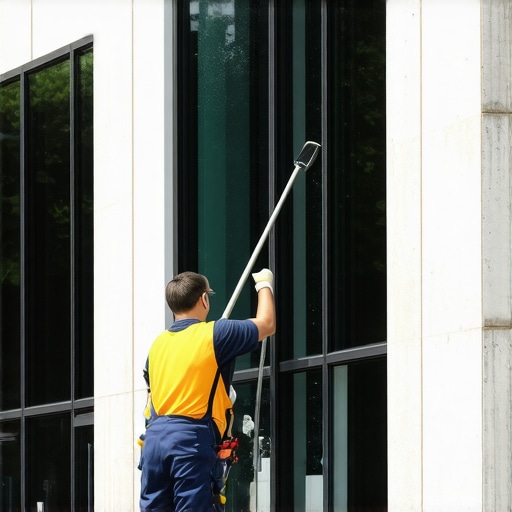
The High-Altitude Maintenance Challenge
In my twenty-five years as a master glazier, I have seen more injuries from ladder falls than I have from broken glass. There is a specific kind of bravado that homeowners and amateur window cleaners exhibit when they see a second-story clerestory window covered in a film of pollen and road grime. They think a 20-foot extension ladder and a bucket of soapy water are all they need. But from the perspective of someone who has hung off the side of a curtain wall in a high-rise, I can tell you that the best way to clean high-reach windows is to stay firmly on the ground. When we talk about window repair or the need to replace windows, we are often dealing with the aftermath of poor maintenance or physical damage caused by improper cleaning techniques. Cleaning high glass isn’t just about aesthetics; it is about preserving the integrity of the glazing bead and ensuring the weep holes remain clear of debris.
The Condensation Crisis: A Lesson in Window Physics
A homeowner once called me in a panic because their new, expensive double-pane windows were sweating so badly they couldn’t see out of them. They were convinced the seals had failed and they were ready to demand a full replacement under warranty. I walked into the house with my hygrometer and found the indoor humidity was sitting at a staggering 65 percent. It was a cold November morning in Chicago, and the U-Factor of the glass was doing exactly what it was designed to do: keep the heat in. However, because the homeowner had heavy drapes closed and zero air circulation, the moisture in the air was hitting the cold surface of the glass and liquefying. It wasn’t a window failure; it was a lifestyle issue. They were trying to clean the ‘fog’ off the inside, but the real solution was managing the dew point. This same logic applies to exterior cleaning. If you don’t understand how your glass interacts with the environment, you’ll spend a fortune on window cleaner and still have streaks or, worse, damaged seals.
“Installation is just as critical as the window performance itself. A high-performance window installed poorly will fail.” AAMA Installation Masters Guide
The Science of the Water-Fed Pole System
If you want to reach the third story without leaving the grass, you need to understand the mechanics of a water-fed pole. This is not just a brush on a stick. Professional-grade systems use a multi-stage filtration process involving reverse osmosis and deionization. Why does this matter for your windows? Tap water is loaded with minerals like calcium and magnesium. If you spray tap water on a window and let it dry, those minerals remain, creating hard water spots that eventually etch into the glass. When we use deionized water, the water is ‘hungry.’ It has a total dissolved solids count of zero. This water aggressively attracts dirt and minerals, lifting them off the sash and the glass surface. As you scrub with a soft-bristle brush, the pure water encapsulates the grime. Because there are no minerals in the water, you do not need to squeegee the glass. You simply rinse it, and it dries completely spot-free.
Why We Avoid the Squeegee on High-Reach Glass
The squeegee is a precision tool, but it requires the correct angle and consistent pressure to work. When you are operating at the end of a 30-foot pole, maintaining that angle is nearly impossible. A skip or a jump of the blade leaves a ‘trail’ that is visible from every angle. More importantly, an amateur using a squeegee on a pole often puts lateral pressure on the window frame. If your window has a high solar heat gain coefficient (SHGC), the glass might be thinner than you realize to accommodate various Low-E coatings. Putting too much pressure on an operable sash can actually displace the glazing bead or cause the sash to shift within the rough opening, leading to air leaks that you’ll feel next winter. This is why the water-fed pole is the superior method for high-reach glass; it relies on chemical purity rather than mechanical force.
The Impact of Climate on Glass Cleanliness
In northern climates, we battle the ‘thermal pull.’ During the winter, the interior surface of the glass is warm, while the exterior is freezing. This creates a static charge that can actually attract dust particles to the exterior pane. If you are in a high-wind area like the Great Plains, that dust is often silica-based, which is abrasive. If you try to clean these windows with a dry cloth or a cheap paper towel, you are essentially sanding your windows. You will create micro-scratches that dull the glass over time. The only way to safely remove this is with high-volume, low-pressure water. This flushes the abrasive particles out of the tracks and away from the weep holes. If those weep holes get plugged with mud and dust, water will back up into the sill pan and eventually rot out your subfloor. I have seen thousands of dollars in window repair bills that started because someone didn’t clean their tracks properly.
“The National Fenestration Rating Council provides energy performance ratings that are only valid if the unit’s physical integrity is maintained through proper cleaning and inspections.” NFRC Homeowner Resource Manual
Identifying the Need for Window Repair During Cleaning
Cleaning is the best time to perform a ‘health check’ on your fenestration units. As you are using your extension pole, look closely at the spacers between the panes of glass. If you see any signs of ‘calcium blooming’ or a white, powdery substance inside the IGU (Insulated Glass Unit), your seals have failed. No amount of cleaning will fix this. This is an atmospheric pressure failure where the argon or krypton gas has escaped and been replaced by moist air. At this point, you don’t need a window cleaner; you need to replace windows or at least the glass inserts. Also, check the muntins and the flashing tape if visible. If the caulking at the head of the window is cracked, water is likely entering the wall cavity every time it rains, regardless of how clean the glass is. A master glazier knows that the glass is just the skin; the flashing and the rough opening are the skeleton that actually does the work.
The Role of Low-E Coatings in Maintenance
Modern windows often have Low-E coatings on Surface #2 or #3. While these coatings are typically inside the sealed unit, some ‘hard coat’ Low-E options are applied to the exterior. If you have a high-performance window designed for the South, it might have a coating meant to reflect long-wave infrared radiation. These coatings can be sensitive to certain chemicals. Amonia-based cleaners can react with the metallic oxides in the coating, leading to permanent streaking or a ‘rainbow’ effect known as thin-film interference. This is another reason why pure water is the safest bet. You aren’t just cleaning the glass; you are protecting a complex chemical barrier that keeps your cooling bills low in the summer. If you ruin that coating, you’ve effectively lowered the R-value of your entire wall.
Summary of Professional Cleaning Steps
To summarize the process for those looking to maintain their home’s value without risking their necks on a ladder: start by inspecting the window for structural damage. Use a telescopic pole with a dedicated glass-cleaning brush. If you can, hook this up to a portable deionization filter. Scrub the frames first, then the glass, working from the top down. This ensures that the dirt from the head and the drip cap doesn’t wash down onto your clean glass later. Ensure the weep holes at the bottom of the frame are clear so the water can drain out as designed. This proactive maintenance will extend the life of your windows and keep your home’s thermal envelope intact.