Stop the Smears: The 2026 Professional Window Cleaner Formula That Kills Greasy Film
In twenty-five years of handling glass, from heavy architectural curtain walls to high-performance residential sashes, I have learned that a window is only as good as its clarity. You can spend thousands on a high-spec Insulated Glass Unit (IGU) with a 0.20 U-Factor, but if it is covered in a molecular layer of kitchen grease and atmospheric soot, you are losing the very visible transmittance you paid for. Many homeowners assume that a hazy appearance means the seal has failed and the desiccant is saturated. While that is often the case in older units, more often than not, it is a failure of chemistry at the surface level. We are seeing a rise in ‘stubborn film’ reports due to the increased use of aerosolized cooking oils and off-gassing from modern synthetic interior materials.
I remember a specific case in a high-rise outside of Chicago where a homeowner was convinced their new triple-pane windows were defective. They called me in a panic because their windows were ‘sweating’ and looked perpetually dirty. I walked in with my hygrometer and a high-intensity inspection light. I showed them that the interior humidity was spiked at 65 percent because of a faulty humidifier setting, but more importantly, the ‘fog’ they saw was actually a sticky residue from a cheap silicone-based polish they used on their furniture. It wasn’t a window repair issue; it was a physics and lifestyle issue. The glass was so cold and the air so moist that the residue was effectively ‘holding’ the moisture on the surface.
“Installation is just as critical as the window performance itself. A high-performance window installed poorly will fail.” AAMA Installation Masters Guide
The Science of the 2026 Professional Mix
To truly kill a greasy film, you have to understand the molecular structure of the contaminant. Most household ‘glass cleaners’ are nothing more than dyed water with a hint of ammonia or vinegar. These products lack the surfactant load necessary to break down lipids. For 2026, we have moved toward a refined chemical approach that focuses on surface tension reduction and the emulsification of oils. The goal is to lift the grease off the silica surface and suspend it in a solution that evaporates before it can redeposit. This requires a precise blend of 99 percent Isopropyl alcohol, distilled water to avoid Total Dissolved Solids (TDS), and a non-ionic surfactant like decyl glucoside. Unlike ionic surfactants found in dish soap, non-ionic versions do not leave a conductive, sticky residue that attracts dust the moment you finish wiping.
When we talk about window repair or the decision to replace windows, we must first look at the state of the glazing bead and the sash. If the greasy film is actually inside the unit, between the panes, no cleaner in the world will save it. That is a total seal failure. However, if the film is exterior or interior, the 2026 mix is the only way to restore the original Visible Transmittance (VT) rating. This is particularly vital in Northern climates where we rely on passive solar gain. A dirty window can reduce your Solar Heat Gain Coefficient (SHGC) efficiency by a measurable percentage, effectively cooling your home when you want it warm. In places like Minneapolis or Chicago, where the U-Factor is king, we need every bit of infrared light to penetrate the glass while the Low-E coating on Surface #3 reflects the long-wave heat back into the room.
Why Traditional Cleaners Fail High-Performance Glass
Modern glass is not just sand and soda ash. It is a complex sandwich of metallic oxides. If you have high-performance windows, you likely have a Low-E coating. In most residential applications, this coating is on Surface #2 (the inner face of the outer pane) or Surface #3 (the outer face of the inner pane). However, some newer ‘Hard Coat’ or pyrolytic coatings are applied to Surface #4, which is the interior surface you actually touch. Using an abrasive or highly acidic cleaner on a Surface #4 coating is a recipe for disaster. You will scratch the metallic layer, leading to permanent ‘streaks’ that are actually physical damage to the window. This is why the 2026 mix uses a pH-neutral approach. We want to dissolve the grease without etching the glass or the delicate coatings that provide your thermal barrier.
“The NFRC provides energy performance ratings in several areas: U-factor, Solar Heat Gain Coefficient, Visible Transmittance, and Air Leakage. All these factors are impacted by the cleanliness and integrity of the glazing system.” NFRC Homeowner Guide
Evaluating the Rough Opening and Sash Integrity
Before you start cleaning, you should perform a basic inspection. Check the weep holes at the bottom of the frame. If these are clogged with the same greasy gunk found on your glass, water will back up into the rough opening. I have seen countless headers rot out because a homeowner ignored a clogged weep hole, thinking the water on the sill was just condensation. Use a small wire to clear the weep holes. Next, examine the shim space if you have access, or look for signs of daylight around the sash. If the window doesn’t sit square in the rough opening, the weatherstripping won’t compress correctly. This allows outdoor pollutants and grease-carrying moisture to bypass the seals and coat the interior glass. If you see ‘pitting’ on the glass, that is a sign of long-term exposure to acidic rain or industrial fallout, and it may require a mechanical polishing or, in extreme cases, you may need to replace windows entirely.
The Professional Application Process
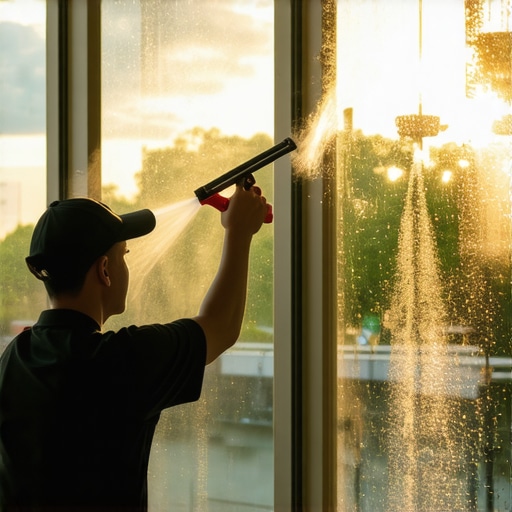
The 2026 mix should be applied using a surgical-grade microfiber cloth or a high-quality squeegee with a fresh rubber blade. Start by misting the glass, not soaking it. You want just enough solution to encapsulate the grease. Using a ‘S’ pattern with a squeegee is the only way to ensure the contaminants are moved off the glass and onto the blade. After each pass, wipe the blade with a lint-free rag. This prevents the ‘ghost line’ often seen at the edges of the glazing bead. If you are dealing with a window that has muntins or decorative grids, you must be even more diligent. Grease loves to hide in the corners where the muntin meets the glass. A soft-bristled detail brush dipped in the 2026 mix is the only way to agitate that film out of the crevices. Remember, a clean window is a high-performing window. By maintaining the glass surface, you are protecting the longevity of the entire IGU and ensuring that your home remains energy-efficient and comfortable through the harshest winters.