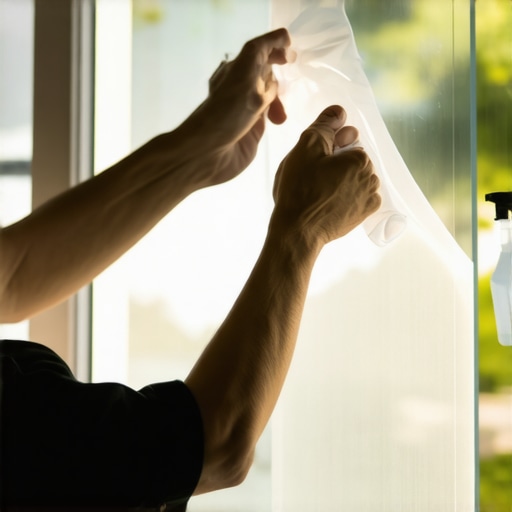
The Residue Crisis: When Sun-Baked Adhesives Compromise Your View
I recently stepped onto a job site in the high desert where a homeowner was in a state of absolute panic. They had spent the weekend trying to peel back a decade-old reflective tint from their south-facing windows, only to find that the film had petrified. What was left behind was not just a sticky mess, but a cloudy, jagged layer of polymerized adhesive that looked like a frosted nightmare. The homeowner had already taken a kitchen scouring pad to one corner, and the screeching sound of metal on glass told me everything I needed to know. I walked in, pulled out my hygrometer and a high-intensity light, and showed them that they weren’t just dealing with dirt; they were dealing with a molecular bond that had been hardened by years of Solar Heat Gain. The adhesive had effectively become part of the glass surface because of the intense UV exposure. This is a common scene for anyone in the window repair or window cleaner business, and it requires a surgical approach rather than brute force.
“Installation is just as critical as the window performance itself. A high-performance window installed poorly will fail, and the same applies to the maintenance of its glass surfaces.” – AAMA Installation Masters Guide
The Physics of Adhesion and Why Harsh Solvents Fail
To understand how to remove this gunk, you have to understand what it is. Most window films use a pressure-sensitive adhesive (PSA) or a water-activated clear acrylic. Over years of thermal cycling, where the glass expands and contracts within the Rough Opening, these adhesives undergo a process called cross-linking. When you apply harsh solvents like acetone or paint thinner, you often just liquefy the top layer of the residue, turning a localized problem into a smeared, oily film that migrates toward the Glazing Bead and can actually degrade the secondary seal of your Insulating Glass Unit (IGU). In my 25 years as a master glazier, I have seen more Sash failures caused by chemical runoff than by actual mechanical wear. The chemicals seep into the glazing pocket, attack the polyisobutylene seal, and lead to premature fogging. This is why we prioritize mechanical and heat-based removal over chemical warfare.
The Technical Protocol: Heat, Moisture, and Agitation
If you want to clear your glass without risking the structural integrity of the Operable parts of your window, you must start with heat. A commercial-grade steamer is your best friend here. By introducing localized, controlled heat, you soften the long-chain polymers in the adhesive without reaching the Dew Point inside the window cavity where condensation could form between the panes. Once the residue is softened, we use a solution of distilled water and a pH-neutral surfactant. This is not just a window cleaner; it is a lubricant. The goal is to create a barrier between your scraping tool and the glass surface. Using a new, surgical-grade stainless steel blade at a 15-degree angle is key. You must never use a blade on tempered glass without testing for ‘fabrication debris,’ which are tiny glass particles that can be dragged across the surface, creating permanent scratches. If you are dealing with a Wood Sash, you must also be incredibly careful not to let excess moisture sit on the bottom rail, as it can lead to rot behind the Glazing Bead.
“The integrity of the perimeter seal must be maintained during any maintenance or repair activity to prevent water infiltration and preserve the U-Factor of the fenestration assembly.” – ASTM E2112 Standard Practice
Managing the Frame and Protecting the Rough Opening
A window is a complex system of water management. When you are cleaning or repairing a window, you have to respect the ‘Shingle Principle.’ Any water you use to soften the adhesive will eventually run down. If your Weep Hole system is clogged with debris, that water will back up into the Sill Pan and eventually into your wall cavity. Before you start the removal process, vacuum out the tracks and ensure the weep channels are clear. This is the difference between a professional glazier and a ‘caulk-and-walk’ installer. We look at the Rough Opening and the Flashing Tape as part of the cleaning environment. If you are working on the exterior, ensure the Drip Cap is redirecting any runoff away from the frame. For those considering if they should replace windows instead of cleaning them, consider the U-Factor and Solar Heat Gain Coefficient. If the film you are removing was there to block heat, its removal will significantly change the thermal performance of that room. You might find that the room becomes uncomfortably hot in July, which might be the real sign that it is time to upgrade to modern Low-E glazing rather than just cleaning the old glass.
The Soft Scrub Method: Using Natural Abrasives
After the bulk of the adhesive is removed, you are often left with a ghosting effect. Instead of reaching for a solvent, use a paste made of baking soda and a tiny amount of water. This provides a very fine mechanical agitation that is softer than the glass itself but harder than the adhesive residue. Work in small circles, focusing on the areas where the film was most exposed to the sun. This technique avoids the risk of ‘scuffing’ the glass, which can happen if you use a dirty rag or low-quality paper towels. Always finish with a microfiber cloth to ensure no fibers are left behind to get caught in the Muntin or the Glazing Bead. This level of precision ensures that your window repair efforts don’t lead to more damage down the line. Remember, the glass is the most visible part of the window, but the seals, Shim placements, and the Sash balance are what keep the window functioning for 30 years.