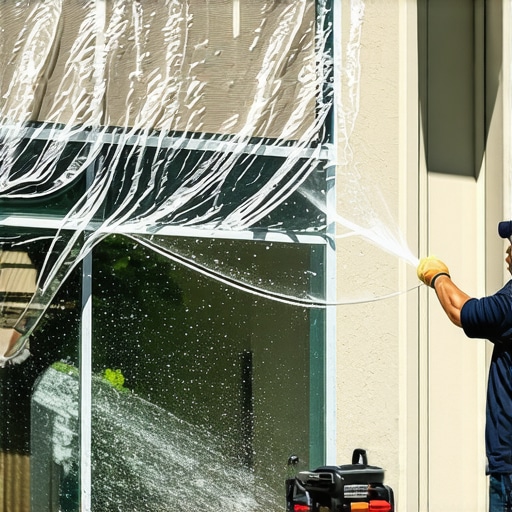
The High-Pressure Hazard: A Glazier’s Perspective
As a master glazier with over two decades in the field, I have seen the aftermath of the ‘caulk-and-walk’ installers and the well-intentioned homeowner with a 3000 PSI pressure washer. A window is essentially a controlled breach in your thermal envelope. When you approach that breach with a high-pressure stream of water intended for siding, you are not just cleaning; you are stress-testing a system designed for gravity-fed rain, not mechanical propulsion. I pulled a vinyl window out of a house in a damp suburb last year and the header was completely black with rot. Why? The previous installer relied on the nailing fin instead of proper flashing tape, and a single aggressive power wash forced gallons of water into the Rough Opening where it couldn’t escape. This is why understanding the physics of your windows is the only defense against rot and the eventual need to replace windows entirely.
“The fenestration product shall be installed in a manner that provides a continuous weather-resistive barrier from the exterior surface of the wall to the interior, ensuring that water is managed to the exterior.” – ASTM E2112 Standard Practice
The Physics of the Seal: Why Your Sash is Vulnerable
To understand the danger, we must look at the Glazing Bead and the Sash. Most residential windows are designed to handle wind-driven rain, which typically hits the glass at a downward angle and drains through a system of Weep Holes at the bottom of the frame. However, a power washer often strikes the window at an upward or horizontal angle. This can bypass the Shingle Principle where every layer of the window overlaps the one below it. When you spray water upward under the Glazing Bead or the Sash, you are forcing liquid into the glazing pocket. This is the space where the Insulated Glass Unit (IGU) sits. If water sits in that pocket, it can saturate the primary seal of the IGU, leading to premature seal failure and that dreaded fogging. This isn’t just a window cleaner issue; it is a structural integrity issue that leads to costly window repair.
Chemical Warfare: Siding Cleaners and Low-E Coatings
In cold northern climates where the U-Factor is king, we rely heavily on Low-E coatings. These coatings are often microscopically thin layers of silver or other metals deposited on the glass. While usually protected inside the IGU on Surface #2 or #3, many modern windows have a hard-coat Low-E on Surface #4 (the interior side) or specialized coatings on the exterior for easy cleaning. When you power wash siding, you often use surfactants like sodium hypochlorite (bleach). If these chemicals are allowed to dry on the glass or the gaskets, they can etch the surface or cause the EPDM rubber gaskets to become brittle. A brittle gasket loses its elasticity and fails to maintain a seal during the expansion and contraction cycles of a cold winter. I have seen homeowners spend thousands on a window cleaner only to realize the chemicals used have stripped the UV-protective finish off their vinyl frames.
The Sill Pan and the Rough Opening: The Hidden Danger
If your installer did not use a proper Sill Pan or high-quality Flashing Tape, water forced behind the siding during a wash will go straight into the wall cavity. This is where the Shim comes into play. Shims are necessary to level the window within the Rough Opening, but they also create small gaps. If the interface between the window frame and the house wrap isn’t perfect, high-pressure water will find those gaps. Once water is behind the house wrap, it stays there. In northern climates, this moisture will freeze, expand, and can actually warp the frame or crack the seal of the glass. It is a slow-motion disaster that often isn’t discovered until you see the mold growth or the paint peeling from your interior trim.
“Installation is just as critical as the window performance itself. A high-performance window installed poorly will fail under mechanical stress.” – AAMA Installation Masters Guide
The Protocol for Protection
Before the power washing begins, you must inspect every Operable sash. Ensure they are locked, not just closed. Locking the window pulls the sash tightly against the weatherstripping, creating the intended compression seal. If you have Muntin bars or Simulated Divided Lites (SDL) that are applied to the exterior of the glass, be extremely cautious. These are often held on by high-bond adhesive tape. A direct hit from a pressure washer can lift the edge of the Muntin, allowing water to get trapped behind it. This trapped water can then freeze in winter, causing the Muntin to pop off or, worse, creating a localized cold spot on the glass that encourages stress cracks. Cover your windows with plastic sheeting and use blue painter’s tape to seal the edges of the frame. This prevents the chemical runoff from the siding cleaner from even touching your Glazing Bead or the frame joints.
Conclusion: Maintenance Over Replacement
The goal is to maintain the integrity of your home’s envelope. Do not let a siding contractor spray directly at the window joints or the Weep Holes. If the window is dirty, the best tool is still a professional window cleaner using a squeegee and a mild, pH-neutral soap. Avoid the temptation of the high-pressure wand. By protecting your glass and frames today, you avoid the need to replace windows or perform a full-frame window repair tomorrow. Remember, a window is a high-performance machine; treat it with the technical respect it deserves.