The Anatomy of a Failing Insulated Glass Unit
You wake up on a Tuesday morning and notice a faint, milky haze between the panes of your living room window. You try to wipe it away, but your hand meets the smooth surface of the interior glass while the fog remains stubbornly out of reach. This is the death knell of an Insulated Glass Unit (IGU). As a master glazier with a quarter-century in the field, I can tell you that this isn’t just a cosmetic annoyance; it is a total failure of the seal system. The desiccant inside the spacer bar has reached its saturation point, and your window’s thermal performance has plummeted to the level of a Victorian-era single-pane. Most homeowners immediately think they need to replace windows entirely, which is a massive expense. Often, a targeted window repair through glass replacement is the surgically precise, cost-effective answer. But success hinges on one thing: a measurement so accurate it accounts for the expansion and contraction of the sash under thermal load.
“Installation is just as critical as the window performance itself. A high-performance window installed poorly will fail.” – AAMA Installation Masters Guide
A homeowner called me in a panic because their new windows were ‘sweating’ only three months after a window cleaner had finished a deep scrub. They were convinced the glass was defective. I walked in with my hygrometer and a laser thermometer. I showed them that their indoor humidity was hovering at 60 percent while the outdoor temperature was near freezing. It wasn’t a manufacturing defect; it was a ventilation issue combined with a high dew point on the interior glass surface. However, when the glass actually fails internally, no amount of dehumidification will save it. You need new glass. Measuring for that glass, however, is where most DIYers and ‘caulk-and-walk’ contractors fail. They forget that glass is a dynamic material that moves within its frame.
The Physics of Heat Transfer and Glass Selection
Before we pull out the tape measure, we must understand what we are measuring for. In northern climates, our primary enemy is heat loss. We want a low U-Factor. The U-Factor measures the rate of non-solar heat loss; the lower the number, the better the window is at keeping the furnace’s hard-earned heat inside. When we measure for a replacement IGU, we aren’t just looking at the height and width. We are looking at the overall thickness of the unit, which usually ranges from 1/2 inch to 1 inch. This air space is where the magic happens. We often replace air with Argon gas because its higher density slows down convective currents between the panes. If you are in a cold region, I typically recommend a Low-E coating on Surface #3. This reflects the long-wave infrared radiation from your heater back into the room. If we were in a southern climate, we would place that coating on Surface #2 to reject solar heat before it even enters the home.
The Master Glazier’s Tool Kit for Measuring
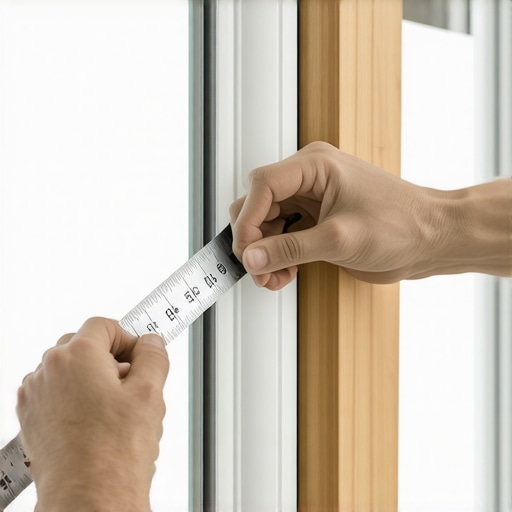
To measure for replacement glass without mistakes, you cannot rely on a soft sewing tape. You need a stiff, wide-blade steel tape measure, a digital caliper for thickness, and a glass thickness gauge if the unit is still installed. We start with the ‘Daylight Opening.’ This is the visible glass you see between the glazing beads. But the glass doesn’t stop at the bead. It extends into the ‘Glass Pocket’ of the sash. Generally, you add 1/4 inch to 1/2 inch to your daylight measurement to account for the glass that is hidden behind the sash frame. This is known as the ‘glass bite.’ If you miscalculate the bite, you will end up with a unit that is either too small to be secured or too large to fit into the frame without hitting the corner welds.
“The fenestration interface must be designed to withstand the environmental loads of the specific climate zone, including wind pressure and thermal cycling.” – ASTM E2112 Standard Practice
Step-by-Step: The Triple-Check Method
Start by identifying the sash type. Is it a fixed lite or an operable double-hung? Remove the glazing bead carefully using a stiff putty knife. The glazing bead is the strip of vinyl, wood, or aluminum that holds the glass in the sash. Once the bead is popped, you can see the actual edge of the IGU. Measure the width in three places: top, middle, and bottom. Record the smallest dimension. Do the same for the height: left, center, and right. Again, record the smallest dimension. In the world of glazing, we usually subtract 1/8 of an inch from these tight dimensions to allow for a ‘shimming’ space. We use setting blocks (usually made of EPDM or silicone) at the bottom to center the glass and ensure it doesn’t touch the frame directly. If the glass touches the frame, the thermal expansion will cause a stress crack.
Understanding the IGU Thickness and Spacer Logic
The overall thickness (OT) of the IGU is the most critical measurement for a successful window repair. If you buy a 7/8 inch unit for a 3/4 inch pocket, the glazing bead will never snap back in. If you buy a 5/8 inch unit for a 3/4 inch pocket, the window will rattle and leak air like a sieve. Use your calipers to measure the total distance from the exterior glass face to the interior glass face. Within that thickness, we also consider the spacer. Modern windows use ‘warm-edge’ spacers made of structural foam or thermoplastic, which break the thermal bridge that older aluminum spacers created. This reduces the chance of condensation at the edge of the glass, where the sash meets the lite.
The Role of the Rough Opening and Frame Stability
While we are focusing on the glass, we must inspect the rough opening of the window frame. If the frame has shifted or the sill has sagged, the glass pocket might no longer be square. I have seen many installers try to force a square piece of glass into a trapezoidal sash. This leads to ‘edge bite’ issues where the glass isn’t supported properly, eventually causing a seal failure. If the sash is severely out of square, it may be time to replace windows entirely rather than just the glass. However, for most glass replacement jobs, as long as the sash is structurally sound, a new IGU with a high-performance Low-E coating and a stainless steel spacer will outperform the original glass by a wide margin.
Why Precision Matters for the Long Term
When you measure correctly, the glass sits perfectly on its setting blocks, the weep holes are clear to drain any incidental moisture, and the glazing bead snaps in with a satisfying click. This precision ensures that the ‘Shingle Principle’ is maintained: water must always be shed to the exterior. A poorly measured unit requires excessive sealant or ‘caulk’ to fill gaps, and caulk is not a permanent waterproofing solution. It is a secondary defense. Your primary defense is the fit. By following these technical steps, you move beyond the guesswork of the average handyman and into the realm of professional fenestration. You aren’t just fixing a window; you are restoring the thermal envelope of the home.