The Invisible Thief: Why Your Sliding Door is Bleeding Energy
That subtle whistle you hear on a Tuesday night in January isn’t the wind singing: it is the sound of your furnace’s hard work escaping through a three-millimeter void in your patio door. As a master glazier with over two decades in the field, I have seen homeowners spend thousands on high-efficiency HVAC systems while ignoring the massive thermal bridge sitting right in their living room. A sliding glass door is essentially a giant hole in your thermal envelope, and if the interlocker or the weatherstripping fails, you aren’t just losing air; you are inviting moisture to destroy your subfloor.
“Air leakage is a major contributor to energy loss and can significantly impact occupant comfort and indoor air quality.” AAMA 101/I.S.2/A440
The Anatomy of a Failure: A Tale from the Field
I recall a specific project where I pulled a vinyl sliding door out of a residence in a damp coastal climate. The homeowner complained of a persistent musty smell. Once I removed the interior casing, the reality was grim: the Rough Opening header was completely black with rot. The previous installer had relied solely on the nailing fin and a bead of cheap latex caulk instead of a proper Sill Pan and high-performance Flashing Tape. The gap in the door seal had allowed wind-driven rain to bypass the primary defense, and because there was no drainage path, the water sat against the wood framing for five years. This is why we don’t just “caulk and walk.” We manage water and air with engineering, not just sticky goop.
Understanding the Physics of the Gap
When we talk about a gap in a sliding door, we are usually looking at a failure in one of three areas: the Sash alignment, the weatherstripping integrity, or the structural squareness of the frame. In a northern climate, the primary enemy is heat loss. Because of the “Stack Effect,” warm air rises and escapes through the top of your house, creating negative pressure that sucks cold air in through every available orifice. If your sliding door has a gap, it becomes a high-velocity intake for 30-degree air.
To fix this, we have to look at the U-Factor. While most people focus on the glass, the seal is where the U-factor effectively drops to zero. A high-performance door uses Low-E coating on Surface #3 to reflect long-wave infrared radiation back into the room. But if the Fin Seal (the fuzzy part with the plastic leaf in the middle) is crushed or missing, the radiant benefits of the glass are negated by the convective cooling of the draft.
Diagnosing the Interlocker Alignment
The interlocker is the vertical member where the fixed panel and the operable panel meet. When the door is closed, these two pieces should hook together, compressing the seals. If your door is even slightly out of level, the interlocker won’t engage fully. You can check this by looking at the reveal. If the gap at the top is wider than the gap at the bottom, your Tandem Rollers need adjustment. Most sliding doors have an adjustment screw at the bottom of the Sash. Turning this clockwise will raise the door, often closing that stubborn gap at the top of the interlocker.
The Glazing Zoom: Weatherstripping Science
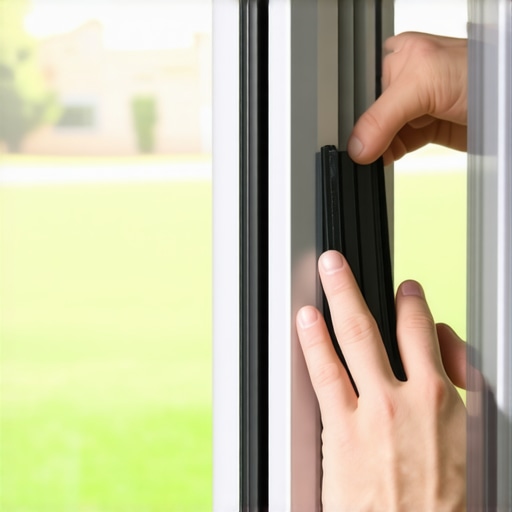
Not all seals are created equal. Most builder-grade doors use a simple pile weatherstripping. Over time, UV radiation and friction degrade these fibers. If you are doing a window repair on a door, you should look for “High-Fin” pile seals. These have a plastic Mylar fin embedded in the center of the brush. This fin acts as a physical barrier to air while the brush provides the necessary friction for the door to slide. When replacing these, you must measure the width of the Glazing Bead or the T-slot channel with a digital caliper. Even a half-millimeter difference will result in a seal that either falls out or prevents the door from sliding smoothly.
“Proper installation of the sill pan is the primary defense against sub-floor rot in fenestration assemblies.” ASTM E2112
The Role of the Window Cleaner in Detection
Interestingly, a professional window cleaner is often the first person to notice seal failure. When they apply a cleaning solution, they might see water tracking toward the interior, which indicates a failure of the Weep Hole system. Every sliding door track is designed to take on some water; the key is that it must exit through the weep holes. If these holes are clogged with debris or if the door is installed without a slight outward pitch, the water will pool and eventually breach the interior seal. If you see daylight at the corners of your door, your Sill Pan is likely the only thing preventing a catastrophe.
When to Repair and When to Replace Windows and Doors
Many homeowners ask if they can simply add more foam tape to a drafty door. As a glazier, I find this offensive. Foam tape is a temporary patch, not a solution. If the frame of your door is bowed—a common issue with cheap vinyl doors that lack steel reinforcement—no amount of weatherstripping will fix the gap. In these cases, you must replace windows and doors with units that have a higher DP (Design Pressure) rating.
For those in mixed climates, I recommend fiberglass frames. Fiberglass has a similar expansion-contraction coefficient to glass, meaning the seals are under less stress as the temperature changes. Unlike vinyl, which can expand up to an inch over a long span in the summer heat, fiberglass remains stable. This stability ensures that the interlocker stays tight and the Rough Opening tolerances remain consistent year-round.
Advanced Sealing Techniques
If the gap is due to minor settlement, you can often use a “Bulb Seal” with an adhesive back as a secondary defense. However, the gold standard is to remove the Operable panel and replace the factory-installed seals. This requires a Shim and a level to ensure the frame hasn’t become a trapezoid over time. If you can see light through the corner, you may need to install a “dust plug”—a small block of closed-cell foam that fills the void where the vertical and horizontal rails meet.
Final Verdict: The Installer is King
You can buy the most expensive door on the market, but if the installer doesn’t understand the shingle principle or the importance of a Thermal Break in aluminum frames, it will fail. A gap in your sliding door seal is a symptom of a larger mechanical or structural issue. Address the rollers, verify the plumb of the frame, and use high-grade Mylar-fin weatherstripping. Don’t settle for a drafty home. Precision is the difference between a hole in the wall and a high-performance glazing system.