A window that refuses to slide is more than a minor annoyance; it is a failure of the mechanical system that protects your home envelope. After twenty-five years as a glazier, I have seen homeowners resort to everything from cooking spray to heavy-duty automotive grease to get their sashes moving. These are fatal mistakes. A window track is a precision-engineered environment designed to manage friction while simultaneously facilitating water drainage through weep holes. When you apply the wrong substance, you are essentially creating a sticky trap for every particulate of dust, pollen, and pet dander that floats through the air. This creates a grinding paste that will eventually destroy the rollers or the vinyl track itself, leading to an expensive window repair or a premature need to replace windows entirely.
“Installation is just as critical as the window performance itself. A high-performance window installed poorly will fail.” – AAMA Installation Masters Guide
A homeowner called me in a panic because their new windows were sweating and the sashes were nearly impossible to lift. I walked in with my hygrometer and showed them the humidity was 60 percent. It was not just the windows; it was their lifestyle choices and a total lack of track maintenance. High humidity in a northern climate like ours causes the interior materials to expand slightly, and when combined with the grime accumulating in the sill pan, the friction becomes insurmountable. The condensation was actually dripping into the tracks, mixing with dust, and forming a sludge that had seized the balance system. This is why understanding the relationship between moisture, cleanliness, and lubrication is vital for any operable unit.
The Physics of Friction and Dirt Attraction
To understand how to lubricate a window properly, we must first look at the coefficient of friction within the rough opening. Most modern windows use either nylon, brass, or stainless steel rollers that sit upon a raised track. In a cold climate, the U-Factor is our primary concern, and we focus on triple-pane units with an argon gas fill. These heavy glass packages put immense pressure on the bottom rail and the rollers. If you use a wet lubricant like WD-40 or a silicone spray that does not dry to a film, you are introducing a liquid that has a high surface tension. This liquid captures atmospheric debris. As the sash moves back and forth, it compresses this debris into the track. This is why your window cleaner often finds a black, gunk-like substance in the corners of the frame. That gunk is actually an abrasive that acts like sandpaper, wearing down the glazing bead and the weatherstripping until the air seal is compromised.
The Proper Cleaning Protocol
Before any lubricant touches the window, the track must be surgically clean. I recommend using a high-quality window cleaner that does not leave a soapy residue. Use a shop vacuum with a crevice tool to remove the large particulates from the sill pan and the weep holes. The weep holes are critical; they are the drainage ports that allow water to exit the frame. If these are clogged with old lubricant and dirt, water will back up into the rough opening, eventually rotting the wooden subfloor or the header below. I once pulled a vinyl window out of a house where the header was completely black with rot because the previous installer relied on the nailing fin instead of proper flashing tape, and the homeowner had inadvertently sealed the weep holes with thick grease. After vacuuming, use a stiff nylon brush to scrub the track with a mixture of water and a drop of vinegar, then dry it completely with a microfiber cloth. Lubricating a dirty track is just polishing the problem.
“Air leakage through windows can account for a significant portion of a building’s heating and cooling load. Maintaining the integrity of the operable seals is paramount.” – NFRC Performance Standards
Selecting the Right Lubricant: The Dry Film Advantage
In our northern environment, we deal with extreme temperature swings. A lubricant that works in July must also work in January when the thermometer hits sub-zero. This is why I advocate exclusively for dry-film lubricants, specifically those containing PTFE (Polytetrafluoroethylene). These sprays go on wet to penetrate the tight tolerances of the sash and rollers but then the solvent evaporates, leaving behind a microscopic, non-stick layer. Because it is dry, dust cannot adhere to it. It remains slippery even when the vinyl frame contracts in the cold, ensuring the U-Factor performance is not hindered by a sash that cannot be fully closed and locked. If the sash is not fully seated, the Low-E coating on Surface 3 cannot do its job of reflecting long-wave infrared radiation back into the room, as the air gap created by the gap allows heat to bypass the glass altogether.
Step-by-Step Lubrication Process
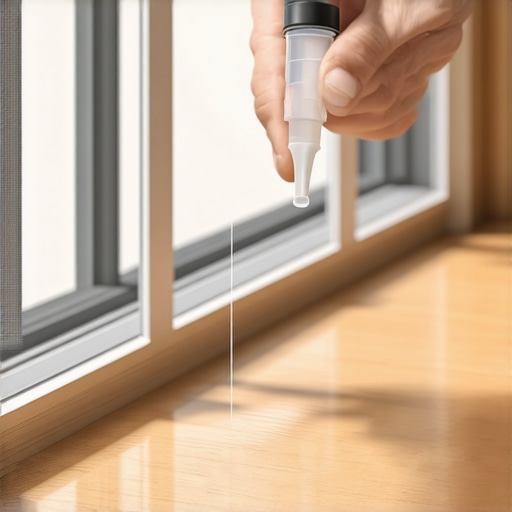
First, open the window to its maximum position. Spray the dry PTFE lubricant onto a clean rag rather than spraying it directly into the track to avoid overspray on the glass. Wipe the rag along the entire length of the vertical and horizontal tracks. Next, apply a small amount to the jamb liners where the sash slides. For double-hung windows, make sure to lubricate the balance covers. Operate the window several times to distribute the film. You should feel an immediate reduction in the force required to move the unit. If you still feel resistance or hear a grinding sound, the issue likely lies with the rollers themselves. This is where a professional window repair technician needs to step in to inspect the shims and the level of the sill. A frame that is bowed because of house settling will never slide correctly, no matter how much lubricant you apply. In some cases, if the frame is severely distorted, the only permanent solution is to replace windows with new units that are correctly squared and plumbed in the rough opening using proper flashing tape and a sloped sill pan.
Maintaining the Seal and Hardware
While the tracks are the primary focus, do not ignore the muntins and the locks. A stiff lock often indicates that the sash is not aligning correctly with the keeper. This misalignment can be caused by dirt buildup in the tracks forcing the sash to sit slightly crooked. By maintaining a clean, lubricated track, you ensure that the locking mechanism can pull the sash tightly against the weatherstripping. This creates the airtight seal required for high energy efficiency. Remember, the goal of any window maintenance is to preserve the factory-rated performance. A clean track facilitates the shingle principle of water management, ensuring that every drop of rain that hits the glass is directed down, into the sill, and out through the weep holes without ever touching the sensitive interior components of your wall assembly.
{“@context”:”https://schema.org”,”@type”:”HowTo”,”name”:”How to Lubricate Stiff Window Tracks”,”step”:[{“@type”:”HowToStep”,”text”:”Vacuum the window tracks and sill pan thoroughly using a crevice tool to remove all loose debris and dust.”},{“@type”:”HowToStep”,”text”:”Clean the tracks with a non-residue window cleaner or a mild vinegar solution and a nylon brush to remove stuck-on grime.”},{“@type”:”HowToStep”,”text”:”Dry the track completely with a microfiber cloth to ensure no moisture is trapped in the assembly.”},{“@type”:”HowToStep”,”text”:”Apply a dry PTFE-based lubricant to a cloth and wipe it onto the sliding tracks and jamb liners.”},{“@type”:”HowToStep”,”text”:”Operate the window sash multiple times to distribute the dry lubricant film evenly across all moving parts.”}]}