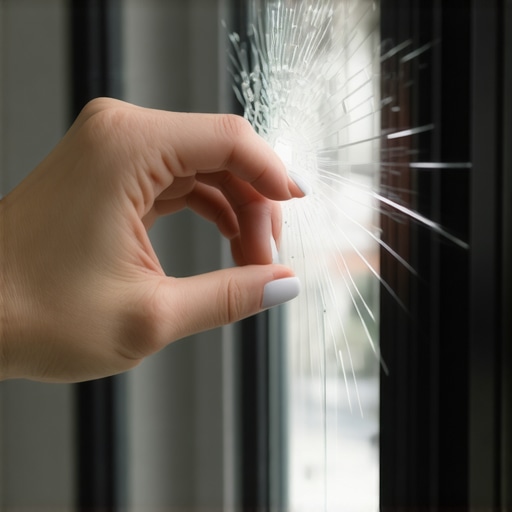
The Reality of a Fractured Pane
As a master glazier who has spent nearly three decades dangling from swing stages and meticulously shimming sashes in historic brownstones, I can tell you that a crack in your glass is never just a crack. It is a breach in your building envelope. Whether it is a hairline fracture caused by thermal stress or a radiating starburst from a neighborhood baseball, that crack is a direct line for moisture and air to bypass your insulation. Most homeowners see a small line and ignore it until the first cold snap hits. Then, they realize that their U-factor has plummeted and their comfort is compromised. While clear nail polish is often dismissed as a DIY myth, in the professional world, we recognize it as a legitimate, albeit temporary, stabilization method for non-structural glass damage.
The Condensation Crisis: A Master Glazier’s Warning
I remember a call I took in mid-November in a drafty suburb. A homeowner complained that her new double-pane windows were sweating on the inside. I walked in with my hygrometer and found the indoor humidity was nearly 65 percent, but more importantly, I found a microscopic crack in the corner of the operable sash. The previous window cleaner had hit the corner with a metal squeegee handle and didn’t mention it. That tiny fracture allowed the argon gas to escape and moisture-laden air to infiltrate the IGU (Insulated Glass Unit). Within weeks, the desiccant inside the spacer bar was saturated, and the window was permanently fogged. This wasn’t a manufacturing defect; it was a maintenance failure. If she had applied a sealant immediately, she might have saved that four hundred dollar IGU for another season. It is a stark reminder that in the world of fenestration, tiny details dictate long-term performance.
“Installation and maintenance are just as critical as the window performance itself. A high-performance window that suffers even minor physical damage will fail to meet its NFRC ratings.” – AAMA Installation Masters Guide
The Science of the Stop-Gap: Why Nail Polish Works
Clear nail polish is essentially a liquid acrylic or nitrocellulose resin. When applied to a clean glass surface, it flows into the microscopic valleys of the crack through capillary action. As the solvents evaporate, the resin hardens, creating a semi-flexible bond that helps prevent the crack from spreading due to vibration or minor temperature fluctuations. It also acts as a weather-seal, preventing rainwater from being pulled into the crack via surface tension. However, this is not a permanent window repair. You are essentially cauterizing a wound, not performing surgery. For those in colder climates, where the temperature differential between the interior and exterior surfaces creates immense tension on the glass, this fix is a race against the clock. The U-factor, which measures the rate of heat loss, is significantly affected if the crack extends through the entire thickness of the lite. If you are dealing with a double-pane unit, and the crack is on the interior surface (Surface #4), you are losing heat directly into the atmosphere.
Step-by-Step: The Professional Way to Seal a Crack
Before you even touch the bottle of polish, you must prepare the substrate. Use a high-quality, alcohol-based window cleaner to remove all oils and dust from the fracture site. Any residue left behind will prevent the resin from bonding to the silica. Once dry, follow this protocol: First, use a toothpick to gently work the polish into the crack. Do not just slap it on the surface; you want it to penetrate. Second, apply the polish in thin layers, allowing at least ten minutes of flash-off time between coats. Third, if the crack is long, apply a small bead at both ends of the fracture to act as a ‘stress-stop.’ This mimics the way we drill holes at the ends of cracks in metal to prevent propagation. Finally, once the polish is fully cured, you can use a fresh razor blade held at a 45-degree angle to carefully shave off the excess, leaving a flush, nearly invisible seal. This keeps the glazing bead clean and ensures the sash can still operate within the rough opening without snagging.
“Standard practice for the repair of exterior windows requires that any sealant used must be compatible with the existing glazing materials to prevent chemical degradation of the IG seals.” – ASTM E2112 Standard Practice
When to Stop Repairing and Start Replacing
There is a point where the clear nail polish trick becomes a liability. If the crack is longer than three inches, or if it is a ‘level A’ impact crack that has shattered the structural integrity of the pane, you need to replace windows, or at the very least, the glass. In my years of service, I have seen people try to save a muntin-heavy wood sash with glue and tape, only to have the glass fall out during a windstorm. If you see signs of ‘creeping’ where the crack grows despite the polish, or if you notice fogging between the panes, the seal is gone. At that point, your argon or krypton fill has been replaced by humid air. No amount of polish will restore the thermal efficiency of that unit. You are better off measuring the rough opening and ordering a new IGU. In a cold climate, the ROI on a high-performance replacement window with a low U-factor is realized through the elimination of drafts and the stabilization of the interior dew point, preventing the rot that eventually eats away at your framing and sill pan.
Technical Considerations: Thermal Stress and SHGC
In regions with high Solar Heat Gain (SHGC), a cracked window is particularly dangerous. If you have a Low-E coating on Surface #2, a crack can cause localized overheating as the coating is interrupted. This creates a thermal gradient that can cause the glass to shatter completely. When you fix a cracked pane with nail polish, you are not restoring the SHGC or the UV protection of the window. You are simply buying time. Always inspect your weep holes during this process. If water cannot escape the bottom of the frame because of debris, it will sit against your repair and eventually find its way into the building paper or flashing tape, leading to the kind of structural rot that requires a full-frame tear-out rather than a simple glass swap. Remember, as a glazier, I don’t just look at the glass; I look at the whole system. A window is a complex machine designed to manage energy. Treat it with the technical respect it deserves.