The Invisible Barrier: Why Screen Maintenance Is a Glazier’s Priority
In my 25 years of standing in rough openings and setting heavy glass, I have seen homeowners spend thousands on high-performance windows only to let them suffocate under a layer of gray filth. Most people view a window screen as a simple bug barrier, but to a master glazier, it is the first stage of your home’s air filtration and thermal management system. When that mesh becomes clogged, it does more than just look unsightly; it alters the Solar Heat Gain Coefficient (SHGC) and can even contribute to premature window repair needs by trapping moisture against the sash.
The Condensation Crisis: A Narrative of Neglect
A homeowner called me in a panic because their new windows were ‘sweating.’ I walked in with my hygrometer and showed them the humidity was 60%. It wasn’t the windows; it was their lifestyle. They were terrified of the dust on their screens and kept the windows locked tight for months. I had to explain that the particulate buildup on their fiberglass mesh was so dense it was effectively acting as an insulator, trapping humid air against the cold glass surface. This lack of airflow is a primary driver of window cleaner frustration and internal gasket failure. If you don’t manage the dust at the screen level, you are inviting a host of mechanical issues into the frame itself.
“Installation is just as critical as the window performance itself. A high-performance window installed poorly will fail.” AAMA Installation Masters Guide
This industry standard applies to maintenance as well. A high-performance window that is never cleaned is a window that cannot perform its thermodynamic duties.
The Physics of the Lint Roller: Why Water Is Often Your Enemy
Most ‘caulk-and-walk’ installers will tell you to just hose off a screen. That is amateur advice that often leads to more window repair. When you apply pressurized water to a dusty screen while it is still in the sash, you create a slurry of mud that flows directly into the weep holes. These tiny drainage ports are engineered to allow water to exit the frame’s sill pan. Once they are clogged with screen-sludge, the water backs up, rots the shim, and eventually destroys the structural integrity of the rough opening.
This is where the common lint roller becomes a precision tool. The adhesive on a standard lint roller is specifically formulated to pick up organic fibers and silica dust without requiring the mechanical pressure that might bow the mesh or pop the glazing bead. By using a dry adhesive method, you remove the contaminant from the environment entirely rather than just relocating it into the internal channels of the window frame.
Step-by-Step Technical Cleaning Protocol
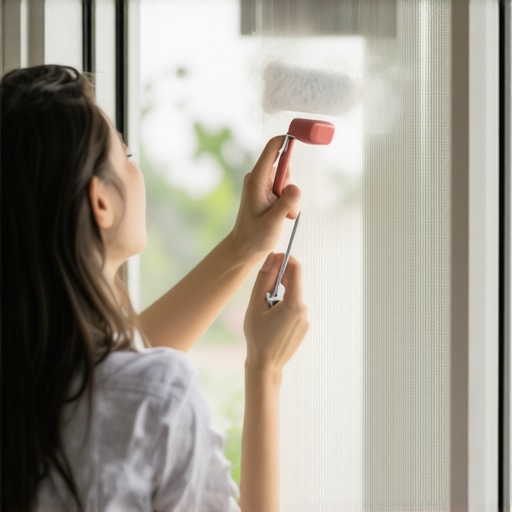
To execute this correctly, you must treat the screen with the same respect as the operable hardware. First, ensure the window is fully closed to provide a stable backing, or better yet, remove the screen and lay it on a clean, flat surface. [image_placeholder_1] Starting at the top corner, roll in a vertical motion. Do not press hard. You are relying on the chemical tack of the adhesive, not physical force. As the sheet becomes saturated with gray matter, peel it back immediately. If you continue with a dirty sheet, you risk ‘ghosting’ the dust back onto the fiberglass fibers.
The Thermal Logic: North vs. South Climate Context
In northern climates like Chicago or Minneapolis, where I have spent many winters, the U-Factor is the most critical number on your NFRC label. A clean screen allows the sun to hit the glass and provide beneficial passive solar heating. Conversely, in the South, a clean screen ensures that your Low-E coating on Surface #2 can properly reflect radiant heat without being obstructed by a layer of insulating dust. If you live in a coastal area, that ‘dust’ is often salt-laden, which can cause galvanic corrosion on aluminum muntins if not removed regularly.
“The performance of the fenestration system is dependent upon the integration of the window into the building envelope and its subsequent maintenance.” ASTM E2112 Standard Practice
When to Stop Cleaning and Start Replacing
While the lint roller is a fantastic maintenance tool, it cannot fix a structural failure. If you notice the mesh is brittle or the spline (the rubber cord holding the mesh in) is cracking, you are looking at a window repair task that goes beyond cleaning. Furthermore, if you see fogging between the panes of glass, your IGU (Insulated Glass Unit) has failed. At that point, no amount of window cleaner will help; it is time to replace windows to restore your home’s thermal envelope. When choosing replacements, look for fiberglass frames which expand and contract at nearly the same rate as the glass itself, ensuring that your screens and sashes remain perfectly aligned for decades.
The Glazier’s Final Word
Don’t be the homeowner who ignores the small components. A window is a machine designed to manage the boundary between your controlled indoor environment and the chaos of the outdoors. By using a lint roller to maintain your screens, you are protecting the weep holes, preserving the SHGC, and ensuring that your rough opening remains dry and rot-free. It is a five-minute task that can add years to the life of your glazing system. If the dust has already led to frame rot or seal failure, do not settle for a quick fix. Invest in quality materials and professional installation that respects the science of fenestration.