The Engineering of Fenestration Alignment: Why Your Sash is Dragging
When a casement or awning window fails to seat properly within its frame, the average homeowner reaches for a can of lubricant or calls a window cleaner to scrub the tracks. As a glazier with over two decades in the field, I can tell you that the issue is rarely about cleanliness and almost always about the physics of the hinge. A window sash is a heavy assembly of glass, spacers, and desiccant, often weighing upwards of fifty pounds. This weight is supported by a friction stay or a rotary hinge that must maintain a tolerance of less than 1/16th of an inch to ensure a proper thermal seal. If that hinge is out of alignment, you are no longer managing a hole in your wall; you are allowing the elements to dictate your indoor climate.
“Installation is just as critical as the window performance itself. A high-performance window installed poorly will fail.” – AAMA Installation Masters Guide
A homeowner once called me in a panic because their new high-performance windows were ‘sweating’ along the bottom edge during a brutal January cold snap. They were convinced the vacuum seal had failed. I walked in with my hygrometer and a digital caliper. After measuring the interior humidity at 58 percent, I looked at the sash alignment. The upper hinge had slipped by a mere 3 millimeters. This tiny gap was allowing the Dew Point to migrate into the interior surface of the frame, causing immediate condensation. It wasn’t a manufacturing defect; it was a gravity-induced alignment crisis. We didn’t need to replace windows; we needed a technical window repair focused on the eccentric cam of the hinge.
The Physics of the Friction Stay and Sash Sag
In the North, where we battle extreme U-Factor variances, the integrity of the compression seal is everything. When you operate a casement window, the hinge must move the sash in a complex arc. If the Rough Opening was not perfectly plumb, or if the installers failed to use the correct Shim at the pivot point, the sash will eventually sag. This sag places immense torque on the screws, often stripping the threads in vinyl frames that lack internal metal reinforcement. To adjust these, you must understand the ‘moment arm.’ The further the glass extends from the pivot, the more leverage it exerts on the hardware. We use 304-grade stainless steel hinges for a reason: they resist the deformation that leads to misalignment, but even the best steel cannot overcome a frame that is out of square.
Step-by-Step Technical Adjustment of Window Hinges
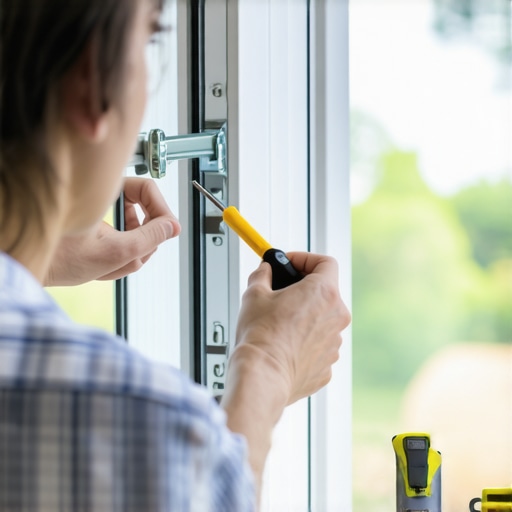
To begin a professional-grade adjustment, you must first identify the type of hinge. Most modern casements use a friction stay with an adjustable brass bush or an eccentric cam screw. Step 1: Inspect the Reveal. Close the window and inspect the gap between the sash and the frame from the outside. If the gap is wider at the top than the bottom, the sash has sagged. Step 2: Clean the Track. Before adjusting, ensure no debris is obstructing the Glazing Bead or the track itself. A window cleaner can remove surface dirt, but you may need a vacuum to clear the Weep Hole. Step 3: Locate the Adjustment Screw. On the hinge arm, look for a small screw that sits in an oblong slot. This is the cam. Step 4: Execute the Correction. Using a 4mm hex key, turn the cam. This shifts the sash horizontally. Turning clockwise typically pulls the top of the sash back toward the hinge side, correcting the sag. Step 5: Verify Compression. Place a piece of paper between the sash and the frame, then close and lock the window. If you can pull the paper out easily, the hinge is still not providing enough pull-in torque.
“Proper installation and maintenance of fenestration products are essential to ensure the continued performance of the building envelope.” – ASTM E2112 Standard Practice
The Impact of Misalignment on Thermal Performance
Why do we obsess over a few millimeters? In a cold climate like Chicago or Minneapolis, air infiltration is the primary enemy. A misaligned hinge creates a ‘chimney effect’ where warm air escapes through the top gap and cold air is sucked in through the bottom. This bypasses the Low-E coating on Surface #3 of your glass, rendering your expensive triple-pane investment useless. The Argon gas fill between your panes prevents conductive heat loss, but it does nothing to stop convective loops caused by a failing sash seal. When we perform a window repair, we aren’t just fixing a squeak; we are restoring the R-value of the entire wall assembly. If the frame itself has warped due to structural settling of the house, hinge adjustment may be a temporary fix, and you may eventually need to replace windows to restore the building envelope’s integrity.
Materials Science: Vinyl, Fiberglass, and Wood Hardware Stress
Different frame materials react differently to hinge stress. Vinyl has a high Coefficient of Thermal Expansion. On a hot summer day, the vinyl frame expands, and if the hinge is tight, it can cause the Sash to bind. Fiberglass, conversely, is incredibly stable but unforgiving. If a fiberglass window is out of alignment, the hardware takes 100 percent of the stress because the frame won’t flex. Wood windows require a different approach; often, the hinge has become loose because the wood fibers have compressed or rotted. In these cases, we must use a longer screw to reach the structural framing beyond the window jamb, essentially anchoring the hinge into the house itself rather than just the window frame. This is why understanding the Rough Opening tolerances is vital for any long-term fix.