The Science of Friction: Why Your Patio Door Sticks and How to Correct It
In my twenty-five years of handling fenestration systems, I have learned that a sliding patio door is essentially a heavy-duty machine that homeowners treat like a simple piece of furniture. When that door starts sticking on the bottom rail, it is not merely an inconvenience; it is a mechanical failure involving weight distribution, thermal dynamics, and structural tolerances. Most people reach for a can of grease and hope for the best, but as a professional, I know that ‘caulk-and-walk’ solutions lead to long-term structural rot and hardware degradation.
A homeowner recently called me in a panic because their new high-performance sliding doors were sweating and the bottom rail felt like it was glued to the track. I walked in with my hygrometer and showed them that the indoor relative humidity was hovering at 60 percent while the exterior temperature was a crisp twenty degrees. It was not a failure of the window repair or the glass itself; it was their lifestyle choices regarding moisture management. That excess humidity was condensing on the cold track, mixing with household dust to create a microscopic paste that was grinding the rollers into the dirt. This illustrates that a sticking door is often a symptom of a much larger environmental issue within the rough opening.
“Installation is just as critical as the window performance itself. A high-performance window installed poorly will fail.” – AAMA Installation Masters Guide
The Anatomy of the Bottom Rail and Roller Assembly
To understand the fix, you must understand the load. A standard six-foot sliding glass door utilizes an Insulated Glass Unit (IGU) that can weigh upwards of 120 pounds. This entire weight is concentrated on two small tandem roller assemblies tucked inside the bottom rail of the operable sash. These rollers are typically made of nylon, steel, or stainless steel, and they ride on a thin metal rib called the track cap. When you feel resistance, you are likely feeling one of three things: mechanical failure of the roller bearings, debris accumulation in the track, or a structural sag of the header pressing down on the sash.
The rough opening must be perfectly level and plumb. If the house has settled, the header may be bowing, which puts vertical pressure on the top of the sash, forcing the bottom rail to dig into the track. This is why I always check the shim spacing at the head of the door before I even touch the rollers. If the shim is too tight, the door will never slide correctly, regardless of how much window cleaner or lubricant you apply. We often see this in older homes where the original installer failed to leave adequate room for structural deflection.
The Climate Factor: Moisture and Thermal Expansion
In mixed climates where we experience high humidity and extreme temperature swings, materials expand and contract at different rates. A vinyl door frame has a much higher coefficient of thermal expansion than the glass it holds. On a hot July afternoon, that vinyl can expand enough to cause the glazing bead to press tightly against the frame, or the bottom rail to bow slightly. Conversely, in the winter, the cold can cause the metal track to contract, potentially loosening the track cap. If you live in an area with high moisture, the weep hole system in your bottom track is your best friend. If these holes are clogged with debris, water will back up into the track, corroding the steel rollers and causing them to seize. This is why regular maintenance from a window cleaner who knows to clear the drainage paths is vital.
“Proper installation of the fenestration product is essential to the long term performance of the product and the building.” – ASTM E2112 Standard Practice
Step-by-Step Mechanical Restoration
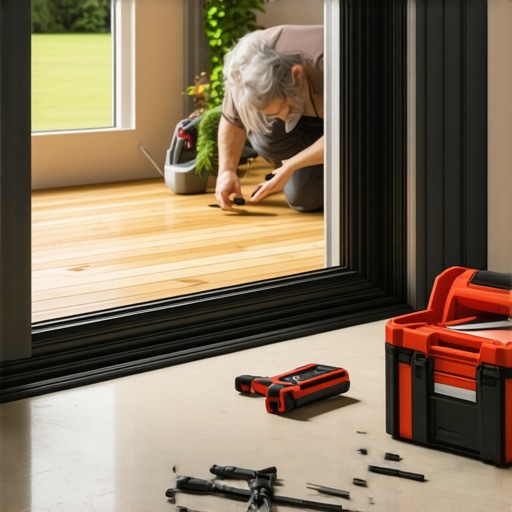
Before you decide to replace windows entirely, we must attempt a mechanical restoration. Start by vacuuming the track using a high-suction shop vac with a crevice tool. Do not use an oily window cleaner here; you want a dry, clean surface. Next, locate the adjustment screws on the bottom rail. These are usually hidden by small plastic plugs. By turning these screws clockwise, you are actually pushing the roller assembly down, which raises the door sash off the track. [IMAGE_PLACEHOLDER] This should eliminate the friction. If the door remains difficult to move, the rollers are likely flat-spotted or the bearings have collapsed. In this case, the operable sash must be removed from the frame. This involves unscrewing the head stop, tilting the door inward, and lifting it out. It is a two-person job, as the weight of the IGU can easily crack the frame if dropped.
Once the sash is out, inspect the rollers. If they are caked with black grime, they are failing. Replace them with stainless steel tandem rollers for better longevity. While the sash is out, inspect the sill pan. A properly installed door should have a sill pan with a rear leg to prevent water from migrating into the subfloor. If you see signs of rot on the sub-sill, the flashing tape was likely applied incorrectly during the initial installation. This is the moment where window repair becomes a structural intervention.
When to Repair vs. When to Replace Windows
I often tell clients that a sticking door is a crossroads. If the frame is wood and shows signs of significant rot at the corners, or if the IGU has a failed seal (manifesting as permanent fogging between the panes), it is time to replace windows. Investing five hundred dollars into a repair for a door that has lost its argon gas fill and has a decaying frame is a poor return on investment. Modern fiberglass doors offer much better thermal stability than old vinyl or wood-clad units. They do not expand and contract at the same rate as the glass, which means the rollers stay aligned for decades rather than years. However, if the frame is sound, a simple roller replacement and track cleaning can extend the life of your door by another decade. Always look for NFRC labels when considering a replacement to ensure the U-factor and Solar Heat Gain Coefficient match your specific climate needs.
In conclusion, a patio door that sticks on the bottom rail is a physics problem waiting for a technical solution. Stop fighting the door and start analyzing the track, the rollers, and the structural opening. By maintaining the weep holes and ensuring the rollers are adjusted to the correct height, you preserve the integrity of your home’s thermal envelope and avoid the high cost of premature replacement.