The Reality of Commercial Fenestration Maintenance
In my twenty-five years as a master glazier, I have seen every imaginable failure in glass maintenance. A facility manager once called me in a panic because their high-rise units were ‘sweating’ and appearing cloudy in the early morning hours. I walked in with my hygrometer and showed them the interior humidity was over 55 percent while the exterior temperature was dropping through the dew point. It was not a product failure; it was a fundamental misunderstanding of how the building envelope interacts with the environment. This same lack of technical understanding leads to the swirl marks and streaks that plague professional office environments. When a window cleaner approaches a large pane of commercial glass, they are not just washing a surface; they are managing the chemical and physical properties of a complex glazing system. If you see persistent marks that look like circular scratches or oily rainbows, you might not need a better soap; you might be looking at Stage II corrosion that necessitates window repair or, in extreme cases, the decision to replace windows entirely.
“Installation is just as critical as the window performance itself. A high-performance window installed poorly will fail.” AAMA Installation Masters Guide
The Physics of the Swirl: Why Traditional Cleaning Fails
Swirl marks in an office setting are typically caused by three factors: particulate abrasion, surfactant residue, and improper squeegee technique. In a commercial environment, the glass surface, often referred to as Surface #1 (the exterior face), is subjected to atmospheric pollutants and alkaline runoff from the building facade. When a window cleaner uses a dirty applicator, they are essentially grinding these microscopic minerals into the glass. This creates micro-scratches that catch the light. Furthermore, many commercial cleaners use high-alkaline detergents that leave a molecular film. When this film is not properly sheared off by a professional-grade squeegee, it dries into the dreaded swirl pattern. In regions with high Solar Heat Gain (SHGC) concerns, such as the South or Southwest, the sun bakes these residues into the glass. On a high-performance unit where the Low-E coating is on Surface #2, the heat is reflected back through the outer lite, accelerating the drying time of cleaning solutions and making it nearly impossible to avoid streaks without specialized techniques.
The Glazing Anatomy: Beyond the Glass Surface
To understand proper maintenance, one must understand the anatomy of the window. The glass is held in place by the glazing bead, a strip of plastic or metal that snaps into the sash to secure the glass. If your cleaning process involves excessive water, that liquid can bypass the glazing bead and sit in the bottom of the frame. This is where the weep hole becomes critical. The weep hole is a small exit point designed to allow water to escape the frame. If these are clogged by dirt or debris during the cleaning process, the water sits against the Insulated Glass Unit (IGU) seal. Over time, this moisture causes seal failure, leading to permanent fogging. If the seal fails, no amount of cleaning will fix the haze, and you will need to perform a window repair to replace the glass unit. During a full-frame installation, we always ensure the rough opening is properly flashed with flashing tape and a sill pan is installed to direct any moisture outward. A professional window cleaner must be aware of these drainage paths to avoid compromising the long-term integrity of the sash.
“The thermal performance of a glazing system is dependent upon the maintenance of the seal integrity and the cleanliness of the primary surfaces.” NFRC Fenestration Standards
Advanced Cleaning Protocols for Professional Results
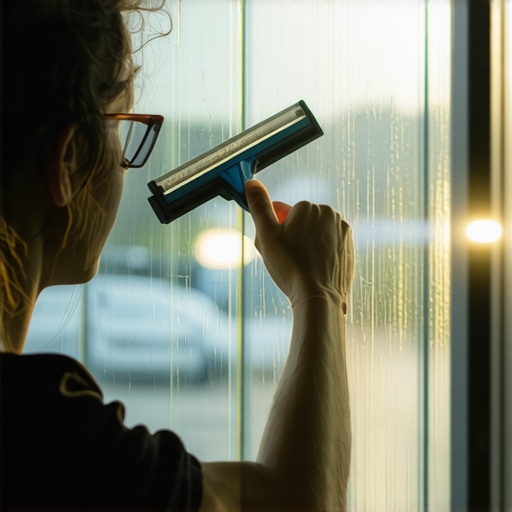
To achieve a swirl-free finish on large office panes, you must manage the Total Dissolved Solids (TDS) in your water. Professional glass maintenance often utilizes deionized water systems that strip minerals from the liquid, preventing spotting. The technique is equally important. The ‘S-stroke’ or ‘fan’ method involves a continuous motion where the squeegee blade never leaves the glass, preventing the start-and-stop lines that create swirls. This requires a blade that is perfectly straight and free of nicks. If the blade is compromised, it will skip across the glass, leaving a rhythmic pattern of marks. For office buildings in northern climates where heat loss is the primary enemy, the U-Factor of the window is maintained by ensuring the glass is clean enough to allow visible light transmittance without absorbing unnecessary radiant heat. If you are dealing with older wood windows, you must be careful not to saturate the muntin (the grid-like dividers) as this can lead to rot and the eventual need to replace windows to maintain structural safety.
When Cleaning Reveals the Need for Window Repair
Sometimes, what looks like a cleaning issue is actually a mechanical failure. If you notice a draft while cleaning near the edges of the frame, the shim may have shifted or the weatherstripping has compressed beyond its effective range. If the window is operable, check the balance and the hardware. A window that does not close tightly will allow dust and pollutants to settle on the interior glass surfaces more rapidly, creating a never-ending cycle of cleaning. In coastal areas, salt spray can etch the glass surface permanently. This etching looks like a persistent film that no window cleaner can remove. At this stage, you are no longer looking at a maintenance task but a restoration or replacement project. Proper maintenance prolongs the life of the unit, but understanding the limits of the material is what separates a technician from a hobbyist. By focusing on the chemical balance of your solutions and the physical mechanics of the glazing system, you can maintain the clarity and performance of your office glass for decades.