The Gravity of the Situation: Why Your Sashes are Slumping
In twenty-five years of glazing, I have seen it all, but nothing irritates me more than a homeowner being told they need to replace windows entirely when the only thing failing is a ten-dollar constant force balance. I remember sitting across from a family in a drafty Victorian who had just been quoted thirty thousand dollars for a full-frame tear-out. The salesman told them their ‘frames had warped’ because the windows wouldn’t stay up. I walked over, popped the sash, and showed them a snapped string in a block-and-tackle system. It was a twenty-minute window repair, not a second mortgage. That is the reality of the window industry: if you do not understand the mechanical guts of your glazing, you are at the mercy of people who only know how to read a commission chart.
A window is a machine. Specifically, a double-hung window is a counterweighted machine designed to defy gravity. When that machine fails, you lose more than just the ability to let in a breeze; you lose the thermal seal that keeps your furnace from running twenty-four hours a day. If your window sash feels like a workout to lift, or if it slowly creeps down after you open it, your balance system is likely shot. But before you call a window cleaner or a contractor, you need to perform the pencil test to diagnose exactly where the mechanical failure lies.
“Installation and maintenance of the hardware components are just as critical as the glass itself. A failure in the balance system often leads to air leakage and structural strain on the sash.” – AAMA Installation Masters Guide
The Physics of the Balance: Constant Force vs. Spiral
To understand the pencil test, you have to understand what is happening inside the jamb liner. Most modern windows use one of three systems: the block and tackle, the constant force balance, or the spiral balance. In a cold climate like the Midwest or Northeast, these components are under constant stress. Metal contracts in the winter, and the lubricants in spiral balances can thicken, leading to a gritty, difficult operation. When these springs lose their tension, the sash does not sit squarely in the frame. This creates a gap at the header or the sill, allowing your expensive heated air to escape via the stack effect.
A constant force balance uses a stainless steel coil spring that unrolls as you lower the sash. It provides a consistent lift regardless of the position. A spiral balance, on the other hand, uses a rod that looks like a drill bit encased in a tube; turning the rod increases the tension. If these are not calibrated correctly, the window will either ‘jump’ or ‘drift.’ This is where the pencil test becomes your most valuable diagnostic tool. By using a simple graphite pencil, you can determine if the spring is providing adequate lift or if the sash has become disconnected from the pivot bar.
How to Perform the Pencil Test
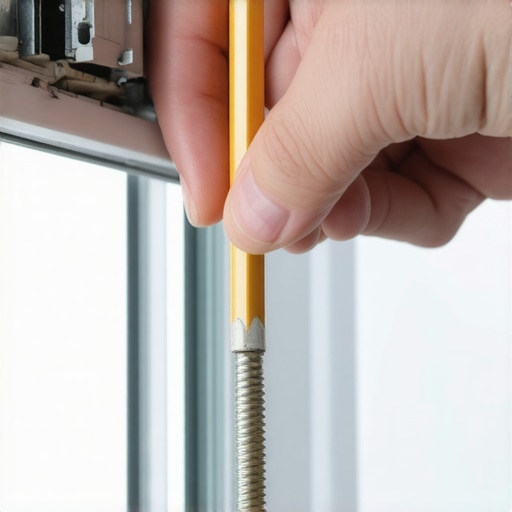
Open your window halfway. Take a standard pencil and place it horizontally across the tracks of the jamb liner, just below the bottom of the sash. Gently let go of the window. If the sash rests its full weight on the pencil and snaps it, or forces it downward, your springs have zero tension left. If the sash hovers or barely touches the pencil, the balance is still functional, but you might have an issue with friction or a dirty track. Many people mistake a dirty jamb for a broken spring. A professional window cleaner often fixes ‘broken’ windows simply by removing the debris and oxidized aluminum dust that creates friction in the tracks.
However, if the pencil snaps, you are looking at a mechanical failure. In northern climates, where U-factor is king, a failing balance is a thermal disaster. When a sash does not stay up, it also does not lock correctly. The cam-action lock on a double-hung window is designed to pull the meeting rails together. If the bottom sash is sagging even an eighth of an inch, the lock will not engage properly, and the air seal is compromised. You might as well leave a brick out of your wall. This is why window repair is not just about convenience; it is about maintaining the integrity of the building envelope.
“The air leakage rating of a window is contingent upon the sash being fully seated within the frame. Mechanical failure of the lifting mechanism is a primary cause of field-performance degradation.” – NFRC Performance Standards
Climate Logic: Why Springs Fail in the Cold
In colder regions, we prioritize the U-factor, which measures the rate of heat loss. But the best Low-E coating on surface number three will not do a bit of good if the weatherstripping is not compressed. When your springs go, the sash slumps, and the bulb seal at the bottom of the window relaxes. This creates a direct path for cold air to enter. Furthermore, in high-humidity indoor environments, this cold air hits the warm glass and creates condensation. If you see ice forming on the inside of your sash, do not immediately assume the glass is bad. Check the balance. If the sash is not being pushed firmly into the header or sill, the cold air is bypassing the glass entirely.
Repairing these systems involves more than just swapping a spring. You have to inspect the rough opening for signs of settling. Sometimes, a house settles and bows the jambs inward, pinching the balance system and causing it to fail prematurely. If you find yourself having to replace windows, look for fiberglass frames. Unlike vinyl, which expands and contracts significantly with temperature swings, fiberglass is made of glass fibers and resin, meaning it moves at the same rate as the glass pane itself. This stability puts far less strain on the balance system over the decades.
The Glazier’s Verdict: Repair or Replace?
If the pencil test shows your springs are shot, do not panic. Most balances can be replaced for under fifty dollars in parts. You will need to remove the sash, unscrew the balance from the jamb, and match the weight stamp on the side of the metal housing. It is a precise job, requiring you to shim the new hardware into place so that the sash moves smoothly without binding. However, if your frames are rot-damaged or the seals between the glass panes have failed (look for fogging), then it is time to talk about replacement. Just make sure you are buying the right glass for your zone. If you are in the North, you want a high Solar Heat Gain Coefficient (SHGC) to let the sun help heat your home in the winter. If you are in the South, you want a low SHGC to block that radiant energy.
Comments are closed.