The Invisible Boundary: Why Your Window Cleaner Fears Your Tinted Film
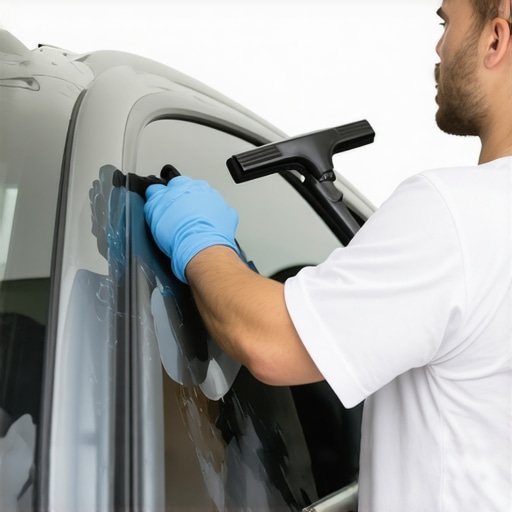
I remember standing in a kitchen in a high-end suburban home where the owner had just invested several thousand dollars in after-market window film to combat the punishing summer sun. They called me because their regular window cleaner had walked off the job, refusing to touch the glass with a standard brass squeegee. The homeowner was livid, accusing the cleaner of being unprofessional. I had to step in and explain that the window cleaner was actually the only person in the room protecting the homeowner’s investment. I sat across from this homeowner and explained that a high-pressure sales pitch for ‘energy-saving film’ often neglects to mention the maintenance nightmare it creates. This wasn’t a case of a lazy service provider; it was a professional recognizing that the surface of that glass had been fundamentally altered from a hard, inorganic material to a soft, organic polyester layer that would be destroyed by standard glazing tools.
The Physics of the Squeegee vs. Polyester Film
To understand why a professional window cleaner avoids the squeegee on tinted film, we have to look at the material science of the glass surface. Standard float glass has a Mohs hardness of about 5.5 to 7. It is incredibly resilient to the mechanical action of a rubber blade and the mild surfactants used in the trade. However, when you apply an aftermarket tint, you are essentially laminating a sheet of polyester to the interior surface. This film is soft. Even ‘scratch-resistant’ coatings on these films are no match for the hydraulic pressure and potential particulate entrapment that occurs during a professional squeegee stroke. When a window cleaner pulls a squeegee across a pane, they are not just moving water; they are managing a microscopic boundary layer. If a single grain of silica or wind-blown dust gets trapped between the rubber blade and the film, it acts like a diamond-tipped stylus, carving a permanent furrow into the tint. This is why a glazier knows that window repair is often the only solution once a film is compromised by improper cleaning techniques.
“Installation is just as critical as the window performance itself. A high-performance window installed poorly will fail.” AAMA Installation Masters Guide
The Thermal Stress Trap: Why Windows Crack After Tinting
In hot climates, the Solar Heat Gain Coefficient (SHGC) is the most critical metric on the NFRC label. When you decide to replace windows, you are usually looking for a low SHGC to keep the radiant heat of the sun out of your living space. Aftermarket film attempts to do this by absorbing or reflecting solar energy. Here is the danger that most ‘tin man’ salesmen won’t tell you: thermal stress. When a film is applied to the interior Surface #4 of a dual-pane Insulated Glass Unit (IGU), it causes the glass to absorb significantly more heat than it was designed for. This heat causes the glass to expand. If the Rough Opening was not prepared with the proper expansion gaps, or if the glass has microscopic edge chips from a poor factory cut, the thermal expansion will lead to a stress crack. I have seen countless homeowners try to avoid the cost to replace windows by using film, only to end up needing a full window repair because the center-of-glass temperature reached 150 degrees Fahrenheit, causing the pane to fracture from the center outward.
The Glass Class: Decoding the NFRC Label for Hot Climates
If you are looking at window repair or considering whether to replace windows, you must understand the numbers. In a southern climate, the enemy is the sun’s short-wave infrared radiation. A professional installation should focus on glass with a Low-E coating on Surface #2. This is the inner face of the outermost pane. By placing the coating here, the heat is reflected back outside before it can even cross the air space of the IGU. This is far superior to any stick-on film. When we talk about Visible Transmittance (VT), we are measuring how much natural light actually gets through. High-quality windows manage a low SHGC while maintaining a high VT, whereas cheap window films often make your home feel like a cavern, forcing you to turn on interior lights and negating the energy savings you hoped to achieve. We also have to consider the U-Factor, which measures the rate of non-solar heat loss. While U-Factor is the king in Minneapolis, in the South, it is the SHGC that dictates your monthly utility bill.
“The fenestration interface must be designed to withstand the environmental conditions of the specific climate zone.” ASTM E2112 Standard Practice
The Anatomy of a Proper Installation
Whether you are dealing with a simple sash replacement or a full-frame tear-out, the mechanics of the installation are what prevent long-term rot. I have seen windows that were top-of-the-line performers fail within two years because the installer relied on a bead of caulk instead of a proper Sill Pan. A window is essentially a hole in your building’s thermal envelope. To manage water, we follow the shingle principle: every layer must overlap the one below it. This starts with the flashing tape at the Rough Opening, integrated into the weather-resistive barrier. We use a Shim to level the frame, ensuring that the Operable parts of the window—the Sash—move freely without binding. If the frame is twisted during installation, the weatherstripping won’t seat properly, and you will have air infiltration that no amount of expensive glass can fix. This is why the window cleaner’s refusal to squeegee your film is actually a sign of a high-quality pro; they understand that every component of the window system, from the Glazing Bead to the Weep Hole, has a specific technical limit.
Window Repair vs. Total Replacement
Many homeowners ask if they can just perform a window repair on their foggy IGUs. When you see moisture between the panes, the seal has failed. The desiccant in the spacer bar is saturated, and the Argon gas has leaked out. At this point, the window’s thermal performance has plummeted. While you can replace just the glass unit, often referred to as a ‘pocket’ or ‘insert’ repair, you must inspect the frame. If you have wood rot in the sill or if the vinyl frame has become brittle and warped from UV exposure, an insert is a waste of money. You are better off performing a full-frame replacement that allows you to inspect the header and the jack studs for water damage. A real pro will check the Rough Opening for squareness and ensure that the new unit is integrated into the house’s drainage plane. Don’t let a salesperson talk you into triple-pane krypton-filled units if you live in a climate where it never freezes; the ROI is simply not there. Focus on a high-quality double-pane unit with a warm-edge spacer and a Low-E coating optimized for your specific elevation and sun exposure.