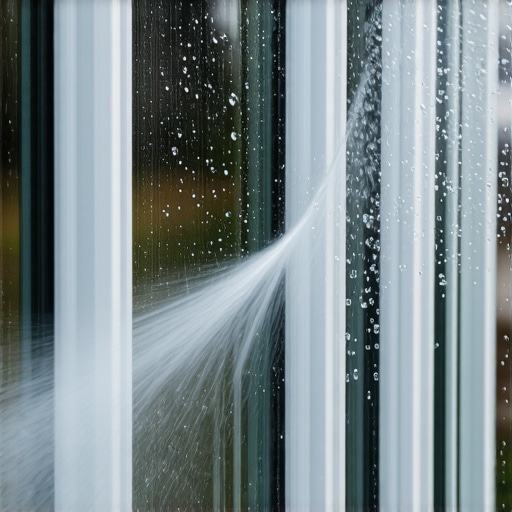
The Deceptive Lure of the High-Pressure Blast
You see the green algae creeping up the vinyl siding and the gray oxidation on your window frames, and the temptation is immediate. You want to rent a 3000 PSI power washer and blast that grime into oblivion. Stop right there. In my 25 years as a master glazier, I have seen more window systems destroyed by well-intentioned cleaning than by actual storm damage. A window is a precision-engineered barrier designed to manage hydrostatic pressure, but it is not designed to withstand a concentrated jet of water moving at two hundred miles per hour. When you point that nozzle at your glazing bead, you are not just cleaning; you are performing an involuntary demolition of your home’s thermal envelope.
The Installation Autopsy: A Case Study in Forced Intrusion
I remember a call-out to a beautiful custom home in the Pacific Northwest. The homeowner was meticulous. Every spring, he power-washed the entire exterior. From the curb, the windows looked pristine. Inside, however, the drywall beneath the master suite’s picture window was soft enough to poke a finger through. When I pulled the sash out, I found that the header and the jack studs were completely black with rot. This was not a failure of the flashing tape or the sill pan. The culprit was the power washer. The high pressure had forced water past the bulb gaskets and underneath the glazing bead, where it collected in the glazing channel. Because the volume of water was so high, it overwhelmed the weep hole system. Instead of draining out, the water backed up over the interior leg of the frame and soaked directly into the rough opening. The moisture was trapped behind the vapor barrier, creating a perfect incubator for wood-destroying fungi. The homeowner didn’t need a window cleaner; he needed a window repair specialist and a structural carpenter, a bill that totaled five figures because of a ‘clean’ window.
“Installation and maintenance practices must ensure that water is managed such that it does not contact un-treated wood or accumulate within the wall cavity. High-pressure water application can bypass traditional shingle-principle drainage systems.” – ASTM E2112 Standard Practice for Installation of Exterior Windows
The Physics of the IGU Seal Failure
To understand why power washing is a death sentence for modern windows, you have to understand the Insulated Glass Unit (IGU). Most modern windows are double or triple-pane. These panes are separated by a spacer bar and held together by a primary seal, usually Polyisobutylene (PIB), and a secondary seal of silicone or polysulfide. This creates a hermetically sealed airspace filled with an inert gas like Argon. When you hit the edge of that glass with a power washer, you are applying massive kinetic energy to the secondary seal. If that seal develops even a microscopic fissure, the Argon gas escapes and humid atmospheric air rushes in. This is why you see ‘foggy windows.’ The desiccant inside the spacer bar can only absorb so much moisture before it reaches its adsorption limit. Once that happens, condensation forms on the internal surfaces of the glass. At that point, you cannot simply fix the seal; you must replace windows or at least the entire glass unit. The ‘clean’ look you achieved for ten minutes just cost you the R-value of your entire window system.
The Shingle Principle vs. Hydrostatic Pressure
Windows are designed on the ‘Shingle Principle.’ This means every layer overlaps the one below it so that gravity pulls water down and away from the structure. Your window cleaner should be using a soft-wash method or a squeegee and applicator because these methods respect the gravity-fed design of the window. When you use a power washer, you are often shooting water upward or horizontally. This forces water into the muntin joins and under the sash in ways that rain never would. Even a properly installed sill pan cannot save a window if the water is being injected into the assembly at high velocity. The water bypasses the gaskets, gets behind the glazing bead, and begins the slow process of delaminating the frame materials.
“Care should be taken to avoid directing high-pressure water at the glass-to-frame interface (the glazing bead) or at the weep holes of the window system. Such action can force water into the building interior or damage the sealants.” – AAMA 609.1-15 Standard Guide for Cleaning and Maintenance
The Anatomy of the Rough Opening
Think about the rough opening of your window. It is the hole in your wall where the window sits. We use shims to level the window and flashing tape to seal the perimeter. If you force water past the window’s external drainage system, that water lands on those shims and the wooden sill. Without airflow, that water has nowhere to go. It sits there, slowly wicking into the end-grain of the wood. By the time you notice the paint bubbling on your interior trim, the structural damage is already done. This is especially critical in coastal environments where the water being forced in is also carrying salt, which accelerates the corrosion of any metal fasteners or operable hardware within the window frame.
Why Professional Window Cleaning is Non-Negotiable
If you want to maintain your windows, put the power washer away. A professional window cleaner uses a T-bar applicator, a mild detergent, and a squeegee. This method uses very little water and relies on mechanical agitation rather than brute force. They also check the weep hole outlets to ensure they aren’t clogged with debris. If your windows are already showing signs of seal failure—such as a rainbow sheen on the glass or actual droplets between the panes—you are past the point of cleaning. You are looking at a window repair or a full-frame replacement. When choosing to replace windows, look for those with high DP (Design Pressure) ratings, but remember: no DP rating accounts for a homeowner with a 3000 PSI nozzle at point-blank range.
Conclusion: Respect the Seal
Your windows are one of the most expensive components of your home’s exterior. They manage solar heat gain, provide thermal insulation, and protect your interior from the elements. Don’t treat them like a concrete driveway. Respect the engineering of the sash, the delicacy of the glazing bead, and the necessity of a dry rough opening. Use the right tools for the job, and if you see moisture where it shouldn’t be, call an expert before the rot takes hold.