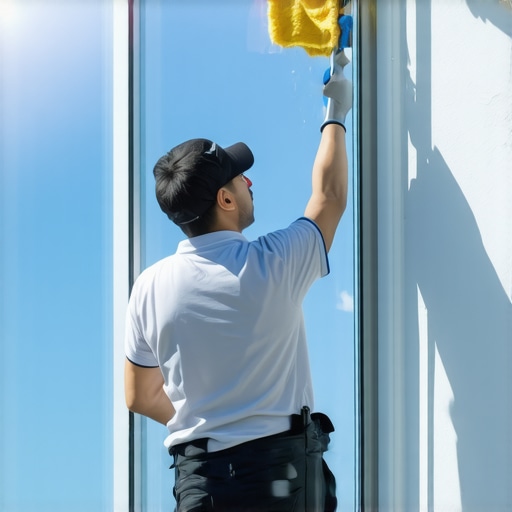
The Glazier’s Perspective: Why Sun-Drenched Glass Defies Standard Maintenance
In twenty-five years of handling high-performance glazing, from heavy-duty commercial curtain walls to residential double-hungs, I have seen every possible failure of glass maintenance. Most homeowners see a window as a simple piece of transparent silica. I see it as a thermal barrier, an operable component that manages Solar Heat Gain and interior comfort. When you approach a window with a bottle of window cleaner in the middle of a July afternoon, you are not just cleaning a surface; you are interacting with a high-temperature substrate that is actively absorbing and radiating long-wave infrared energy. If you do it wrong, you aren’t just leaving streaks; you are risking the structural integrity of the seal and the coating.
A few years ago, I received a frantic call from a client in a high-rise who claimed their brand-new windows were ‘sweating’ and ‘fogging’ internally after they had spent a Saturday cleaning them. I grabbed my hygrometer and thermal imaging camera and headed over. It wasn’t a seal failure. The homeowner had sprayed a high-ammonia solution onto glass that had reached a surface temperature of 120 degrees Fahrenheit. The rapid evaporation didn’t just leave a film; the chemical reaction with the heat had actually compromised the glazing bead and left a stubborn residue that mimicked the appearance of internal condensation. I had to explain that their humidity levels were fine, but their cleaning methodology was fundamentally at odds with the physics of glass.
“Installation and maintenance are just as critical as the window performance itself. A high-performance window that is improperly maintained or cleaned with abrasive chemicals can suffer premature seal degradation.” – AAMA Installation Masters Guide
Understanding the Physics of Surface #2 and Solar Heat Gain
To clean a window effectively in direct sunlight, you must understand what you are actually touching. In a modern dual-pane unit, we count the surfaces from the outside in. Surface #1 is the exterior. Surface #2 is the inner side of the outer pane. In hot climates, this is where the Low-E (Low-Emissivity) coating is usually located. This coating is designed to reflect solar heat back outside. This means Surface #1 gets significantly hotter than the air around it. When you apply a liquid window cleaner to a surface at 130 degrees, the carrier agent—usually water or alcohol—flashes off almost instantly. This leaves behind the surfactants and solids in the cleaner, which then bake into the glass. This is the origin of those white, hazy streaks that seem impossible to buff out. It is not dirt; it is dehydrated soap.
The Solar Heat Gain Coefficient (SHGC) of your windows dictates how much of that solar energy is entering your home. A window with a low SHGC is doing a lot of work to reject heat, which means the glass itself is absorbing a massive amount of energy. If you apply freezing cold water from a garden hose to this hot glass, you risk thermal shock. I have seen rough opening tolerances so tight that the sudden contraction of the glass causes it to snap right out of the sash. If you hear a sharp ‘crack’ while cleaning, you are no longer in the realm of maintenance; you are in the realm of window repair or full replace windows projects.
The Professional Protocol for High-Heat Cleaning
If you must clean in direct sunlight, you need to manage the evaporation rate. First, you must pre-cool the glass. Do not use a pressurized jet of water. Instead, use a gentle mist to slowly lower the surface temperature. This prevents the thermal shock that leads to window repair calls. Once the glass is closer to the ambient air temperature, you must use a solution with a slower evaporation rate. Professional glaziers often avoid ammonia-based products in the sun because ammonia acts as an accelerant for drying. A mixture of distilled water and a tiny amount of specialized glass soap is the only way to go. Distilled water is key; mineral-rich tap water will leave calcium deposits that the sun will bake into the glass, creating ‘etching’ that looks like permanent damage.
“The performance ratings of fenestration products, including U-factor and SHGC, are contingent upon the maintenance of the glass surfaces and the integrity of the weatherstripping.” – NFRC Performance Standards
When you are working on the sash, pay close attention to the weep holes. These are small gaps in the bottom of the frame designed to let moisture escape. Many ‘caulk-and-walk’ installers or over-eager cleaners accidentally plug these with soap scum or debris. If the water cannot drain, it sits against the sill pan and the flashing tape, eventually leading to rot in the subfloor. A clean window is useless if the frame is holding water against your house’s structure.
When to Stop Cleaning and Start Planning to Replace Windows
Sometimes, the ‘dirt’ you are trying to clean is actually on the inside of the insulated glass unit (IGU). If you see streaks, fog, or a ‘rainbow’ effect that you cannot reach from either the inside or the outside, your window cleaner won’t help you. This is a sign of seal failure. The shim might have shifted, or the glazing bead has shrunk, allowing the argon gas to escape and moist air to enter. In my experience, once a seal has failed, there is no permanent window repair that restores the original U-factor. You are looking at a glass-only replacement or, if the frames are warped, a decision to replace windows entirely with a more stable material like fiberglass or thermally broken aluminum.
The Detailed Cleaning Procedure for Direct Sun
- Thermal Acclimation: Mist the glass with room-temperature water to reduce surface heat.
- Chemical Selection: Use a pH-neutral, ammonia-free solution to prevent chemical etching.
- The Squeegee Technique: In the sun, you must use a single-pass squeegee method. Do not go back over areas that have started to dry. Use a high-quality rubber blade that won’t skip on hot glass.
- Detailing the Perimeter: Use a microfiber cloth to immediately dry the muntins and the edges near the glazing bead. Water trapped here can degrade the primary seal of the IGU.
- Inspection: Check the weep holes for blockages. Use a small wire to clear any soap buildup.