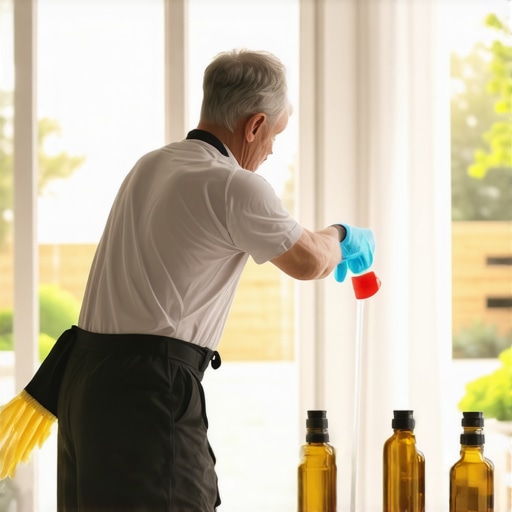
The Molecular Reality of Your Windows
In my twenty-five years of handling everything from heavy-duty commercial curtain walls to delicate historic wood sash restorations, I have learned that most homeowners view glass as an impenetrable, static barrier. This is a fundamental misunderstanding of fenestration. Glass is a porous material at a microscopic level, and the way you treat its surface affects not just the view, but the thermal performance of the entire unit. When we discuss a window cleaner, we aren’t just talking about removing streaks; we are talking about maintaining the surface energy of the glass and the chemical stability of the surrounding glazing bead. Many people are turning toward essential oils for a better scent and a more natural approach, but as a master glazier, I need to explain the physics behind this before you start spraying oils on your high-performance Low-E coatings.
A homeowner once called me in a panic because their new windows were ‘sweating’ and looked permanently foggy. They thought the seals had failed within six months of installation. I walked in with my hygrometer and found the interior humidity was hovering at sixty percent because they had recently installed a massive indoor water feature. It wasn’t a window repair issue; it was a lifestyle and ventilation issue. The ‘dirt’ they were trying to clean off was actually internal condensation that had started to etch the glass surface because it wasn’t being managed properly. This taught them that how you maintain your home’s air quality is just as important as how you scrub the glass.
“Cleaning and maintenance of the fenestration product are essential to ensure its longevity and performance. Failure to maintain the glass and frame can lead to premature degradation of the sealants and finishes.” – AAMA Selection and Maintenance Guide
The Science of Essential Oils on Glass Surfaces
When you use essential oils like lemon, peppermint, or eucalyptus in a window cleaner, you are introducing terpenes and various organic compounds to the glass surface. Glass has a specific surface tension. Most commercial cleaners use high-volatility alcohols or ammonia to strip away oils. Using essential oils does the opposite; it introduces a microscopic layer of lipids. If handled incorrectly, this can create a ‘haze’ that isn’t actually dirt, but a change in the refractive index of the glass surface. However, when properly emulsified with distilled water and a high-grade surfactant like white vinegar, essential oils can help break down the non-polar bonds of bird droppings and tree sap without the harsh respiratory impact of industrial chemicals.
You must be particularly careful if you have modern windows with a Surface #4 Low-E coating. In the industry, we number glass surfaces from the outside in. Surface #1 is the exterior face, Surface #2 and #3 are inside the Insulated Glass Unit (IGU), and Surface #4 is the room-side face. Some high-performance coatings are ‘hard-coats’ applied to Surface #4 to improve the U-factor in cold climates like Chicago or Minneapolis. If you scrub an essential oil mixture onto a Surface #4 coating with an abrasive cloth, you risk permanent scratching or stripping of the metallic oxide layer. Always verify your glass type before applying any DIY solution.
The North Climate Context: U-Factor and Condensation
In northern climates, the primary enemy is heat loss. We focus heavily on the U-factor, which measures the rate of heat transfer. A lower U-factor means the window is better at keeping the heat inside. When you clean your windows in the winter, you are often dealing with the ‘dew point.’ If the interior glass temperature drops below the dew point of the indoor air, you get condensation. I have seen many replace windows projects that could have been avoided if the homeowner had simply understood how to manage the ‘warm-edge’ spacer performance. Using a warm-water cleaning solution with essential oils can actually help you identify where air leaks are occurring. If you see the cleaning solution drying instantly in one corner of the sash, you likely have a shim that has shifted or a rough opening that wasn’t properly insulated with low-expansion foam.
Anatomy of the Window: Beyond the Glass
A window is a complex system of operable parts. When you are cleaning, you should be inspecting the glazing bead, which is the strip of plastic or wood that holds the glass in place within the frame. If this bead is cracked or pulling away, water can seep into the sill pan. I’ve pulled out frames where the flashing tape was perfectly intact, but the weep hole was clogged with years of ‘natural’ cleaning residue and dust, causing water to back up and rot the subfloor. Your cleaning routine must include vacuuming the tracks and ensuring the weep hole is clear of debris. This is the only way to ensure the ‘shingle principle’ of water management remains functional.
“Installation is just as critical as the window performance itself. A high-performance window installed poorly will fail to meet energy expectations regardless of the cleaning regimen.” – ASTM E2112 Standard Practice
The Blueprint for Professional-Grade Cleaning
To create a professional-grade cleaner with essential oils, start with sixteen ounces of distilled water. Tap water contains minerals like calcium and magnesium that leave ‘hard water’ spots, which are actually mineral deposits etched into the glass. Add two tablespoons of white vinegar to act as an acid to dissolve these minerals. Then, add ten drops of lemon essential oil. Lemon oil contains high concentrations of limonene, a powerful solvent for organic residues. If you are cleaning in a humid environment, a few drops of tea tree oil can act as a mild antimicrobial agent for the muntin bars where mold tends to spores.
When you apply this, use a microfiber cloth or a professional squeegee. Do not use paper towels; they are made of wood pulp and can be abrasive, and they also leave behind lint that bonds with the essential oils to create a messy film. Start from the top and work your way down. If you notice that the glass remains cloudy despite your best efforts, you might be looking at ‘ghosting’ or desiccant failure inside the IGU. This is when the moisture-absorbing pellets in the spacer bar have reached their saturation point. In this case, no amount of cleaning will help; you are looking at a window repair involving an IGU replacement or a full decision to replace windows entirely.
Technical Signs It Is Time to Stop Cleaning and Start Repairing
During your cleaning process, perform a ‘Glazier’s Audit.’ Check the sash operation. Does it glide smoothly, or is it grinding? If it’s grinding, the rollers or balances are failing. Look at the flashing tape around the exterior brickmould. Is it peeling? Check the rough opening for any signs of daylight. Cleaning is the best time to catch these issues before they become structural failures. Many ‘tin man’ salesmen will tell you that a little bit of draft means you need a $20,000 replacement job. Often, it’s just a matter of replacing the weatherstripping or adjusting the shim points to re-square the frame. However, if the frame itself is warped vinyl or rotted wood, cleaning it with the finest essential oils in the world won’t save your R-value. At that point, you need to look into high-performance fiberglass or thermally broken aluminum replacements that can handle the specific solar heat gain requirements of your zone.
In summary, cleaning windows with essential oils is a viable, pleasant-smelling method for maintaining your home, provided you respect the chemistry of the glass and the mechanical requirements of the window unit. Keep your weep hole clear, respect your Surface #4 coatings, and always remember that a window is a high-performance engine for your home’s envelope. Treat it with the technical precision it deserves.