The Mechanical Reality of the Sliding Portal
A homeowner called me in a panic because their new windows were sweating. I walked in with my hygrometer and showed them the humidity was 60 percent. It was not the windows; it was their lifestyle, specifically their penchant for boiling large pots of pasta without using the range hood. This same disconnect between hardware and environment is usually at the heart of why a sliding glass door refuses to stay on its track. When you feel that jarring thud as the door jumps out of its channel, you are not just dealing with a minor annoyance. You are witnessing a failure of the Operable system that relies on tight tolerances and mechanical alignment. As a glazier with over two decades in the field, I can tell you that a door jumping track is rarely an accident. It is the end result of cumulative structural stress or neglected maintenance.
The Anatomy of the Sliding System
To understand why your door is failing, we have to look at the Rough Opening and the load path. A standard sliding glass door consists of a fixed Sash and an active Sash that glides on tandem rollers. These rollers are typically made of nylon or stainless steel, and they are the only thing separating a 150 pound piece of tempered glass from the sill. If the original installer did not place a proper Shim under the sill track to ensure a perfectly level surface, the weight of the door will eventually cause the track to bow. This bowing changes the vertical alignment, meaning the rollers are no longer centered in the track. Once that alignment is off by even a few millimeters, any lateral force, such as a child pulling the handle too hard, will cause the roller to climb the track wall and jump.
“Installation is just as critical as the window performance itself. A high-performance window installed poorly will fail.” – AAMA Installation Masters Guide
The Role of Thermal Expansion and Frame Material
In warmer climates, we see a significant amount of thermal expansion. If you have a vinyl sliding door, the material has a high expansion coefficient. On a hot July afternoon, that vinyl frame can expand by a measurable fraction of an inch. If the Rough Opening was too tight and did not allow for this expansion, the frame can buckle slightly. This buckling narrows the channel where the Sash is supposed to travel. When you try to force the door through a narrowed channel, the rollers lose their grip. For those in the south, this is why we often recommend thermally broken aluminum or fiberglass frames, which offer much better dimensional stability than cheap vinyl. If your door only jumps the track when the sun is hitting it directly, you are likely looking at a thermal expansion issue that might require you to replace windows or the entire door assembly to a more stable material.
Water Management and the Sill Pan
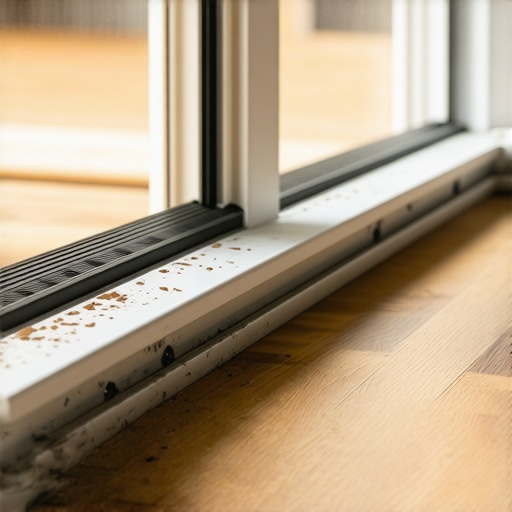
One of the most overlooked components in a sliding door installation is the Sill Pan. This is a critical piece of flashing that sits beneath the door frame to catch any water that bypasses the primary seals and direct it back outside through the Weep Hole. If the Weep Hole is clogged with dirt or pet hair, water backs up into the track. This standing water eventually corrodes the metal housings of the tandem rollers. Once the housing rusts or becomes jammed with debris, the rollers stop spinning and start sliding. This flat spotting of the roller is a primary cause of the door jumping. You can use a window cleaner to keep the glass looking good, but if you are not using a vacuum to clear the grit out of the track every few months, you are asking for a mechanical failure.
“Water penetration is the leading cause of building envelope failure, and the window to wall interface is the most vulnerable point.” – ASTM E2112 Standard Practice
The Myth of the Quick Fix Window Repair
Many homeowners think a simple window repair involving a can of silicone spray will fix a jumping door. While lubrication helps, it often masks a deeper issue like a failing header. In some of the worst cases I have seen, the header above the door has sagged because it was undersized for the span. This puts downward pressure on the top of the door frame, effectively squeezing the Sash into the track. No amount of cleaning or adjustment screws will fix a structural sag. If you notice that the gap between the top of the door and the frame is uneven, you are not looking at a door problem, you are looking at a framing problem. This is where the Shingle Principle of water and load management comes into play. Everything must flow from the top down without interruption.
How to Diagnose and Resolve the Issue
Before you decide to replace windows or doors entirely, check the adjustment screws located at the bottom of the active Sash. These screws raise or lower the rollers. If the door is sitting too low, the bottom rail might be dragging on the track itself rather than riding on the rollers. This friction creates the resistance that causes the door to jump. However, if you find that the Glazing Bead is loose or the frame itself feels flimsy when you move the door, the structural integrity of the unit has been compromised. At that point, a professional intervention is necessary. Proper maintenance involves more than just a bottle of window cleaner. It requires a deep understanding of how the Flashing Tape, the Sill Pan, and the mechanical rollers work in unison to maintain the thermal and structural seal of your home. If the door continues to fail after cleaning and adjustment, it is time to admit that the installation has reached its end of life.