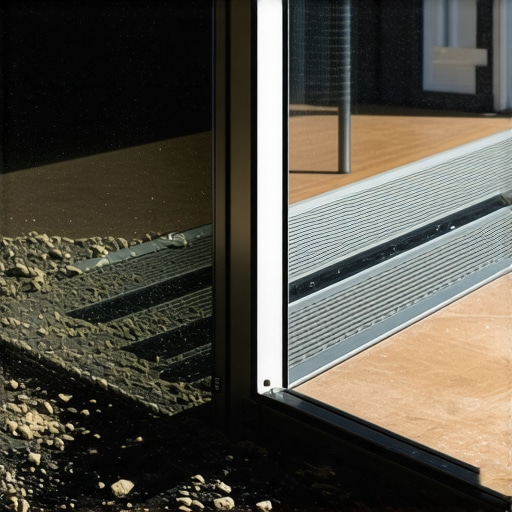
The Engineering Failure Behind the Frustration
A sliding glass door that repeatedly jumps its track is more than a nuisance; it is a mechanical failure that signals deeper issues within the fenestration assembly. When you find yourself wrestling with a multi-hundred-pound slab of glass just to let the dog out, the problem rarely begins and ends with a stray pebble. As a glazier with over two decades in the field, I have seen these units fail in every conceivable environment. The mechanics of a sliding door rely on a delicate balance of gravity, friction, and structural alignment. When that balance shifts, the door becomes a safety hazard.
I once pulled a massive aluminum bypass door out of a residence where the homeowner complained the door felt like it was ‘grinding through sand.’ Upon extraction, I discovered the subfloor was completely compromised. Why? The previous installer had relied on a simple bead of caulk along the nailing fin instead of an integrated sill pan with proper flashing tape. Water had been infiltrating for years, rotting the rough opening and causing the track to sag by nearly half an inch. That sag changed the geometry of the entire opening, making it impossible for the rollers to remain seated. This is the reality of a poor installation; it turns a high-end product into a structural liability.
“Installation is just as critical as the window performance itself. A high-performance window installed poorly will fail.” AAMA Installation Masters Guide
The Anatomy of a Jumped Track: Roller Fatigue and Geometry
The primary culprit in a jumping door is usually the tandem roller assembly hidden within the bottom rail of the sash. These are not simple wheels. In a high-quality door, these are precision-engineered components with ball bearings housed in nylon or stainless steel. Over time, the adjustment screw that sets the height of these rollers can vibrate loose due to constant operation. When one roller sits lower than the other, the door cocks at an angle. This misalignment means the Glazing Bead and the weatherstripping are no longer centered, and the flange of the roller can easily hop over the stainless steel track cap.
Furthermore, we must look at the Rough Opening. If the header above the door has settled or was not sized correctly for the span, it can put downward pressure on the top track. This compression limits the vertical clearance the door needs to operate. In a South-facing exposure, such as those found in Texas or Arizona, thermal expansion becomes a dominant factor. Aluminum and vinyl have high coefficients of linear thermal expansion. On a 100-degree day, a wide sliding door can expand significantly. If the installer did not leave adequate Shim space for this movement, the frame bows, the track warps, and the rollers are forced out of their grooves.
Climate Logic: The Southern Heat Factor
In hot climates, the glass itself plays a role in the door’s mechanical health. Large sliding doors are essentially massive heat collectors. To manage this, we utilize Low-E coatings specifically on Surface #2 (the inner face of the outer pane). This reflects long-wave infrared radiation back toward the exterior before it can even enter the building envelope. This is measured by the Solar Heat Gain Coefficient (SHGC). A low SHGC is king in the South. When the SHGC is managed, the interior temperature of the frame remains more stable, reducing the extreme expansion and contraction cycles that loosen the Sash fasteners and cause the door to jump.
If your door is jumping and you notice the room is exceptionally hot, you are likely dealing with an uninsulated frame or a failed seal. Modern high-performance doors utilize a thermal break—a reinforced polyamide strip—between the interior and exterior aluminum extrusions. Without this break, the entire frame acts as a heat bridge, causing the lubricants in your roller bearings to bake and seize, which leads to flat-spotting on the wheels and eventual jumping.
The Installation Autopsy: Why Repairs Often Fail
Many homeowners attempt a quick fix by hiring a window cleaner or a handyman to spray WD-40 in the track. This is a mistake. Petroleum-based lubricants attract dust and grit, creating a grinding paste that destroys the rollers and the track cap. A professional window repair requires a full diagnostic of the Sill Pan and the Weep Hole system. If the weep holes are clogged, water backs up into the track, corroding the steel rollers from the bottom up.
“The flashing system must be integrated with the water-resistive barrier (WRB) to ensure a continuous drainage plane. Failure to do so will result in moisture accumulation and structural degradation.” ASTM E2112 Standard Practice for Installation
If you are constantly resetting your door, it may be time to replace windows and doors entirely, especially if the track itself is scarred. Once the stainless steel or aluminum track cap is dented or ‘pitted,’ no amount of roller adjustment will provide smooth operation. A full-frame replacement allows for the installation of a modern sill with a higher ‘back dam,’ which prevents air and water infiltration even during high-pressure wind events. During this process, ensuring the unit is level, plumb, and square is paramount. We use high-density plastic shims rather than wood, as wood shims can compress or rot over time, leading back to the same track-jumping issues.
Long-Term Maintenance and Prevention
To keep a sliding door operable and seated, the track must be kept surgically clean. This is where a specialized window cleaner is valuable, provided they use a vacuum to remove debris rather than washing it into the weep holes. Periodically checking the Muntin bars and the interlocker at the meeting stiles for plumbness can catch a sagging header before it ruins your rollers. If you find the door jumping, stop immediately. Forcing a jumped door back into place often bends the Glazing Bead or chips the glass, turning a simple roller replacement into a dangerous and expensive glass failure.