The Mechanics of Resistance: Why Your Sliding Door Fights Back
I once walked onto a job site in a humid coastal region where the homeowner was convinced their foundation was sinking. Every time they tried to open the massive eight-foot sliding glass door to the deck, it sounded like a gravel crusher. I pulled the door panel out of the frame and what I found wasn’t a structural failure of the house, but a failure of basic maintenance. The track extrusion was packed with a slurry of salt air, pet hair, and cheap grease that had hardened into a substance resembling low-grade concrete. The previous installer had skipped the sill pan, and water had been wicking into the subfloor for years, causing the threshold to crown upward by a fraction of an inch. That tiny deviation was enough to trap the rollers. It is a classic case of how a simple mechanical system fails when the physics of the installation are ignored.
“Installation is just as critical as the window performance itself. A high-performance window installed poorly will fail.” AAMA Installation Masters Guide
When you find yourself tugging on a patio door with both hands, you are not just fighting the weight of the tempered glass; you are fighting friction and gravity. Most modern patio doors rely on a pair of adjustable tandem rollers located at the bottom of the sash. These rollers are designed to glide over a stainless steel or aluminum track. However, because a patio door is essentially a giant hole in your thermal envelope, it is subject to extreme temperature fluctuations. In a southern climate where the solar heat gain coefficient (SHGC) is high, the vinyl or aluminum frame can expand significantly during the day. If the rough opening was not shimmed correctly, this expansion has nowhere to go but inward, putting pressure on the sash and causing it to bind. This is why a door might slide perfectly at 7:00 AM but feel like it is glued shut by 3:00 PM.
The 2-Minute Roller Adjustment Fix
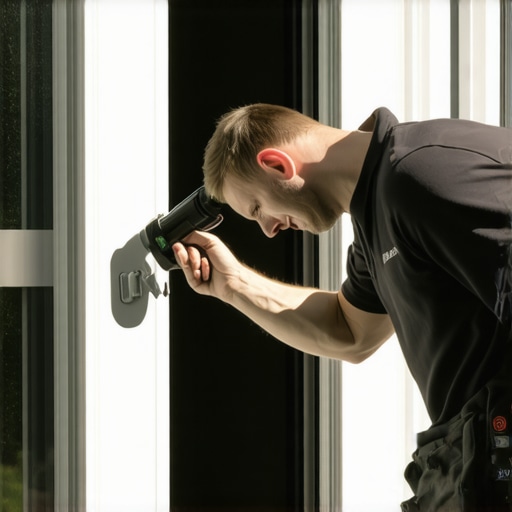
Before you call a professional for a window repair or start looking to replace windows entirely, you must check the adjustment screws. Look at the bottom edge of the sliding door panel. You will usually find two small holes, often covered by plastic plugs. These are the access points for the roller adjustment screws. Using a Phillips head screwdriver, you can raise or lower the door. Turning the screw clockwise typically raises the door, increasing the clearance between the sash and the track. This is critical if the door is dragging on the bottom. Conversely, if the door is leaning or not hitting the side jamb squarely, you can adjust one side higher than the other to square it up. This simple mechanical calibration solves 80 percent of sticking issues without requiring a single replacement part.
The Chemistry of Clean: Beyond the Window Cleaner
While most people reach for a standard window cleaner to handle the glass, the track requires a different level of attention. Particulate matter like sand, dust, and dead skin cells creates an abrasive paste when mixed with moisture. This paste grinds down the nylon or stainless steel rollers until they develop flat spots. Once a roller has a flat spot, it will never glide smoothly again. To prevent this, vacuum the track weekly with a crevice tool. After vacuuming, use a stiff nylon brush to loosen any stuck debris. Do not use heavy oils or WD-40. These products are dust magnets. Instead, use a dry silicone spray. Silicone provides a hydrophobic layer that reduces friction without attracting the grit that leads to premature roller failure.
“The water-resistive barrier must be integrated with the window flashing to ensure long-term durability of the rough opening.” ASTM E2112 Standard Practice
When the Problem is Structural: Assessing the Rough Opening
If you have adjusted the rollers and cleaned the tracks but the door still binds, we have to look at the rough opening and the shim placement. Over time, the header above a large patio door can sag. If the header deflects by even 1/8 of an inch, it can put downward pressure on the top of the door sash. You can diagnose this by looking at the reveal (the gap) between the top of the door and the frame. If the gap is narrower in the middle than at the corners, your header is sagging. In this scenario, a simple adjustment won’t work. This is a structural issue that often occurs in older homes where the framing wasn’t sized for the weight of modern, heavy-duty glazing units. This is the point where you must decide if you can live with the friction or if it is time to consult a specialist to re-square the frame.
Thermal Dynamics and Frame Selection
For those in hotter climates, the material of your door frame dictates how much maintenance you will do. Vinyl is a popular choice because it is cost-effective, but it has a high rate of thermal expansion. In a southern exposure, a dark-colored vinyl door can expand enough to jump the track or bind against the head jamb. This is why we prioritize thermally broken aluminum or fiberglass for large-span patio doors in high-heat areas. Fiberglass is particularly stable because it is made of glass fibers and resin, meaning it expands and contracts at nearly the same rate as the glass it holds. This harmony between the frame and the glass reduces the stress on the glazing bead and ensures that the operable panels stay aligned regardless of the temperature outside. Maintaining that alignment is the key to a door that slides with a single finger versus one that requires a gym membership to operate.