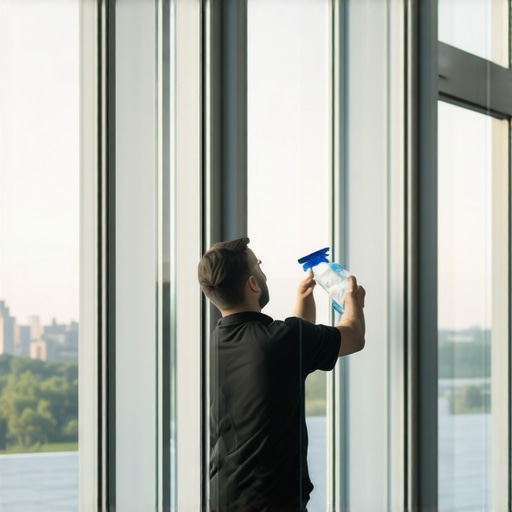
The Invisible Enemy on Your Glass Surface
Most homeowners view a window as a solid, impenetrable barrier. In my twenty-five years as a master glazier, I have learned that glass is far more dynamic and, surprisingly, more porous than people realize. When you look through a window, you are looking through a complex silicate structure that is constantly reacting to its environment. This is why the chemistry of the liquid used to clean it matters just as much as the quality of the glass itself. A common mistake I see in the field involves the use of standard tap water for creating a window lather. To the untrained eye, water is water. To a professional, tap water is a cocktail of dissolved minerals, including calcium, magnesium, and sodium, that can lead to a condition known as mineral etching.
The Condensation Crisis: A Master Glazier’s Perspective
A homeowner called me in a panic because their new windows were ‘sweating’ and appearing permanently cloudy after only two years. I walked in with my hygrometer and showed them the humidity was 60%, but more importantly, I looked at the glass under a magnifying loupe. It wasn’t the windows failing; it was their lifestyle and their cleaning habits. They had been using a garden hose and dish soap to wash their windows. The high mineral content in their local water—what we call hard water—had begun to create a crystalline bond with the silica in the glass. This wasn’t just dirt; it was a chemical transformation. This is the primary reason why a professional window cleaner insists on distilled water or a deionization process. We are not just removing debris; we are protecting the structural integrity of the glazing bead and the glass surface.
“Installation is just as critical as the window performance itself. A high-performance window installed poorly will fail, and a high-performance window maintained poorly will degrade prematurely.” – AAMA Installation Masters Guide
The Chemistry of Distilled Lather
Why distilled water? It comes down to Total Dissolved Solids (TDS). Tap water can have a TDS reading anywhere from 100 to 500 parts per million. Distilled water is stripped of these minerals, bringing the TDS down to zero. When we create a lather with a professional-grade surfactant and distilled water, we are creating a ‘hungry’ solution. Because the water is pure, it has a natural affinity for the dirt, pollen, and pollutants sitting on the glass. It pulls these contaminants into suspension more effectively than mineral-heavy water, which is already ‘full.’ [IMAGE_PLACEHOLDER] If you use tap water, as the liquid evaporates, the minerals are left behind. These minerals don’t just sit on the surface; in a cold climate like Chicago or Minneapolis, the freeze-thaw cycle can trap these minerals against the glass, leading to micro-pitting. This pitting eventually makes the glass look hazy, a state that no amount of window cleaner can fix, often forcing a homeowner to replace windows prematurely when a simple window repair or proper maintenance would have sufficed.
Thermal Stress and Mineral Deposits
In northern climates, the U-Factor is our primary concern. We want to keep heat inside. We use Low-E coatings, typically on Surface #3, to reflect long-wave infrared radiation back into the living space. However, if the exterior surface (Surface #1) is covered in mineral deposits from poor cleaning practices, it can actually affect the visible transmittance and the glass’s ability to handle thermal stress. When the sun hits a window with heavy mineral buildup, those spots absorb heat differently than the clear glass. This creates localized hot spots. While it is rare for this to cause a thermal fracture, it contributes to the degradation of the glazing seals over time. A professional window cleaner understands that their job is part of the building’s thermal management system.
“The performance of a fenestration product is dependent on the maintenance of its components. Accumulation of surface contaminants can lead to accelerated aging of the glass and frame materials.” – NFRC Performance Standards Handbook
Beyond the Glass: Protecting the Sash and Frame
The use of distilled water and proper lather extends the life of the entire window assembly. When you use harsh chemicals or mineral-heavy water, the runoff enters the weep hole system. These holes are designed to allow water to exit the frame, but minerals can clog them. A clogged weep hole is a death sentence for a window. If water cannot escape, it sits against the insulated glass unit (IGU) seal. Once that seal is saturated, the desiccant inside the spacer becomes overwhelmed, leading to the dreaded ‘fogged’ window. At that point, you are no longer looking at a cleaning job; you are looking at a window repair or a full IGU replacement. When we shim a window into the rough opening and apply flashing tape, we are creating a water management system. Using distilled water for maintenance ensures that this system remains free of mineral blockages.
Blueprint for Long-Term Glazing Health
If you are deciding whether to repair or replace windows, look at the glass quality first. If you see ‘stage one’ lime scale or mineral haze, it can often be corrected with a professional acidic wash followed by a distilled rinse. However, if the etching has progressed to ‘stage two,’ the glass is physically damaged. For those in cold climates, I always recommend triple-pane units with argon or krypton gas fills and warm-edge spacers. These features reduce the temperature differential between the center of the glass and the edge, which significantly reduces the condensation that often traps minerals on the glass surface. Don’t buy into the marketing hype of ‘self-cleaning’ glass without understanding that even those systems require pure water to function without spotting. In the world of high-end glazing, purity isn’t a luxury; it is a technical requirement for longevity.