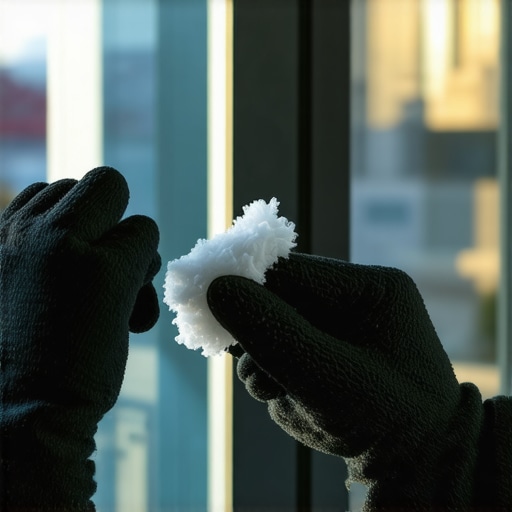
The Secret Tool of the Master Glazier
Most homeowners assume that a bucket of soapy water and a squeegee are the only tools required for a pristine view. However, if you watch a professional window cleaner or a veteran glazier working on a high-end residential site, you will often see them reach into their pouch for a small, grey tuft of material. This is not ordinary scrub padding. It is #0000 grade super fine steel wool. To the uninitiated, rubbing metal against glass sounds like a recipe for a catastrophic window repair bill, but to those of us who have spent decades in the trade, it is the only way to achieve a surgical level of clean without compromising the integrity of the silica surface.
The Narrative of the Cloudy Panes
I recall a specific instance where a homeowner called me in a panic because their brand-new, high-performance windows were sweating and appeared cloudy after only six months of service. I walked into the living room with my hygrometer and a handful of #0000 steel wool. I first showed them that their indoor humidity was hovering at 60 percent, which was the primary cause of the interior condensation. But the cloudiness was different. It was a fine layer of mineral salts and construction debris that the regular cleaning crew could not budge. I took a dry piece of that fine steel wool and, with light pressure, sheared the mineral deposits right off the glass. The homeowner gasped, expecting a scratch. Instead, the glass beneath was flawless. It was not the windows that were failing, it was a lack of understanding of glass surface chemistry.
The Physics of Glass and Steel
To understand why this works, we have to look at the Mohs scale of mineral hardness. Standard float glass used in residential windows typically sits between 5.5 and 7 on the Mohs scale. Standard steel is actually softer than glass, but the secret lies in the grade. Grade #0000 steel wool is approximately a 2 on the hardness scale. This disparity allows the wool to act as a precision scraper that removes anything protruding from the glass surface, such as paint overspray, sap, or calcium carbonate deposits, without being hard enough to abrade the glass itself. This is critical because any scratch on the glass surface creates a micro-fissure that can eventually lead to stress cracks or provide a foothold for more aggressive corrosion.
“Installation is just as critical as the window performance itself. A high-performance window installed poorly will fail.” AAMA Installation Masters Guide
When we talk about the longevity of a window, we are really talking about the management of the IGU, or Integrated Glass Unit. If a window cleaner uses the wrong abrasive, they can damage the glazing bead or the perimeter seal. This is where a simple cleaning job turns into a need to replace windows. A scratched pane is not just an aesthetic issue: it is a structural liability. In northern climates where we deal with extreme temperature swings, any surface damage increases the risk of thermal stress fractures as the glass expands and contracts within the sash.
Surface Coatings and the Low-E Dilemma
You must exercise extreme caution when dealing with modern energy-efficient glass. As a glazier, I always check which surface the Low-E (Low Emissivity) coating is on before I even think about using steel wool. In a standard double-pane unit, there are four surfaces. Surface #1 is the exterior, Surface #2 is the inner face of the outer pane, Surface #3 is the outer face of the inner pane, and Surface #4 is the interior. In cold climates like Chicago or Minneapolis, we prioritize the U-Factor. We want to keep heat inside. Usually, the Low-E coating is a soft-coat vacuum-sputtered silver layer on Surface #2. Because it is inside the hermetically sealed gap filled with Argon or Krypton gas, it is safe from cleaning tools. However, some newer high-performance units have a hard-coat (pyrolytic) Low-E on Surface #4 to further reduce heat loss. If you hit Surface #4 with steel wool, you will strip the coating right off, destroying the thermal performance of the unit.
The Anatomy of Failure: When Cleaning Becomes Window Repair
A pro window cleaner is often the first person to spot a failing seal. While they are buffing the glass, they might notice moisture that cannot be wiped away because it is inside the unit. This is the death knell for a window. Once the desiccant in the spacer bar is saturated, the dew point inside the IGU rises. This leads to internal condensation and the eventual etching of the glass from the inside out. This is not a situation where steel wool can help. At this point, the options are to replace windows or at least the IGU itself. The reason these seals fail is often traced back to the rough opening and the installation method. If the window was not shimmed correctly, the frame can twist, putting uneven pressure on the primary and secondary seals of the glass unit. Furthermore, if the weep holes in the sill are clogged with dirt or paint, water will back up and sit against the glazing bead, eventually rotting wood frames or bypassing the seals in vinyl and aluminum units.
“Proper water management starts at the head flashing and ends at the sill pan. If the shingle principle is violated, the window becomes a bucket rather than a shield.” ASTM E2112 Standard Practice
The Right Way to Use Steel Wool
If you are going to use this pro secret, you must follow a strict protocol. First, ensure the glass is not