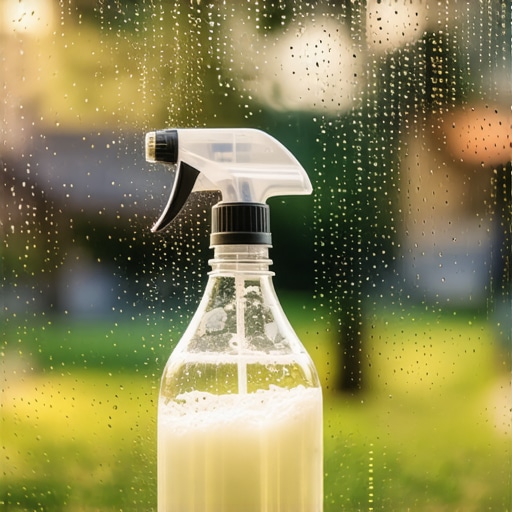
The Science of the Streak-Free Surface
When you are staring at a hazy pane of glass in the middle of a February freeze, your first instinct is to grab a bottle of whatever is under the sink. But as a master glazier with a quarter-century in the trade, I can tell you that the secret to a professional finish often lies in a simple mixture of vinegar and cornstarch. Why cornstarch? Most people do not realize that glass is not as smooth as it looks under a microscope. It has peaks and valleys. The cornstarch acts as a very fine abrasive that reaches into those microscopic pits to lift away stubborn pollutants without damaging the surface or the glazing bead. Vinegar, or acetic acid, dissolves the mineral deposits left by hard water and the oils that accumulate from indoor cooking and HVAC circulation. This combination is a powerful window cleaner, but before you start scrubbing, you need to understand what you are actually looking at. Is it dirt, or is it a symptom of a deeper structural failure?
The Condensation Crisis: A Reality Check
A homeowner called me in a panic because their new windows were sweating. I walked in with my hygrometer and showed them the humidity was 60 percent. It was not the windows; it was their lifestyle. They were running a humidifier in a tightly sealed house during a Minneapolis cold snap. The windows were the coldest surface in the room, reaching the dew point and causing water to transition from gas to liquid. Replacing them would not have fixed the physics of their indoor air. This is a common misunderstanding in the world of window repair. Sometimes the glass is performing exactly as it should, but the environment is working against it. If you see moisture between the panes of an Insulated Glass Unit (IGU), however, that is a different story. That is a seal failure, and no amount of vinegar and cornstarch will clear that fog.
Installation is just as critical as the window performance itself. A high-performance window installed poorly will fail. – AAMA Installation Masters Guide
The Anatomy of Thermal Efficiency in Cold Climates
When we talk about whether to replace windows, we have to talk about the U-Factor. In northern climates, the U-Factor is the king of metrics. It measures the rate of non-solar heat loss. The lower the number, the better the window is at keeping your expensive furnace-heated air inside the house. A standard double-pane window might have a U-Factor of 0.30, but a high-performance unit with a Low-E coating on Surface #3 can drop that significantly. Surface #3 is the indoor-facing surface of the outer pane in an IGU. By placing the metallic oxide coating here, we reflect long-wave infrared radiation (heat) back into the room. This is critical for comfort. If your sash is cold to the touch, your body will radiate heat toward it, making you feel chilly even if the thermostat says 70 degrees. We also have to look at the gas fill. Argon is denser than air and slows down the convection currents between the glass panes, further reducing heat transfer. If you want the ultimate protection, you look at Krypton gas, though the cost-to-performance ratio is often steep for the average residential rough opening.
Water Management and the Sill Pan
One of the biggest failures I see in the field is not the glass itself, but the way the unit is integrated into the wall. Many installers practice what I call caulk-and-walk. They rely on a bead of sealant to keep the water out. But sealant fails. A professional installation relies on the shingle principle: every layer of flashing tape and building wrap must overlap the layer below it so that gravity pulls water away from the structure. I always insist on a sill pan. This is a three-sided flashing element that sits at the bottom of the rough opening. If water ever gets past the primary seals, the sill pan catches it and directs it out through weep hole systems in the frame. Without this, that water sits on your wooden 2×4 framing, leading to rot that can cost thousands to remediate. Proper use of a shim is also vital. If you over-shim the head of the window, you can cause the frame to bow, which puts pressure on the IGU and can lead to a stress crack that looks like a spider web creeping across your view.
The National Fenestration Rating Council (NFRC) provides energy performance ratings in several areas: U-factor, Solar Heat Gain Coefficient (SHGC), Visible Transmittance (VT), and Air Leakage. – NFRC Performance Standards
Maintenance and Long-Term Care
To keep your windows functional, you must maintain the hardware. This means cleaning the tracks of an operable window and ensuring the muntin bars are not collecting moisture that could peel the finish. When using your DIY window cleaner, avoid getting the solution on the weatherstripping. The acid in vinegar can prematurely age certain types of rubber seals if not rinsed properly. If you find that your windows are difficult to open, do not force them. This usually indicates that the house has settled or the rough opening was not sized with enough tolerance for expansion and contraction. In these cases, a window repair might involve plane-ing the wood or adjusting the balance systems, but if the frame is warped, you are looking at a full-frame replacement. Remember, the glass is only as good as the hole it fills. Whether you are using a cornstarch spray for clarity or investing in triple-pane technology, the goal is always the same: controlling the transition between the harsh outdoor elements and your controlled indoor environment.